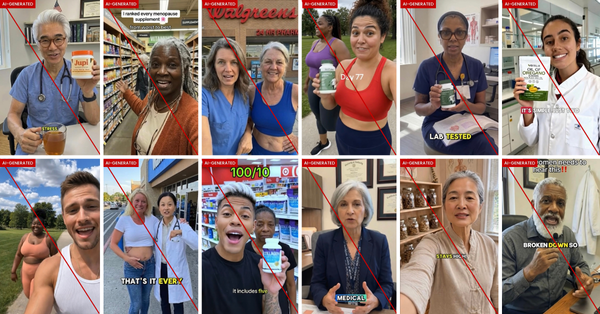
The Ad Was Fake. The Reach Was Real.
A synthetic attack ad cost a couple hundred dollars to run and reached six million people. Here’s how that happens — and how to see it coming.
In June, a video of James Talarico began circulating in Texas. The Democratic state representative, running for the U.S. Senate, appeared on screen in a dress, singing a rewritten version of “My Favorite Things” about transgender children. Talarico never sang those words. He never wore that dress. The clip was AI-generated. A conservative dark-money group called Citizens for Sanity paid to run it, describing the effort to a friendly outlet as a six-figure ad buy against him.
The money Citizens for Sanity spent to run the ad on Facebook and Instagram was pocket change — a couple hundred dollars to reach 10,000 to 15,000 impressions. The video reached millions of views somewhere else. On June 9, Daily Caller White House correspondent Reagan Reese posted it to X while breaking the news of the ad buy. That single post has been viewed 6.2 million times.
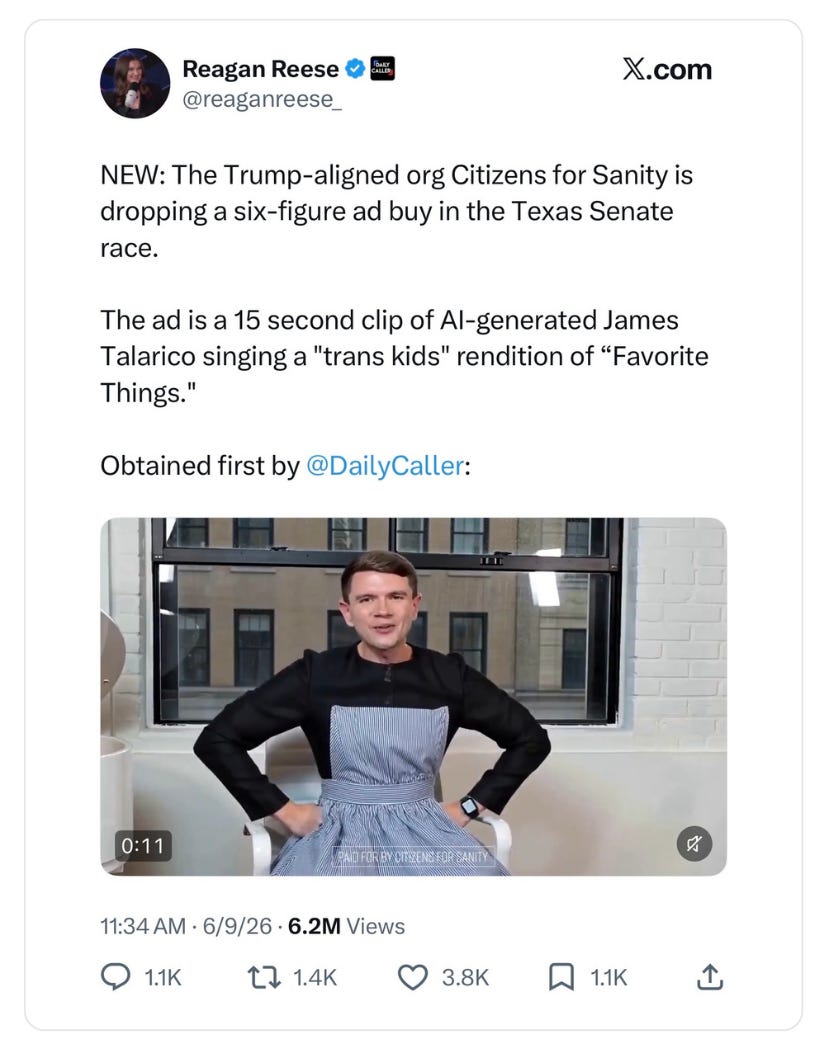
A few hundred dollars of advertising bought 10,000 to 15,000 impressions. One reporter’s post amplified the same video to six million. The coverage out-delivered the ad by roughly four hundred to one.
That four-hundred-to-one gap now runs through nearly every political fight that reaches your feed, and Texas is only the latest place it surfaced. Political persuasion has quietly changed shape, and most voters still judge what reaches them by a standard that expired years ago.
The old model was simple. Campaigns bought access to voters. They paid for airtime, hired crews, commissioned polished spots and repeated a message until enough people knew the name. Money set the ceiling on reach, because making and moving political media was expensive. A cinematic thirty-second ad required a production company, a director, actors, an edit suite and weeks of scheduling before a single voter saw a frame. That expense worked as a filter. Costly things get made deliberately, by people with reputations and elections at stake, under the eye of lawyers.
Your feed runs on a different system. A political video can now be made in an afternoon for pocket change, posted by someone no campaign employs, and carried to millions by recommendation algorithms, influencers, partisan outlets and ordinary news coverage. The campaign can spend next to nothing. The content can still become impossible to avoid.
Three separate shifts made that possible.
The first is that production became nearly free. This spring, a filmmaker named Charles Curran made a video of Los Angeles Mayor Karen Bass on a throne, her face painted like the Joker, the Hollywood sign burning behind her. Mayoral candidate and reality TV personality Spencer Pratt appeared as Batman, leading a crowd that pelted her with tomatoes. The Pratt campaign never paid Curran. He had already made a viral clip about the war in Iran, which he told the New York Times took him thirty minutes with two consumer AI tools. The work is not inherently difficult, he added, “which is why I think you’ll see a lot more of this.” His Joker post has racked up 5.3 million views (as of this publishing). Former Florida governor Jeb Bush shared the Joker video on Xand called it “Maybe the best political ad of the year.” His repost drew another 2.1 million views. Bush did not make the clip. Nor did he pay for it. He simply reposted the video, carrying it further than the campaign's money ever could, with the added weight of a former governor's name behind the share.
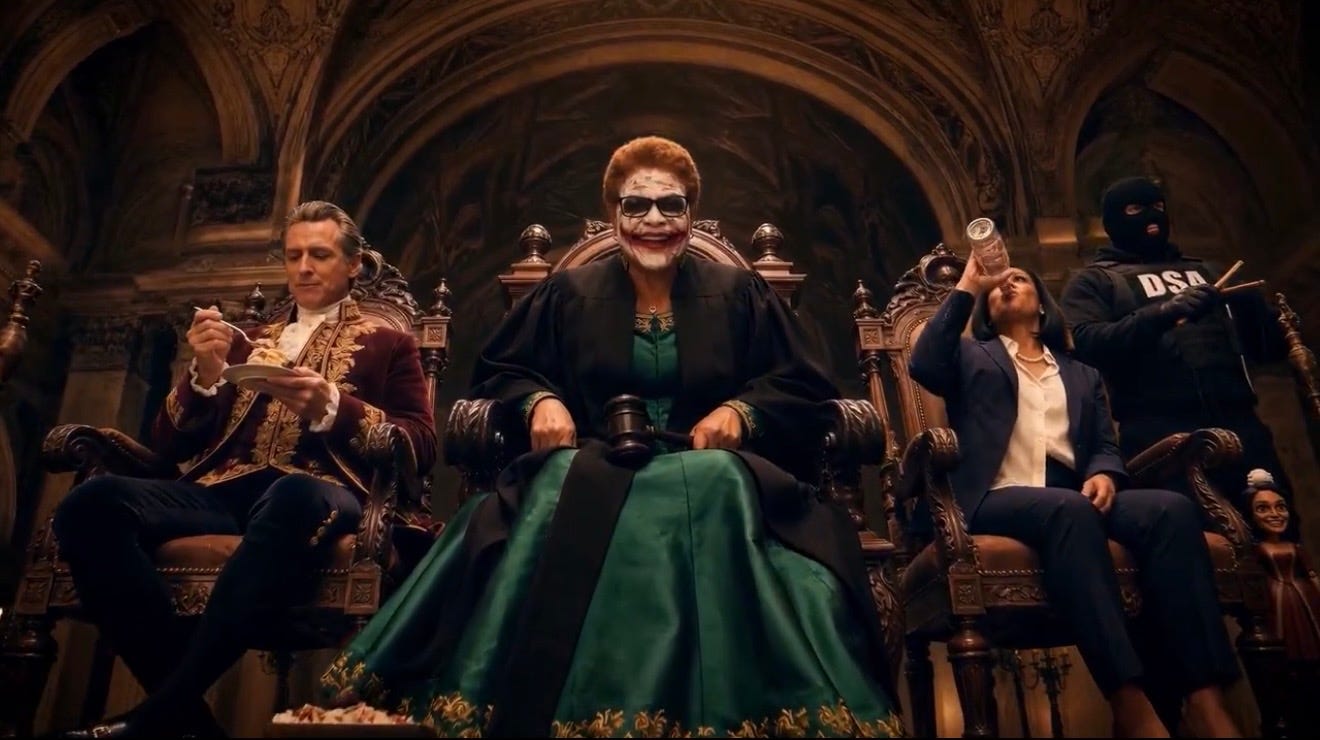
In the weeks that followed, Pratt raised more than $600,000 in donations of $1,000 or more, over ten times what Bass collected in the same stretch. And he did it without buying a minute of airtime while his opponents spent close to $2 million on television and radio.
Producing this kind of video once took real money. That barrier is gone. Influence no longer belongs only to whoever can afford a production budget. Anyone with a laptop and an afternoon can now make something that reaches millions, and a lot of people are trying. That flood is the point. Pratt did not commission, storyboard or pay for the Joker clip. He did not need to. When production is that cheap and that widespread, the person who benefits no longer has to create anything. He waits for supporters to make it, or for material to arrive in his feed, and then he does the one thing that still costs nothing and carries all the value. He shares it.
Attention is not votes, though. More than two-thirds of Pratt’s money came from people who couldn’t cast a ballot in Los Angeles, and a candidate can dominate a national conversation while losing the electorate that actually decides the race. The lesson survives anyway. Political value still flows from attention. Virality attracts donors, volunteers, endorsements and the look of momentum. Around Pratt an informal army of supporters competed to make the most outrageous clip, cross-promoting each other’s work in a loop no campaign directed and no campaign had to answer for. His campaign’s position was that it had no say in what fans produced.
The second shift is the difference between advertising and amplification. Advertising is distribution you buy. A known sum, a known audience, a paper trail. Amplification is distribution you earn, borrow or provoke, delivered by people no one paid and platforms no one billed. A campaign can now spend a token amount on the first to set off a great deal of the second.
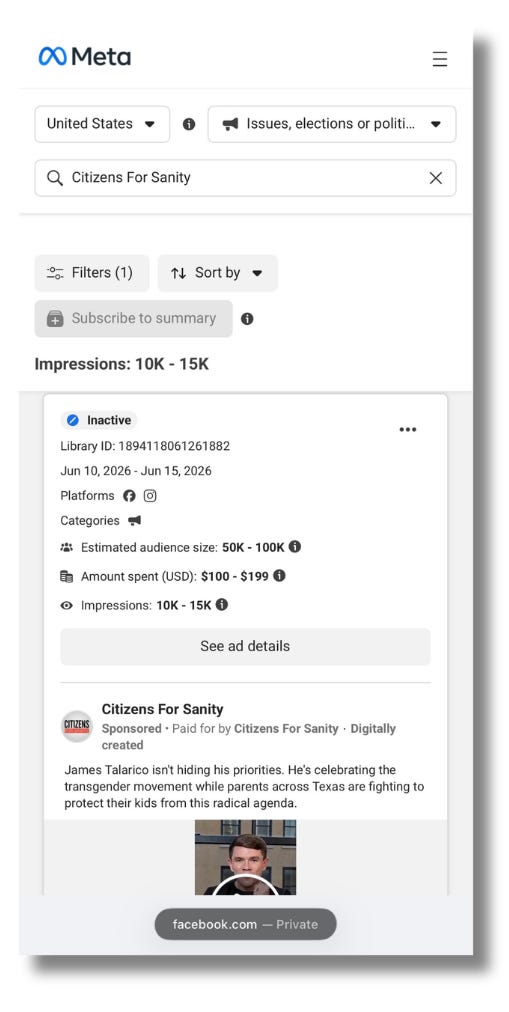
The Talarico ad is what that looks like in full. Meta’s public ad archive shows the clip ran from June 10 to June 15 for an estimated $100 to $199, reaching 10,000 to 15,000 impressions. A search of the FCC’s political file turns up no television record under the group’s name, though political buys are often filed under a media agency or a shell company, and smaller cable systems file incompletely. As of this writing, the video appeared nowhere on Citizens for Sanity’s own Facebook, YouTube, or X accounts. The group told a friendly outlet the effort was a six-figure ad buy. Public records tell a different story: a placement of just a couple hundred dollars. That small buy did one useful thing: it turned the video into a live political ad running in Texas, which handed reporters a story worth covering. The coverage did the rest, placing the video in front of millions the ad would otherwise never have reached.
The third shift is the hardest for journalists to look at directly. Newsworthiness has itself become a distribution channel, and one that political operators can exploit from the outside.
Notice how the Talarico clip actually traveled, because the routing was deliberate. Citizens for Sanity did not just post the video and wait. On June 9 the group handed two different ads to two different conservative outlets on the same day, each one stamped an exclusive. The dress video went to the Daily Caller. A second clip, showing Talarico laying a welcome mat at the southern border for a cheering crowd of armed cartel members, went to Breitbart. The choice of outlets was the strategy. A fabricated attack on a Democrat is a debunking assignment at one newsroom and a gift at another, and these were newsrooms whose audiences would take it as a gift. Both clips belonged to a run of six AI ads the group posted over several days. Citizens for Sanity seeded those ads to sympathetic outlets and then declined to answer PolitiFact’s questions about the campaign. That is a press strategy dressed as a leak.
At the Daily Caller, Reese wrote the outlet’s story, which reported that the ad existed and that the group was paying to run it. She then posted the clip to her own verified account, labeled it AI-generated and framed her post as breaking news. The result was 6.2 million views. When a critic told her that reposting the AI clip was “part of the problem,” she answered, “I’m not reposting, I am breaking the news of the ad.”
Every incentive pointed in the same direction. The group benefited from distribution that its couple-hundred-dollar budget could never buy. The outlet wanted the exclusive. The reporter wanted the scoop, and the scoop rewarded her with an audience of millions. No one had to coordinate for those interests to line up, and they lined up completely. A group spending on synthetic attack videos in a live Senate race is real news, and a reporter who covers it is doing her job. The trouble is that the same post did two jobs at once. It reported a story, and it delivered a fabricated image of the candidate into millions of feeds that the ad itself could never reach. Media scholars call this maneuver trading up the chain: produce something too cheap and too niche to travel on its own, hand it to a sympathetic outlet, and let the coverage do the carrying.
Reese drew a line between breaking news and reposting. Whether that line means anything to the group that handed her the clip is worth asking, and so is whether it means anything to the platform that counted the views. To both of them, a reporter with a large following distributing their fabrication for free is the entire point, whatever she believed she was doing. That is what makes the pattern durable. It requires no willing accomplice, only aligned incentives, and the incentives are always there. Whether Reese understood her place in the chain changes nothing about where the video ended up. The machine runs the same either way.
Disclosure does less than we hope. She told six million people the video was fake, and the video worked anyway. The clip carried no on-screen label, so the disclosure lived only in the caption, which didn’t travel with the footage. Someone scrolling past absorbed the image of a candidate in a dress singing about children’s bodies, and the words above the image did not unmake the image. Visual memory files pictures, not their footnotes. Months from now, some share of the people who saw the clip will keep a vague sense of Talarico and gender they cannot source to anything, and the caption will be long gone. As of August 2026, more than thirty states regulate realistic AI political media, most by requiring disclosure and a few by barring distribution outright in the weeks before an election. Texas is among them. The state bars deceptive political deepfakes within thirty days of an election, so an ad running in June, with the November vote nearly five months away, sat comfortably outside the law. Those laws fight deception. They do not address memory, which is where persuasion actually lives.
Underneath all of it sit the recommendation systems, which now matter more than any broadcast schedule. A TV ad reached whoever happened to be watching when it aired, and the campaign chose the slot. A feed reaches whoever the system predicts will react, and the system optimizes for engagement rather than truth or civic worth. Content that provokes gets pushed. Content that provokes hard gets pushed further. Outrage qualifies. So do mockery, quote-posts, rebuttals and fact-checks. A fabricated clip built for conflict looks, by the only standard the software applies, like excellent material. The algorithm is indifferent to synthetic media, and indifference at scale is enough.
The machinery belongs to no coalition. In the 2025 New York City mayoral race, Andrew Cuomo’s campaign posted an AI video casting Zohran Mamdani’s supporters as drug dealers, abusers and pimps. In Kentucky this spring, a Trump-aligned super PAC ran an AI ad showing Republican Congressman Thomas Massie holding hands with Representatives Alexandria Ocasio-Cortez and Ilhan Omar and checking into a hotel, under the words “Massie caught in a throuple.” The ad ended with a line admitting it was made with AI. The picture did the work regardless. Democrat against progressive, Trump ally against dissident Republican: the target changes and the tool does not.
Every campaign now faces the same incentive: distribution you earn costs nothing, and distribution you buy costs everything. A million dollars of television buys a fixed, knowable audience. Two hundred dollars spent manufacturing a clip built to be reported on, argued over and stitched into other people’s videos might buy nothing, and might buy six million views. At that price the second wager is worth making every time, so campaigns will lean harder into whatever triggers free distribution: the shareable image, the exclusive slipped to a friendly outlet, the artifact designed to be covered.
The deeper cost arrives later in what legal scholars Bobby Chesney and Danielle Citron refer to as the liar’s dividend. Once fabricated video becomes ubiquitous, anyone caught on real video can argue that it is fake, and the denial sticks, because everyone has learned that images lie now. Nathaniel Persily, who co-directs the Stanford Law School AI initiative, called that the greater danger to democracy: as AI saturates political life, “people will be less trusting of true things.” A public that doubts everything is no sharper than one that believes too much. Both are equally easy to manipulate.
Election integrity rests on a familiar set of safeguards: secure ballots, tested machines, clean voter rolls, audited counts. Every one of them protects the moment a vote is cast. But an election can be run flawlessly and still turn on impressions voters formed months earlier from material that spread because software found it engaging. The integrity of the count and the integrity of the information reaching voters are now the same question asked at two different moments.
The tool is not the villain here. Every clip in this story exists because a person decided to make it, publish it, and share it. AI simply made those decisions cheap. The platforms made decisions of their own. They built systems that reward whatever gets a reaction. Systems that do not distinguish between fabrication and fact. What matters is who makes these clips, who chooses to spread them, and who decides how far they travel.
None of this is an argument for banning synthetic political content. A ban is unenforceable against a tool this cheap and this scattered, and enforcement aimed at the clip always arrives after the it has already done its work. The durable protection comes from an educated public that recognizes the system while it is operating.
When political content lands in your feed this season, a few questions are worth considering before you react. Ask what a piece was built to do. Something made to inform you reads differently from something made to be shared, and the second kind usually gives itself away in the strength of the emotional reaction it produces in the first two seconds. Ask where it came from, and whether you can find it on the candidate’s or group’s own channels, because material that lives mostly in coverage of itself was probably built for the coverage. Ask who carried it to you, and notice that a reporter, an influencer and a friend forwarding a clip are all performing distribution no matter what any of them intended. Ask what the money in the story actually proves, when a group’s claim about its own spending doesn’t necessarily match the public record. Ask whether learning a clip is fake has changed your impression of the person on screen, then notice how little it does.
Finally, take particular note of when a story seems to be everywhere. Ubiquity used to signal importance, because reaching everyone was expensive. Reaching everyone is cheap now, so ubiquity mostly signals that something was engineered to travel. Visibility tells you the content moved. Only verification tells you whether the claim behind it deserves belief.
Your feed will keep asking for a reaction. Before the next election, compare it with the feed of someone who votes differently, and see how little the two overlap. Then decide which claims can survive outside the system that delivered them.
A note on process: This piece was researched, structured, and drafted using AI tools, then edited, fact-checked, and published with human oversight. Read my full disclosure & process policy here.
The best defense against a fake is a reader who sees it coming. Subscribe to Safe Online Futures.