The Government Manufactured a Crime to Justify Watching You
How a botched contract at the Lincoln Memorial Reflecting Pool became a surveillance operation, built on video no one could verify.
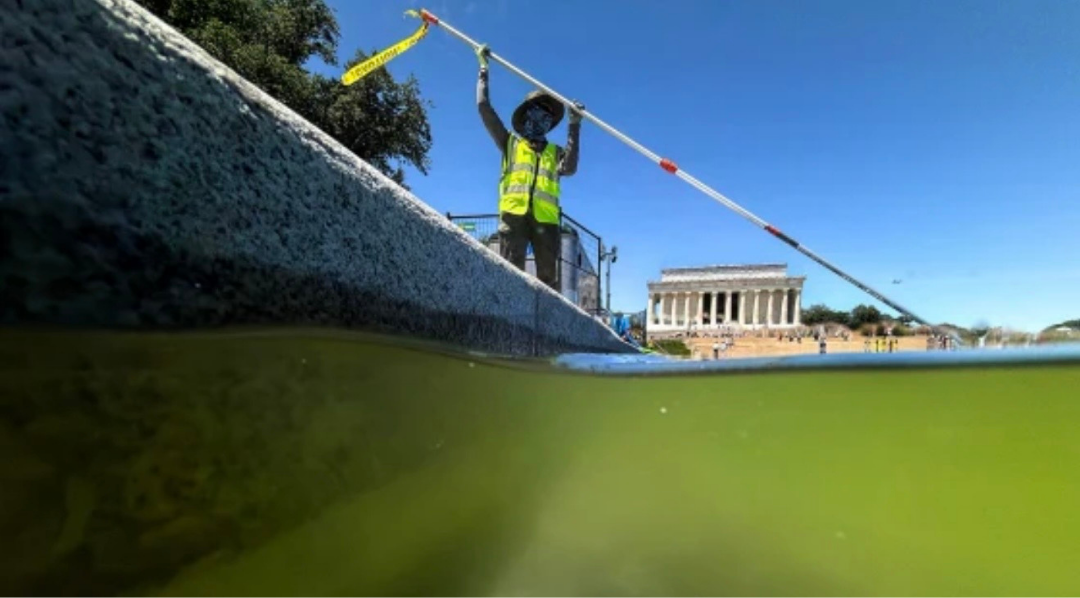
The Lincoln Memorial Reflecting Pool sits below the monument of a man who held the union together, a long rectangle of water built to mirror his memorial on the surface. By the summer of 2026 it reflected something else entirely: a government manufacturing the public’s consent to its own surveillance. The cameras, National Guard troops, and expanded Park Police presence were installed in a matter of days. The government claimed that the actions of alleged vandals justified this aggressive response. But the evidence behind that claim came from a conservative media personality, a government surveillance camera, and an administration-friendly cable news segment that admitted on air it could not verify what it was showing. None of it had to be true for the response to become permanent.
The cameras are the part you can see. The part worth paying close attention to is how they got there. A government that cannot simply order its citizens to accept expanded control over public space has to make them agree to it, and the reflecting pool shows exactly how that agreement gets manufactured: a threat assembled from footage nobody checked, run through institutions that repeated it anyway, converted into standing authority that outlasts the news cycle. What happened here is rare only because the process, this time, was visible.
The threat needed a story, and the story needed a reason to exist. In April, the administration announced an emergency renovation of the pool ahead of the country’s 250th anniversary, expedited through two no-bid contracts under an “unusual and compelling urgency” exemption. The painting and waterproofing contract went to Atlantic Industrial Coatings, a firm Trump had previously called his personal “pool guy,” at a cost that rose from an initial estimate of roughly $1.8 million to a final figure around $16 million. A second contract, for a nanobubble ozone water purification system, went to Greenwater Services, owned by a longtime Republican donor and Mar-a-Lago neighbor John Cafaro. Lawmakers objected immediately, citing the absence of competitive bidding and the contractors’ ties to the president. Senator Richard Blumenthal wrote to the interior secretary demanding documents, describing the project as marked by corruption and a disregard for legal requirements. The Cultural Landscape Foundation sued over the no-bid process itself. Paul Strauss, the District’s senior shadow senator, put the arrangement plainly: “This is what happens when instead of going through the proper government contracting process you get your buddies from down the street at Mar-a-Lago to do a job quickly.”
Then the renovation failed. The pool’s new “American flag blue” coating began peeling within days of the administration declaring the project complete on June 6. A green algae bloom clouded the water. Three ducks died, prompting an environmental group to call for a federal investigation under the Migratory Bird Treaty Act. Crews tried treating the algae with hydrogen peroxide, a chemical that can itself strip paint. By mid-June, congressional Democrats were demanding answers, and DC Water had already issued a permit to drain the pool a second time for repairs. The administration had a botched renovation on its hands, publicly, right before the anniversary it had rushed to meet.
The groundwork for the vandalism narrative was laid weeks before. On May 4, well ahead of any reported damage to the pool, Trump described the new coating on a livestream as too strong to cut with a knife, joking that he didn’t want to give anybody ideas. Nobody had claimed the pool was cut at that point. The claim would arrive six weeks later, once the peeling paint and the algae bloom were already the story and the administration needed an excuse.
The vandalism excuse does two jobs here. It covers for a botched, corrupt contract. And it justifies the cameras, troops, and surveillance now indefinitely stationed at the nation’s most symbolic civic space. The cover-up explains the timing, but the surveillance is the actual payoff, the part still standing long after this news cycle fades.
The administration’s vandalism narrative needed images, and they surfaced almost immediately. On June 19, one day after reporters documented blue material peeling from the pool floor, conservative media personality Emily Miller posted video on X of a man being detained near the Reflecting Pool, captioned as exclusive raw footage of vandalism in progress. The video contains inconsistencies serious enough to raise real doubt about what it shows, which is a question of authenticity and provenance, not a claim about who staged it or how. It reached 1.7 million views (as of July 6, 2026).
Watch my video breakdown of the anomalies in Miller’s clip here.

A few hours after Miller’s video went up, Trump posted on Truth Social blaming “Radical Left Lunatics” for vandalism at the pool and promising the algae problem would be resolved within days. His accusation formed the same night the first unverified clip appeared, before any investigation had opened and before the Interior Department or the Park Police had said a word about vandalism. Fox News embedded Miller’s clip in its own coverage the next day, in a story reporting that a former Olympian was among those charged. That Olympian, David Hearn, later told reporters he had reached into the water only to examine the peeling coating and was held by National Guard troops and Park Police for five hours.
Four days later, Miller posted a second video, again containing anomalies that call its authenticity into question, described as exclusive photographic proof that vandals had cut a large section from the pool.
Watch my video breakdown of the anomalies in Miller’s clip here.

That same evening, Fox aired a third and separate piece of footage on Jesse Watters’ program, sourced not to Miller but directly to the U.S. Interior Department: grainy surveillance video of a man and a woman reaching into the pool. Watters admitted to his audience the network had not been able to verify it, then proceeded to walk them frame by frame toward the conclusion that the people in the video were cutting the liner. The clip had reached Fox before any government account had posted it publicly. A fourth clip, similar in angle but not the same footage the Interior Department had given Fox, surfaced the following day from the U.S. Park Police’s own X account, framed as a public appeal for help identifying a suspect. It too contains inconsistencies serious enough to raise doubt about what it actually shows.
Watch my video breakdown of the anomalies in the U.S. Park Police clip here.

Four videos, three sources, and not one of them independently authenticated before it reached an audience.
This is what narrative laundering looks like in real time, and it works less through belief than through repetition. Fox embedding Miller’s Hearn-arrest clip into its own reporting, with no independent verification, turned an influencer’s post into a network’s story simply by carrying it inside the broadcast. The Interior Department’s clip that follows four days after Watters’ show is the second, more explicit version of the same move. A disclaimer gets read aloud and then ignored for the rest of the segment. A government agency’s own account posts something adjacent to it a day later, and the two start to blur into a single, cumulative impression of proof, even though neither one, on its own, demonstrates anything. You don’t have to trust any single video to believe the pattern they form together. That is the design, and it is worth admitting how well it works on all of us: repetition reads as corroboration long before it has earned that status.
Strip the specifics away and the mechanism is simple.
A government manufactures a threat. It wraps that threat in footage that feels true but cannot be verified. It runs that footage through institutions that launder it into fact, and ultimately converts the fear it manufactured into standing authority over public space. This is what narrative control produces: manufactured consent for expanded state power. The Reflecting Pool is the rare case where you can watch it run from start to finish.
The one verified fact in the entire timeline is narrower than what the president claimed. A court filing from a National Park Service official confirmed that a section of caulk over foam sealant had been cut with a sharp knife or razor, and that roughly seventy fence post caps had been thrown into the pool. Trump, by contrast, described a continuous gash growing over days from 250 feet to 350 feet, cut by “a box cutter or a very sharp razor of some kind or a knife,” and claimed separately that someone had poured chemicals into the water to cause the algae. The New York Times reported that government documents showed no indication the peeling paint or algae bloom had been caused intentionally. A narrow, verified act of damage existed somewhere inside this story. It got folded into a far larger and far less verified narrative regardless.
On June 25, the administration made that fold official. When FactCheck.org requested more information on Trump’s vandalism claim, the White House responded with a press release titled “Radical Lunatics Deface America’s Reflecting Pool, and President Trump Was Right (Again).” It linked directly to the Park Police’s surveillance post, to Miller’s second video, to the Fox News story built around Miller’s Hearn-arrest video, to the Fox segment built on the Interior clip, and to a post from a TMZ reporter speculating on camera about sediment patterns at the bottom of the pool. FactCheck.org concluded that the White House failed to provide any evidence for the long gashes Trump had described or for anyone deliberately introducing algae. The Interior Department told FactCheck.org that six people had been arrested and seven cited, but declined to name any of them or describe what they were alleged to have done. All five unverified sources became, in that release, the government’s own evidence for its own claim, cited with the same institutional confidence the release gave the verified National Park Service court filing sitting alongside them.
The numbers behind the arrests never quite agreed either. The White House press release cited seven arrests, seven federal citations, and eighteen police reports. The Interior Department, separately, told FactCheck.org six arrests and seven citations. The U.S. Marshals Service, asked directly, said its own count showed five. No agency named the people behind those figures or described what any of them had specifically done, beyond the one confirmed case of Hearn, the former Olympic canoeist who says he was examining peeling paint. A story built on evidence nobody verified produced a body count that nobody could settle on, which is its own kind of tell.
That single confirmed case became an indictment. On July 2, Hearn was charged with one felony count of property destruction. The government's case rests not on the unverified videos the administration spent weeks promoting, but on Park Service employees who say they watched him pull at the already-peeling liner, an account he disputes. The videos manufactured the public's certainty; they never had to hold up in court. His lawyers called the charge a "misuse of government power against an ordinary citizen based on a concocted narrative."
By then the apparatus the story justified was already installed. National Guard troops and Park Police had been patrolling the site since the weekend Trump first blamed vandals, days before any footage existed to back the claim. Fencing that a U.S. Interior Department spokesperson later described as always planned ahead of the anniversary went up early instead, attributed to what she called a rise in vandalism by leftist activists, a claim she offered no evidence for. A federal task force created to surge law enforcement presence and immigration enforcement across the district was already active in the area. A day before the press release, Trump described the vandalism to NATO’s secretary-general in the Oval Office as though it were established fact, telling him vandals had gone to the bottom of the pool and started ripping it up. What began as anniversary security became, on the strength of four unverified videos, a standing security and law enforcement posture at the country’s most symbolic civic space, expected to outlast the holiday it was built for.
The apparatus is the payoff. What makes it repeatable is that no law forced anyone to confirm the vandalism was real before the government acted as though it were. No law compelled the Department of the Interior to authenticate footage before handing it to Fox. No law compelled Fox to hold a clip until it could authenticate what its own anchor admitted, on air, it had not verified. No law compelled the White House to confirm a single video’s origin before citing four unverified sources in an official release as evidence of a federal crime. Section 230 of the Communications Decency Act shields the platforms Miller posted to from any liability for the videos she uploaded. And no federal law requires labeling of manipulated or synthetic video, so the anomalies in both of her clips never had to be resolved before millions of people saw them. Every institution in this chain did exactly what current rules allow. Threats have justified permanent surveillance expansions before, the Patriot Act among them. The difference now is that the threat itself can be manufactured, on evidence no one is required to verify. That is precisely why the mechanism will run again: the next site a government decides needs watching, the next neighborhood it decides to militarize, the next narrative it manufactures to justify either.
The reflecting pool was built to mirror the Lincoln Memorial, one steady image held on the water for a century. Instead, it spent the summer of 2026 reflecting the administration that renovated it. The no-bid contracts mirrored its corruption. The algae clouding the water mirrored how it clouds the information reaching the public, obscuring the truth and the rule of law to drive opinion where it wanted. The cameras and troops are real, and if they remain, they become the lasting legacy: a militarized surveillance footprint normalized at the nation’s most symbolic civic space.
A government that could simply force its citizens into obedience would have no need for any of this. It could skip the conservative social media reporter, the friendly cable news anchor, the official press release, the whole elaborate laundering of footage into fact.
The reason this administration invented a narrative instead of issuing an order is that it governs a country where power still depends on the appearance of consent. So it manufactures the consent.
It fabricates a threat, wraps it in unverifiable media, and lets a public that thinks it is debating vandalism land on the conclusion the government wanted all along. The verdict feels like your own. Producing that feeling is this adminstration’s entire aim. The real lesson of the reflecting pool is not that the government can watch you. It is that the government can manufacture your agreement, using a media ecosystem that never requires the truth before making something official. Whether these particular cameras stay is almost beside the point. The method that installed them has been tested. It works. And it will be used again.
A note on process: This piece was researched, structured, and drafted using AI tools, then edited, fact-checked, and published with human oversight. Read my full disclosure & process policy here.
Safe Online Futures tracks how narratives are manufactured, laundered, and sold back to you as fact. Subscribe, and learn to spot the machine before it runs on you.