Seen Everywhere, Checked Nowhere
What a viral World Cup story reveals about the modern information ecosystem.

If you’ve been following the World Cup, you’ve probably seen Swedish soccer fan Elsa Thora. Her videos marveling at American life are spreading across social feeds and have even been covered in major news outlets: the cavernous grocery stores, the yellow school buses, and the ranch dressing on everything. The story has felt like a relief from the outrage that usually fills your feed, and millions are sharing it without a second thought.
The Atlantic has since added some context that most of mainstream media coverage had left out. Thora is not a wide-eyed newcomer stumbling onto America for the first time. She arrived with a substantial social media following, real experience building online audiences, and a past that had made her a familiar name in the European tabloids. You can argue about whether that background changes your view of her. The more revealing question is why so many outlets ran the story without that context, and what that omission tells us about the moment we are entering. The authenticity of online content is becoming harder to judge at the exact moment journalism is becoming more dependent on content that originates online.
Recently, I wrote about the invisible editor, the automated systems that decide what reaches your screen before you choose to look. That reality raises an inevitable question: What happens when those systems increasingly select content whose authenticity is difficult to evaluate?
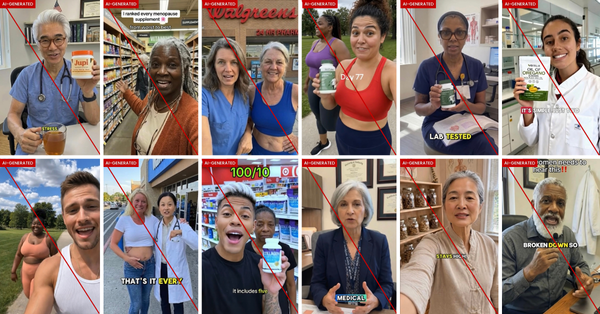
Spend ten minutes scrolling online and the challenge becomes obvious. The person on camera may be real and the experience genuine, while AI wrote the caption, smoothed the skin, translated the speech, generated the backdrop, and tuned the clip for maximum engagement. The content may be entirely synthetic, created without a camera, a location, or even a real person. Most often, viewers have no reliable way to determine where a piece of content falls on that spectrum. That uncertainty would be significant on its own. It becomes far more important when stories originating in those environments increasingly find their way into mainstream news coverage.
For most of the internet era, the concern about online content was simpler. A false claim appeared, fact-checkers investigated, journalists corrected the record, and a reader could at least picture a clean line between true and false. The environment taking shape now blurs that line. A growing share of what you see online lives on a spectrum between authentic and synthetic. Sometimes the person is real, but AI helped generate the images, rewrite the captions, clone the voice, create the background, or optimize the message for engagement. Sometimes the content is generated entirely by AI. Most often, viewers have no reliable way to determine where a piece of content falls on that spectrum. While some platforms have introduced AI-labeling policies, disclosure remains uneven and often depends on creators accurately reporting their own use of AI tools. As a result, audiences are frequently left with little visibility into how much AI was involved in producing the content in front of them. That uncertainty matters. A genuine experience can be engineered for maximum persuasion. A synthetic experience can be presented as authentic. Both can arrive in your feed with the same credibility signals, the same emotional impact, and the same potential to shape perception.
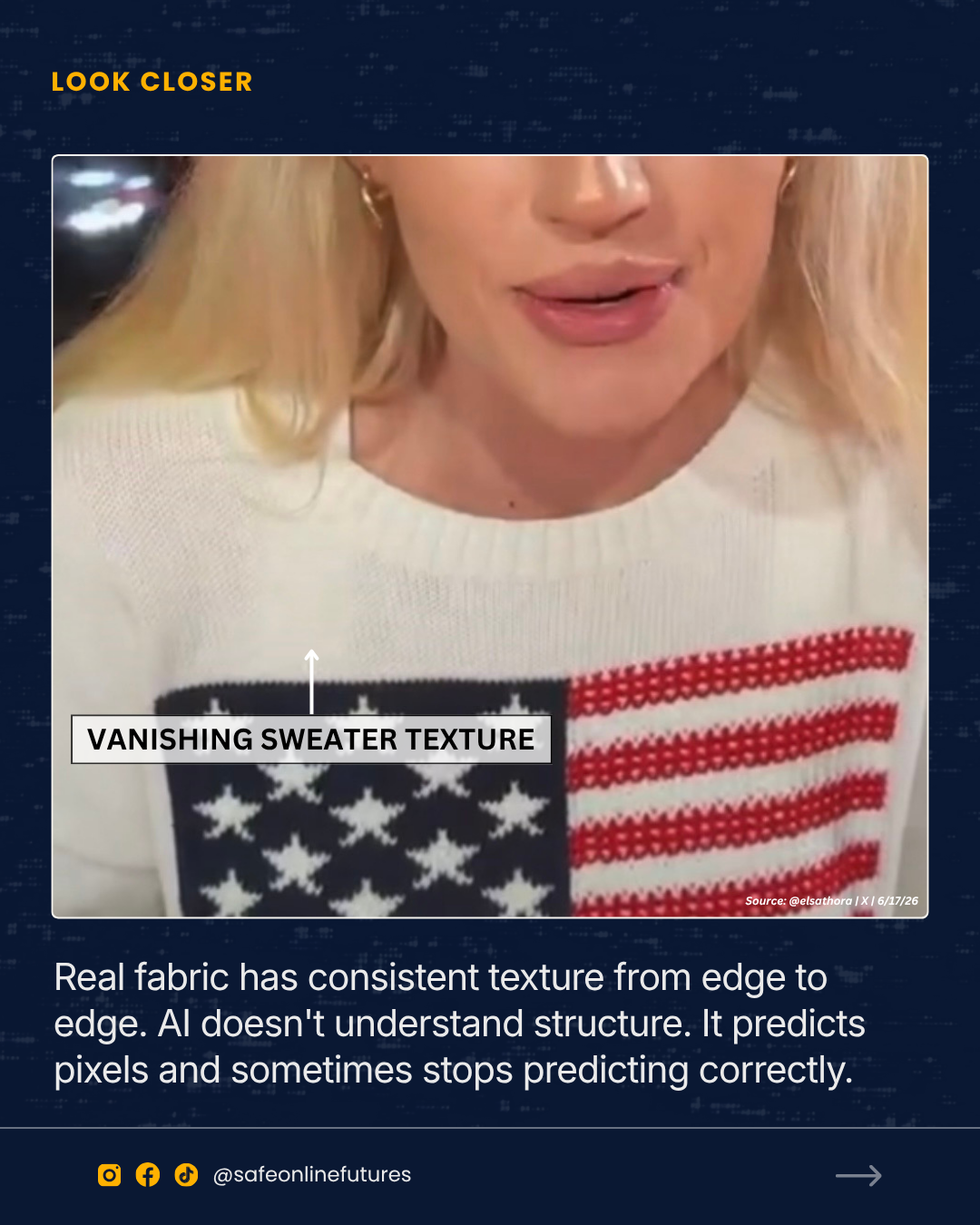
Thora’s content is a useful and timely example. After reviewing a number of her photos and videos, I noticed several visual anomalies that are consistent with documented markers of AI manipulation, including disappearing fabric textures, warped text, missing and distorted rhinestones, inconsistent hair detail, and unusual eye-gaze behavior. None of those observations proves that her content is AI-generated, and I am not making that claim. The larger point is that I cannot confidently authenticate what I am seeing, and neither can the millions of people who encountered her content. Yet many viewers formed strong impressions and emotional reactions from it anyway. Some described the videos as restoring a sense of national pride. Others saw them as evidence of what makes America special. Whether those conclusions are justified is not the point. The point is that highly persuasive narratives can emerge from content whose production process remains largely invisible to the audience.
The second shift compounds the first. News organizations now draw a growing share of their stories from the same platforms where that uncertainty lives. Consider how much of modern coverage begins. A post goes viral, a video jumps from platform to platform, millions react, and reporters start covering the phenomenon itself. At that point the coverage often centers on the virality. The fact that a clip is spreading becomes the news, but virality and credibility do not measure the same quality. A recommendation system never asks whether a piece of content is true, representative, or complete. The system measures whether you clicked, commented, shared, and watched to the end, and those signals alone decide what becomes visible.
The same incentives shape the people making the content. A video that sparks curiosity, outrage, nostalgia, or national pride will usually outperform one that offers nuance, so the creator earns more reach, the platform earns more engagement, and you receive a sharper emotional hit. Everyone is responding rationally to the incentives in front of them. The machinery stays in place regardless. Once a narrative gathers enough momentum, its visibility starts to pass for proof. We assume that if millions have already seen, discussed, and shared something, someone along the way must have checked whether the story held up. That assumption made sense when the path from event to journalist to audience was short. Today that path runs through systems built to maximize attention, and the old assumption no longer holds.
Many of us still carry a mental model of journalism from before social platforms reshaped the information system. An event occurred, reporters investigated, editors weighed whether the public needed to know, and the audience saw the finished story only after verification had taken place. That model still exists, and original reporting and fact-checking remain essential to a democracy. But a second model now runs alongside the first. Journalists increasingly see a story only after it has already trended on social platforms, arriving with millions of views and a built-in audience, and the attention itself becomes part of the reason it gets covered. For generations visibility tended to follow verification. Now the two travel on separate tracks, and a story can reach enormous scale before anyone has seriously examined the surrounding context.
This pattern shows up far beyond a charming influencer. In 2019, a clip seemed to show a teenager in a MAGA hat confronting a Native American elder at the Lincoln Memorial. Longer footage that surfaced later revealed a far more complicated and nuanced picture of the encounter. The left amplified the first version. In 2020, a video from a Georgia vote-counting site circulated as proof of suitcases stuffed with fraudulent ballots. It was repeated by officials and later explained by investigators as routine processing. The right amplified the first version. Different politics, opposite audiences, identical machinery. A clip wins attention, the narrative hardens, and fuller context arrives only after the moment has passed. Sometimes the first version survives scrutiny and sometimes it collapses. The amplification happens either way.
That alone is why visibility has become such a poor stand-in for credibility.
Your feed no longer shows you reality. It shows you what won the competition for your attention. That competition rewards many qualities, of which accuracy is only one.
The skill this moment demands is separating two very different questions. Is this story true, and why am I seeing it at all? For years, digital literacy trained us on the first question alone, on telling a true claim from a false one. That skill still matters but it no longer suffices. The second question carries just as much weight now, because a story can be entirely accurate and still reach you only because it was engineered, amplified, and selected for the feelings it produces.
The Elsa story is low-stakes by design. Nobody will lose sleep over a viral clip of a Swedish World Cup fan obsessing over ranch dressing. What makes this example useful is not the content itself. It is that millions of people formed impressions, emotions, and even feelings of national pride from material whose authenticity they could not independently evaluate. The same machinery that lifts a cheerful piece about a grocery store also lifts coverage of immigration, crime, elections, and foreign conflict. The system draws no distinction between subjects. Picture a future election in which voters meet a steady stream of videos and personal testimonials, some authentic, some entirely synthetic, some partly synthetic, some heavily optimized, some produced by campaigns or foreign actors using tools that keep getting cheaper and better. The narratives gain traction, platforms amplify them, news organizations report on the swelling conversation, and public attention grows while the underlying authenticity stays unknown. Information now moves faster than verification, and perception can harden long before the full picture is available.
The structural answer to all of this is governance, rules for the systems that decide what we see, which is the case I made when I wrote The Invisible Editor. Those safeguards remain largely absent. In their absence the burden falls back on us by default, which makes media literacy the only real defense we have right now. So the next time a story appears in your feed and then again in a major outlet, slow down before you immediately accept the narrative. Ask why this story became visible, what incentives shaped its creation, what context fell away on the journey to your screen, and whether you are looking at verification, amplification, or some blend of the two. Those habits will not make you cynical. They will make you more resilient, and in a world where attention has become one of the most valuable resources on earth, that resilience may be the most useful form of citizenship available to us.
If you're interested in understanding the systems shaping our information environment, subscribe to Safe Online Futures for weekly analysis of AI, media, incentives, and the future of online trust.