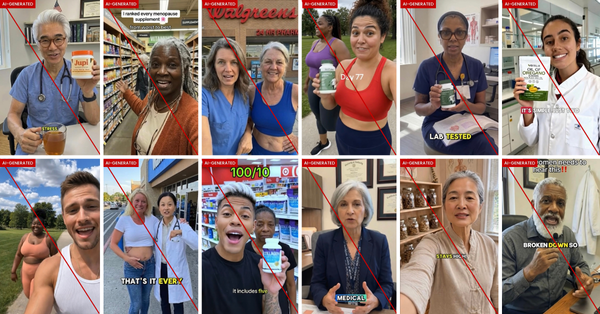
The Epistemic Glitch: Why We Fight Over Images We Can No Longer Verify
The panic over Ariana Grande's weight is a dress rehearsal. The real performance, waged over political images we can't confirm are real, is still to come.
We didn’t arrive here suddenly. For roughly forty years, popular culture has been quietly training the public to stop asking whether what it is watching is real, and eventually, to stop caring. The writer Jamie Bartlett traces the arc in his BBC podcast series Everything Is Fake (and Nobody Cares). Professional wrestling turned “kayfabe,” the shared agreement to treat an obvious performance as real, into mainstream entertainment. Daytime talk shows elevated personal feeling and “my truth” to the status of fact. The 2008 financial crash taught a generation that people at the top could invent value out of nothing, grow rich, and face no consequences. Silicon Valley rebranded “fake it till you make it” as visionary. Social platforms then rewarded not truth but attention, and the most emotional, most shareable version of any story won.
The methods kept changing. The intent stayed the same, and so did the result: audiences learned to treat performance as reality and to stop minding the difference. By the time the technology could convincingly fake almost anything, we had already been conditioned not to check.
The Ariana Grande “weight controversy” of 2026 is what that conditioning looks like when it collides with a genuinely new problem: a moment where the public no longer simply declines to verify what it is seeing, but cannot, and argues ferociously anyway.
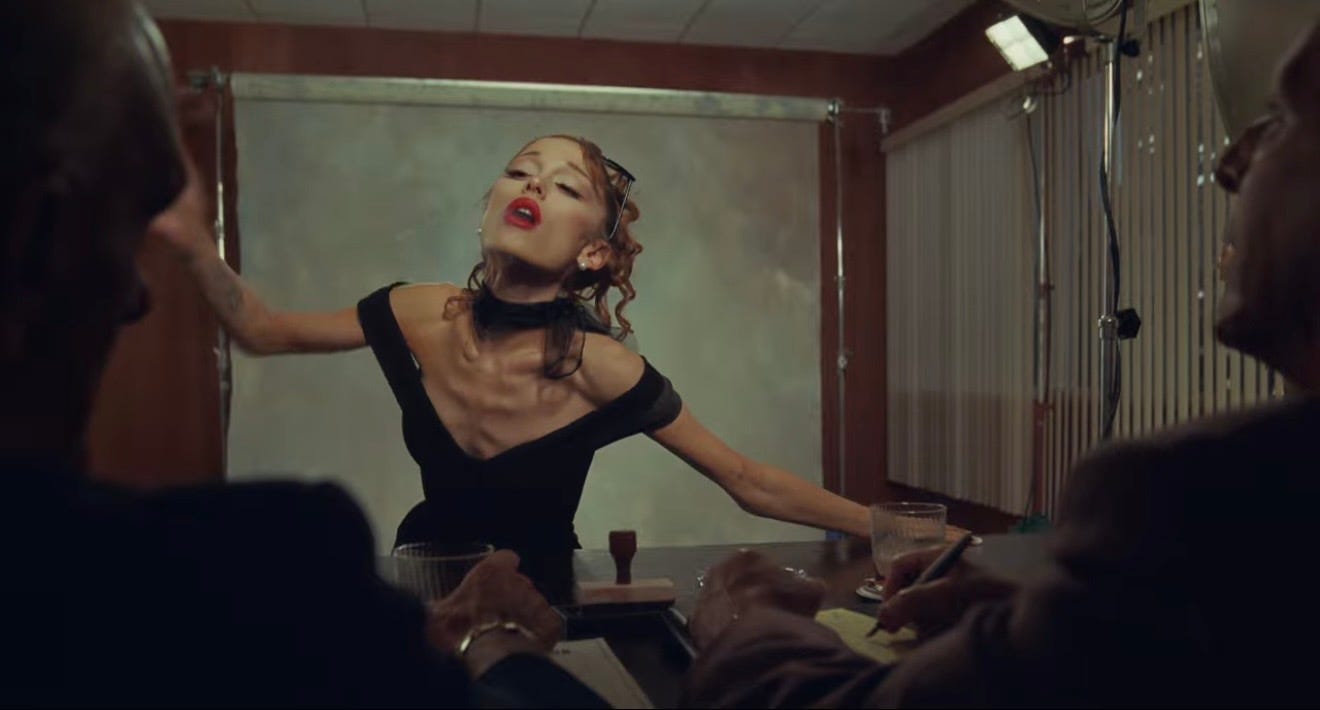
Look closely at Grande’s hands about a minute into the music video for her single “Petal.” She stands before a panel of executives, arms spread wide, palms open, wearing sheer white gloves. On her right hand, her middle and ring fingers seem to flash solid white while her thumb appears bare. On her left, the middle finger looks subtly warped against the others — and where a curl of cigar smoke drifts across her palm, the edge of her hand seems to dissolve into the haze.
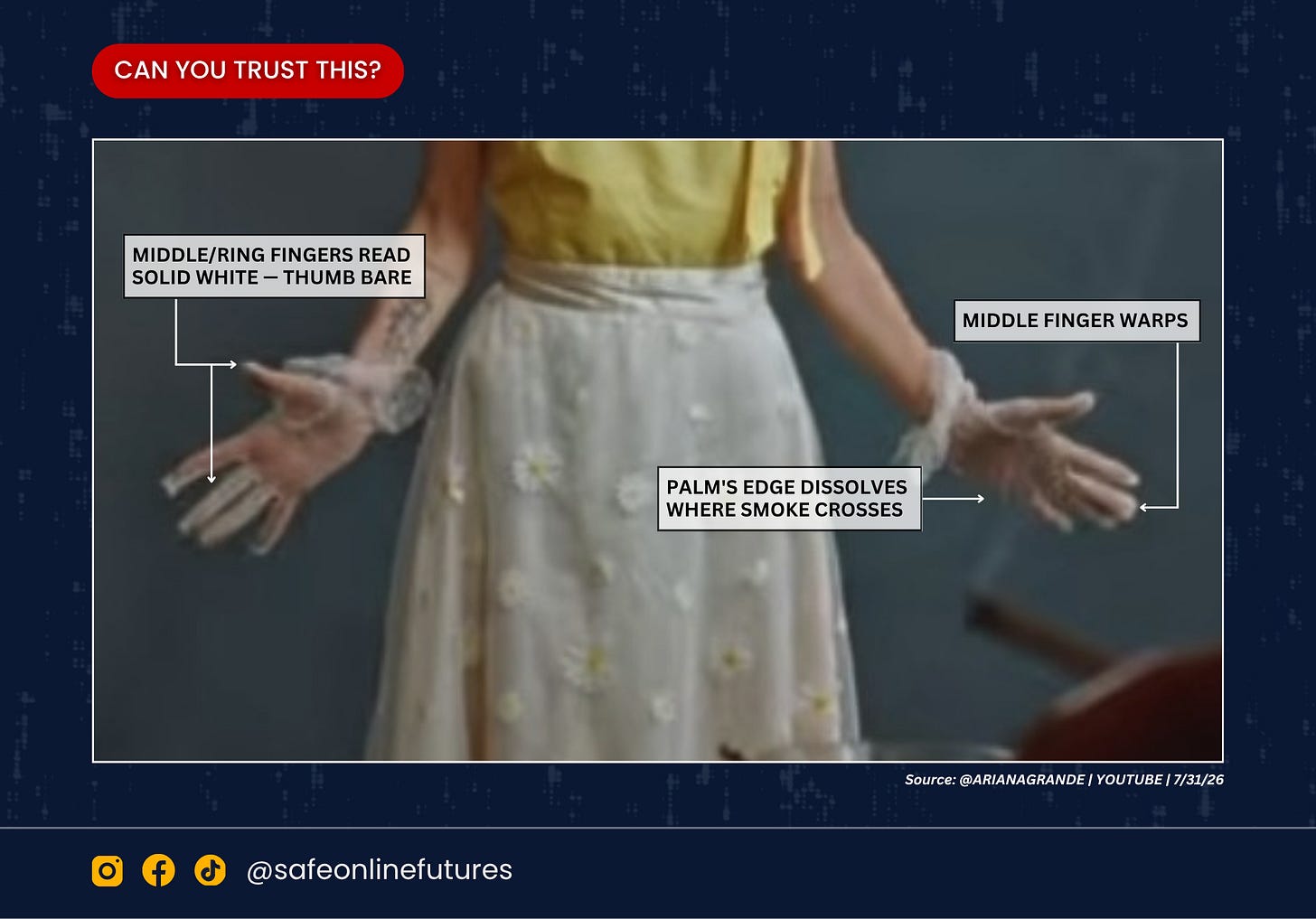
Here is the honest answer to what you are seeing: no one watching can say for certain. It could be ordinary motion blur. It could be video compression. It could be a beauty filter losing track of a moving edge, digital slimming software catching on the seam of a glove, an AI-assisted tool, or some combination of all of them — or it could be nothing more than the ordinary strangeness of how cameras render fast motion. The tools that produce each of these outcomes leave behind nearly identical smudges, and nothing on the screen tells you which was used.
That uncertainty should have been the story. Instead, within hours of the video’s release, social media feeds were not discussing editing at all. They were exploding with intense, polarized debate over Grande’s physical body. Tabloid headlines detailed “fan concern” over her weight. TikTok creators posted frame-by-frame dissections. Comment sections descended into ideological warfare between defenders warning against body-shaming and critics accusing the singer of promoting an impossible standard.
The mainstream media covered the story through a familiar cultural lens: body image, celebrity health, and parasocial ethics. But that narrative obscures a more significant issue.
The public was waging a high-stakes debate over a physical human body based on a digital asset that no one could actually verify. We have reached an epistemic glitch in modern media: a point where the public can no longer confirm what is real on screen, yet continues to generate massive cultural outrage over the results anyway.
The obvious objection is that none of this is new. Grande’s body has been a subject of public concern for years, and the internet is full of images of her looking strikingly thin — most of them nothing to do with this video. Many people who care about her are genuinely worried, and that worry may well be warranted. She may be struggling. She may be as thin as the most alarming pictures suggest. You and I have no way of knowing, and neither does anyone arguing about it online — and that is precisely the point. Two things can be true at once. She may genuinely be very thin, and the video may present a version of her that looks thinner still, and no one scrolling past can tell where one ends and the other begins. The existence of a hundred other thin-looking images doesn’t settle the question; it multiplies the uncertainty, because every one of those images is exactly as mediated, filtered, and unverifiable as the last. Pointing to more of them isn’t a rebuttal. It is the same instinct — treating a screen as a mirror — repeated a hundred times.
That instinct runs deep, and it is worth understanding where it comes from. For over a century, moving images carried a foundational premise: if it appears on video, it represents a real-world event. Even as the public grew aware that photos could be altered, video held a higher bar of perceived authenticity. The sheer labor required to retouch thousands of individual frames meant heavy manipulation was historically reserved for high-budget blockbusters and obvious CGI.
That reality no longer exists. Modern editing software, powered by automated beauty filters, generative AI tools, and real-time digital contouring plugins, has democratized high-end retouching. A single editor can now smooth skin, adjust proportions, or alter lighting across an entire music video in a few clicks. The problem is not that these tools exist; it is that their use is invisible to the viewer. When an anomaly appears — a warping background, a disappearing glove — the viewer is trapped in an information vacuum. Is it motion blur? A compression artifact? An AI filter struggling to track a moving object? Digital slimming misreading the edge of a sheer glove? The first laws requiring disclosure have only just arrived. The EU began mandating visible labels for AI-generated and manipulated video in August 2026 but they reach only overt AI synthesis, exempt artistic works like music videos from all but the lightest disclosure, and have no counterpart in the United States. The ordinary retouching and filters at issue here fall through every gap, which means we are left with a 'mystery edit.’ Viewers are forced to guess where physical reality ends and software begins. Yet despite that total lack of transparency, our brains default to the legacy reality assumption, treating retouched digital files as unmediated reflections of human bodies.
If the core issue is an inability to verify what we are looking at, why did traditional media and social algorithms focus almost exclusively on the body-image debate? The answer lies in the mechanics of the attention economy. High-engagement media runs on emotional friction. Moral debates about health, celebrity behavior, and body image activate deep cultural anxieties and personal identities. A post asking, “Is this singer healthy?” generates far more comments, shares, and watch time than a technical analysis asking, “Which compositing plugin caused this artifact?”
Tabloids, entertainment sites, and commentary channels also have a financial incentive to maintain the illusion that celebrity media is raw and scrutinizable. Acknowledging that a video may be heavily retouched or algorithmically altered neutralizes the spectacle. It turns a viral scandal into a dry discussion about post-production software. And the algorithms themselves do not evaluate truth; they measure engagement. In the attention economy, genuine worry for an artist’s well-being and malicious outrage yield the exact same return: impressions and ad revenue. By treating both sides as valuable activity, the algorithm pushes the controversy to millions of additional feeds, creating a self-sustaining loop. In this environment, the mystery edit becomes a commercial feature rather than a flaw. The less the public can verify the frame, the more it speculates; the more it speculates, the longer the topic trends.
None of this can be separated from commercial timing. The discourse unfolded precisely as Grande released a new album, well into her Eternal Sunshine Tour. In the modern music industry, breaking through a saturated landscape requires massive, sustained visibility, and a controversy that dominates feeds for a week provides millions of dollars in free exposure. Whether an anomaly is intentional or accidental, the economic outcome is identical. Every comment arguing about a frame, every reaction video, and every news article directs traffic straight to the artist’s name, streaming channels, and ticket portals. Outrage is no longer just a side effect of celebrity culture; it has become one of its primary distribution strategies. And when artists fold public criticism directly into their work — as the “Petal” video does, staging executives who review critiques of the singer’s appearance — it creates a metatextual loop: the art critiques the obsession with the artist’s body, which prompts the media to produce a new wave of coverage dissecting that body. The cycle completes itself.
The cost of all this reaches far beyond pop music. When we treat algorithmically optimized, unverified media as raw reality, viewers compare their physical bodies to files that may have been adjusted by software, judging themselves against standards that are literally impossible in the real world. Worse, genuine conversations about body image and mental health get co-opted by commercial algorithms designed to profit from confusion. To break the cycle, we have to update our media literacy for the age of automated editing and AI generation. Just as food carries ingredient labels and sponsored posts carry disclosure tags, digital media, especially from major studios and brands, should carry clear indicators when footage has been retouched, altered, or filter-enhanced. Until disclosure is the norm rather than a narrow exception, the public needs a simpler rule of engagement: if you cannot verify the frame, do not feed the outrage. When a viral clip sparks a fight over someone’s appearance, the first question should not be “What do I think about this person’s body?” It should be “What was used to build this file, and who profits from me fighting over it?”
There is a reason this matters beyond one pop star and one video. The habit we practice on a celebrity’s body — accepting an unverifiable image as real enough to fight over, then scrolling on when the next one arrives — is the same habit that gets exploited in far higher-stakes arenas. Bartlett draws the line himself: the willing suspension of disbelief that made professional wrestling work has migrated, over decades, into politics, where actors who benefit from confusion have learned that a confident performance beats a checkable fact. It works for the same reason the “Petal” discourse worked: the audience has been trained to engage with the spectacle as if it were reality, and the platforms and the press profit whether or not anyone verifies anything. A celebrity’s weight is low-stakes, which is exactly what makes it such an effective training ground. We rehearse the surrender there — the shrug, the fight, the scroll — and the same muscle is waiting when the image is a political one. Picture the mechanics we have just watched, pointed at a leaked clip of a candidate, a piece of “evidence,” a video of something that may or may not have happened. The anomalies will look identical to motion blur or a filter or a fabrication; the disclosure gap will be just as wide; the algorithm will reward the fight just as reliably. And the person who built the image will be counting on the same habit the outrage machine has trained us for all along — that we will argue passionately about what we cannot verify, and never think to ask who profits from the argument.
Ariana Grande is the dress rehearsal. The performances that matter are still to come — and by then, the habit of not checking will already be ours.
A note on process: This piece was researched, structured, and drafted using AI tools, then edited, fact-checked, and published with human oversight. Read my full disclosure & process policy here.
I write about what's real, what isn't, and who's counting on you not to check.