1.1 Million People Watched a Child That Never Existed
What a viral AI video reveals about grief, algorithms, and who profits from both.
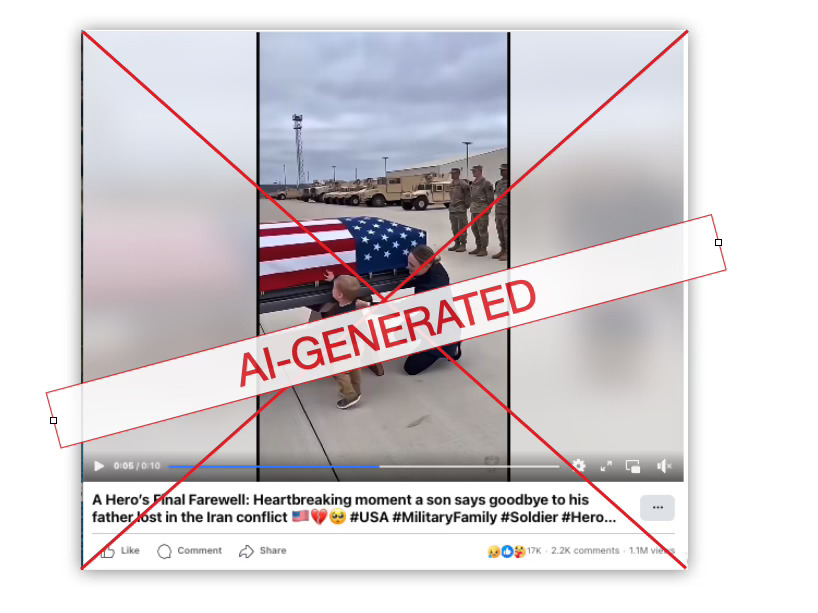
One of the most shared videos online this month never happened. A toddler crying "Daddy" at a flag-draped casket. His father, according to the caption, was an American soldier killed in the Iran war. In just one day, it racked up 1.1 million views on a single Facebook post — generating ad revenue for accounts that will keep running the same template with different faces. None of it was real but the grief it triggered in you was, and that's exactly the point.
What the Evidence Shows
Digital forensics experts at Berkeley and Northwestern analyzed the video independently and concluded it was almost certainly AI-generated. The subtle but consistent tells included a child’s hand disappearing into the flag, soldiers’ faces blurring unnaturally in the background, and a runtime of exactly ten seconds, which is a common ceiling for current AI video tools.
It wasn’t one video either. Multiple versions circulated simultaneously on Facebook, Instagram, TikTok, X, and Threads. Same scene, different faces, different ethnicities, different clothing — the same emotional template, replicated at scale.
This is part of a broader phenomenon called AI slop — low-effort, AI-generated content churned out for engagement. Across every major conflict and breaking news cycle, AI tools are being used to generate fake emotional content designed specifically to exploit the moment and monetize your reaction. But what’s circulating around this war is something more calculated than slop. It’s manufactured grief, engineered to reach you at a moment of national vulnerability and convert your emotion into revenue.
Underneath the fabrication were real casualties. Thirteen American service members died. Seven had their remains returned. At least three left behind children, none of whom were toddlers. That's the context this video was designed to exploit.
The clip worked because grief is not a casual emotion. It overrides skepticism. It’s part of what makes us human. And human emotion, it turns out, is highly monetizable.
And here's what most people miss: the platform didn’t create this video. But it created the conditions that made it profitable. Every major social platform is built to maximize engagement: shares, comments, watch time. And on these platforms, nothing travels further than emotion.
When a video like this performs, the algorithm doesn't just reward it — it teaches everyone watching what works. Copycat videos follow immediately. One successful template spawns dozens more, all chasing the same engagement numbers. The cost of manufacturing emotionally manipulative content has collapsed to nearly zero. A prompt, a free tool, ten seconds of video, and a topical caption is all it takes to enter the market. The incentive is structural. As long as grief travels faster than fact-checking, this template will keep running
Meta Is a Case Study, Not an Exception
Every platform runs on the same fundamental business model. Meta is worth examining in detail not because it is uniquely culpable, but because it is uniquely transparent about what that model looks like in practice.
Meta has a policy for this. It just doesn’t enforce it. The tech company requires users to label AI-generated content — but the policy relies primarily on voluntary self-disclosure, with automated detection as a backstop rather than the first line of defense. It's the equivalent of putting 'please don't shoplift' on a sign and calling it a security system. Asking bad actors to label their own manipulation is not a content moderation strategy. It’s a liability shield. This video was not labeled and it reached 1.1 million people within 24 hours.
But Meta's earnings calls offer a clearer window into the company's true incentives than any content policy ever could. In a Q2 2025 earnings call, CEO Mark Zuckerberg confirmed the company’s commitment to AI across its platforms, framing it as a way to improve user experience. The numbers tell a different story. AI advancements drove a 5% increase in time spent on Facebook and a 6% increase on Instagram in Q2 of 2025 alone — and time spent on platform is how Meta sells advertising. The profit motive was never subtle.
Several months after that call, Meta launched Vibes, its AI video generation feed that allows users to create, remix, and publish AI-generated videos directly to Instagram, Facebook Stories, and Reels. Where previously creating and posting AI-generated content required multiple steps across different tools and platforms, Vibes makes it a single seamless action. Meta does use an invisible watermarking system designed to identify AI-generated video content created on its platforms. But the system has documented limitations — it depends on native uploads and can be circumvented by re-posting or re-encoding content, which is exactly how manipulative AI videos spread. And even when it works as intended, an invisible watermark does nothing for the person watching the video. By definition, they can't see it.
The bottom line: the platform that requires you to label your manipulation is the same platform that built the tools to create it, the feed to distribute it, and the algorithm to monetize it.
Under Section 230 of the Communications Decency Act, platforms are not legally liable for the content their users post. That single legal protection is the foundation the entire business model rests on. It means Meta can build the tools, profit from the engagement, and face no legal consequences when manufactured grief goes viral. Until that changes (and there is no indication it will anytime soon) the burden of navigating this environment falls on the people consuming it. That's you.
Until the legal landscape catches up, the most powerful tool you have is your own critical eye. Here's how to sharpen it.
Three things to do before you share:
- Check the source before the content. One of the Facebook pages spreading this video openly states in its bio that it posts “fictional content for a real cause.” The disclaimer was public. Most people never looked.
- Notice the flags — literally. AI-generated videos consistently get the American flag wrong — stars misplaced, stripes skewed, proportions off. It’s a small detail, but it’s a reliable one. Your gut won’t catch it but your eyes can.
- Ask who benefits. Emotional urgency is a design feature, not a side effect. When a video is engineered to make you feel something and share it immediately, pause. Find the account. Look at what else they post. The answer is usually right there.
These aren't difficult habits. But they matter because what's at stake isn't abstract. Thirteen service members have died. Their families are grieving. That grief doesn't need to be manufactured by opportunists who understand that emotional content travels further and pays better. And it doesn't need to be amplified by platforms that built the infrastructure to make that exploitation possible and the algorithms to profit from it. These aren't separate problems. They're the same business model, operating at two different levels. The algorithm will keep offering you reasons to feel things quickly and share them widely. That's what it was built to do. You don't have to comply.
The algorithm is getting smarter. So are you. Subscribe to Safe Online Futures.