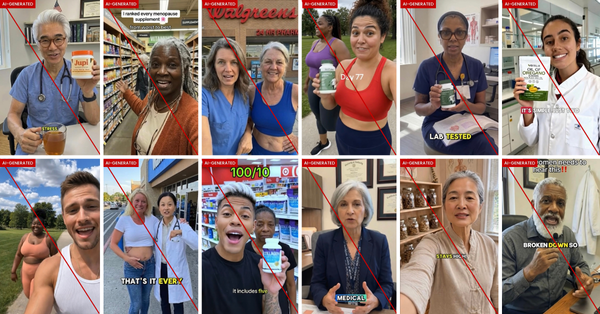
AI Advertising Slop Is Already Here
How undisclosed AI imagery is becoming normal in everyday advertising — and why spotting it matters
Most people don’t remember individual ads. They remember the feeling they leave behind.
A holiday image that looks polished but oddly flat. A lifestyle scene that feels real enough — until you pause. Increasingly, those images aren’t photographs at all. They’re generated.
In recent months, the term “AI slop” has emerged as shorthand for low-effort, mass-produced AI imagery — content designed to look passable at a glance, but not built with care, transparency, or clear human oversight. In advertising, it often shows up as polished visuals that feel slightly off when you slow down and look closely.
AI-created imagery is already embedded in everyday advertising, from seasonal campaigns to routine product marketing. And most consumers would never know. That’s not because people aren’t paying attention — it’s because they aren’t being told.
The real issue with AI advertising isn’t that brands are using it — it’s that consumers are rarely told when the images selling them products were never photographed at all.
In rare cases, companies are upfront. Coca-Cola’s 2025 holiday campaign explicitly disclosed its use of AI-generated imagery. That disclosure mattered. It gave viewers context. It acknowledged that what they were seeing wasn’t a moment captured in the real world, but something constructed. (View the official AI-generated Coca-Cola ad here.)

That level of transparency, however, remains the exception.
A Closer Look: What Changes When You Slow Down
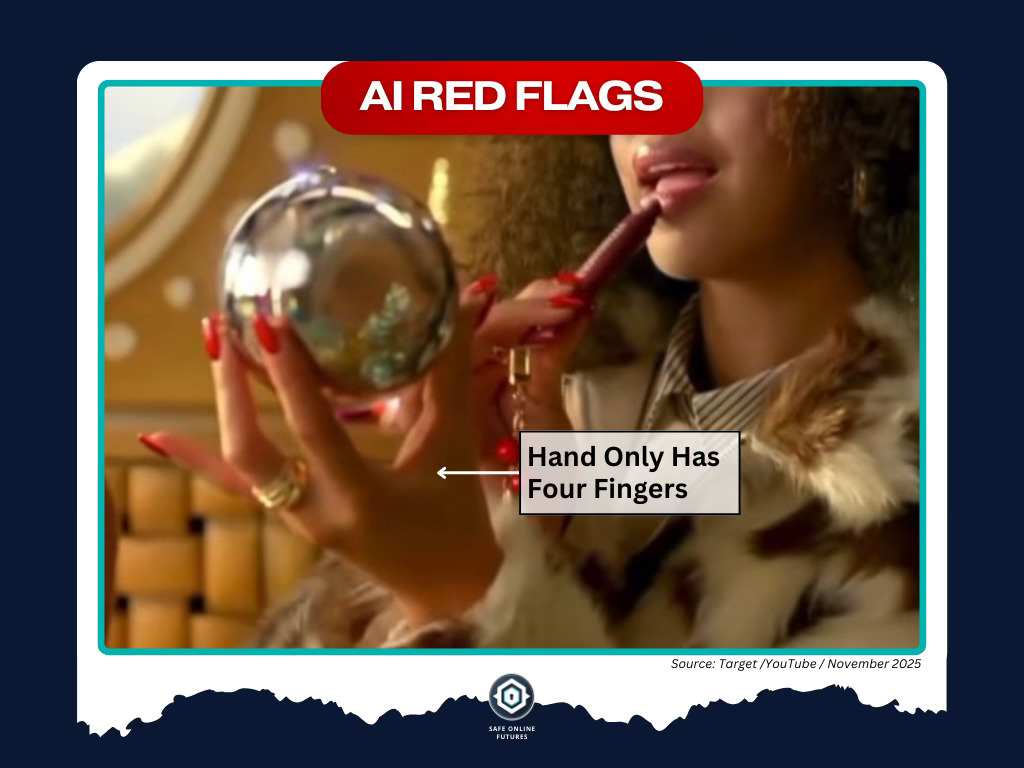
Take the above still frame from a recent Target holiday commercial. At first glance, it appears ordinary: a young woman applying makeup in a festive, well-lit setting. But when the image is paused and examined closely, an anomaly becomes clear. One of her hands has only four fingers.
There is no visible amputation, prosthetic, obstruction, or motion blur that would explain the missing digit. The lighting is stable. The rest of the body resolves normally. In conventional photography, a human hand does not lose a finger under these conditions.
This kind of anatomical inconsistency is not random. Missing or extra digits are a well-documented failure mode of AI-generated and AI-assisted imagery, particularly in systems that synthesize or modify human forms. These artifacts are not rare outliers — they are widely documented characteristics of generative image systems that struggle with human anatomy.
The issue here is not intent. This observation does not require a claim about which tools were used or how the image was produced internally. What matters is the visual result — and the absence of disclosure alongside it.
That gap is where the problem lies.
(For readers who want to examine the full sequence themselves, the original Target holiday ad is linked here.)
Across major retailers and e-commerce platforms, similar anomalies increasingly appear in holiday ads, product listings, and lifestyle imagery. They blend seamlessly into feeds and storefronts, presented as if they were conventional photography. No labels. No explanation. No signal to the viewer that what they’re seeing may be synthetic or partially generated.
This isn’t happening because brands are engaged in some elaborate attempt to deceive. The incentives are straightforward. AI imagery is faster to produce, cheaper to scale, and easier to revise than traditional photography. It removes the need for locations, models, reshoots, and long production timelines. From a business perspective, the appeal is obvious.
But from a consumer perspective, something subtle is shifting.
Advertising has always been curated. What’s new is that the underlying media itself is increasingly synthetic — while still being treated as if it reflects reality. When AI-generated or AI-assisted imagery is introduced quietly, consumers are trained to accept it as normal without ever being asked to recognize it as such.
That normalization doesn’t arrive as shock or scandal. It arrives gradually, through repetition. And over time, the line between what was captured and what was constructed becomes harder to see — not because people agreed to it, but because they were never given a reason to question it.
Most people aren’t trying to become AI experts. They’re just trying to shop, scroll, and move on with their day. That’s precisely why media literacy matters now. Sometimes the most important skill isn’t knowing how AI works — but knowing when to slow down, look closely, and ask whether what you’re seeing actually adds up.
AI advertising isn’t going away. It will become more polished, more convincing, and more common. Until disclosure becomes standard practice, awareness is the only real safeguard — and attention is the only tool consumers still control.
Seeing AI in everyday media starts with knowing how to look. Subscribe for free for ongoing analysis of AI, advertising, and media literacy.