AI Fakes Are a Weapon Now. And The Iran War Is Proof.
What's flooding your feed isn't just misinformation. It's infrastructure.
This is part one of a two-part series on AI disinformation and the Iran war.
The United States and Israel launched strikes on Iran on February 28th. Within minutes, disinformation about the attack was already flooding X (formerly Twitter). Not just a few bad posts. Hundreds of them. Some racking up millions of views before anyone thought to question them.
That part isn’t speculation. WIRED reviewed hundreds of posts in the immediate aftermath. Old footage repackaged as new. Explosions attributed to the wrong cities. Images that appeared to be AI-generated, shared by accounts with blue check marks, earning engagement — and in some cases, money — for content that was simply not real.
That was day one. It has gotten significantly worse since.
What’s Actually Being Reported
The New York Times identified more than 110 unique AI-generated images and videos about this conflict in its first two weeks alone. The fakes depicted screaming Israelis cowering under missile strikes that never happened. Iranian forces celebrating victories they didn’t win. American warships under torpedo attack. Mushroom clouds over unnamed cities. Hypersonic missiles leaving glowing streaks across the sky.
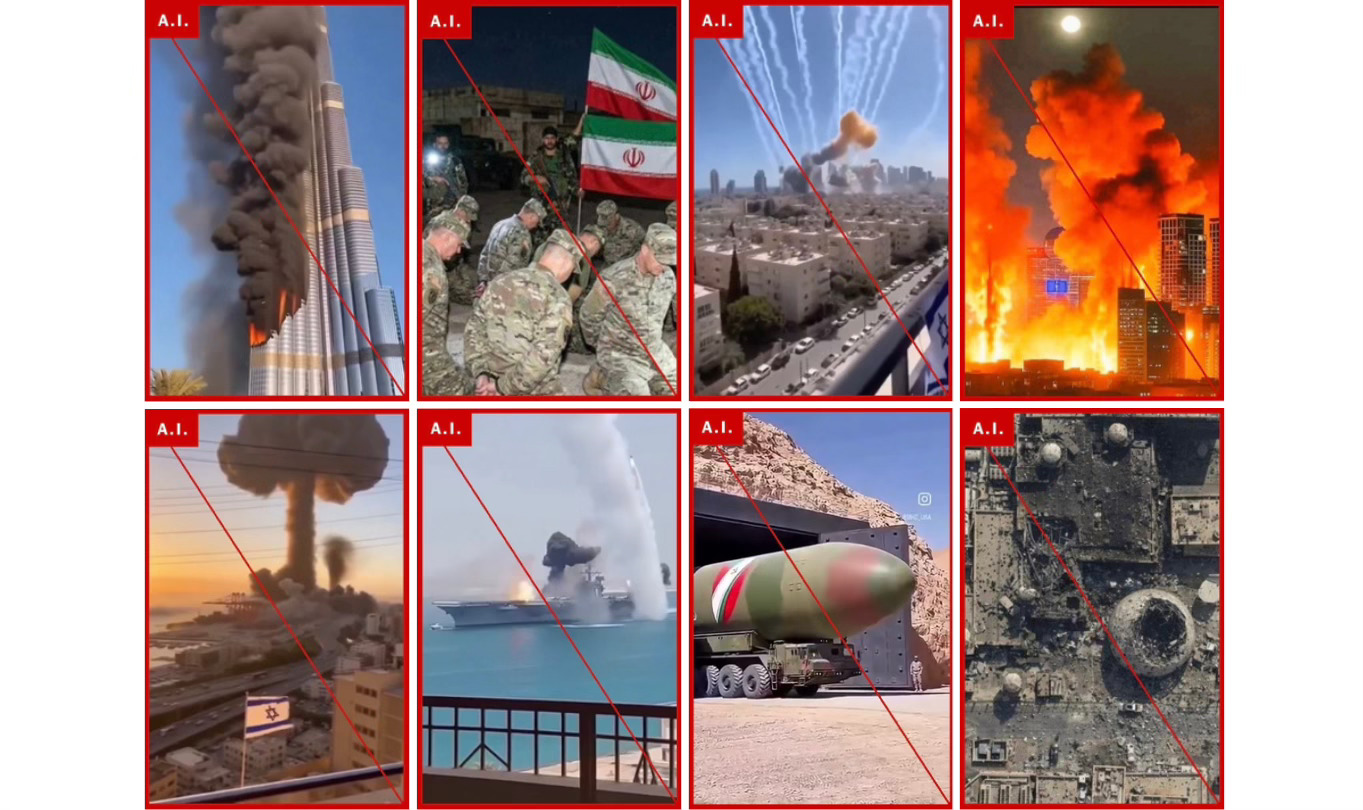
Collectively, they were viewed millions of times across X, TikTok, and Facebook, and countless more times in private messaging apps.
This isn’t ambient noise. Researchers at Cyabra, a social media intelligence firm, found that the majority of AI-generated war content skewed pro-Iranian. It was designed specifically to make the conflict look more devastating than it is, to shake public tolerance for the war, and to project Iranian military strength that doesn’t exist. And it wasn't spreading organically. Cyabra identified a coordinated network of tens of thousands of inauthentic accounts distributing AI-generated footage across TikTok, Facebook, X, and Instagram. The campaign displayed clear markers of coordination, including identical video assets, synchronized posting windows, and repeated hashtag clusters pointing to centralized content production. In under two weeks, that network generated more than 145 million views. To characterize this as just chaos misses the point. This is a highly coordinated online influence operation.
Marc Owen Jones, an associate professor of media analytics at Northwestern University in Qatar, told the Times: compared to when the Ukraine war broke out, AI-generated content in this conflict is operating at a scale we’ve never seen before.
One expert put it more bluntly. Valerie Wirtschafter of the Brookings Institution called it “a tool of war.”
And then there’s Grok, X’s own AI chatbot.
When disinformation researcher Tal Hagin asked the chatbot to verify a video of Iranian missiles supposedly striking Tel Aviv, Grok repeatedly misidentified the location and the date. Then it tried to support its wrong answer by generating its own AI image of the destruction. That’s right: Asked to verify a fake, X’s AI responded by producing another fake.
Hagin put the broader stakes plainly: "AI is now advanced enough to fool journalists," he told WIRED, "and users can create this content with zero consequences. I see us being pushed over the edge of a fact-based world unless we enact change now."
X announced it would temporarily demonetize accounts posting unlabeled AI-generated war footage. It did not say how many accounts had actually been penalized. Many of the Iranian-linked accounts spreading this content, per Cyabra’s research, appeared less interested in revenue than in reach. Demonetization doesn’t stop someone who isn’t in it for the money.
Meta’s own Oversight Board weighed in this week, criticizing the company’s AI labeling approach as “neither robust nor comprehensive enough to handle the scale and speed of AI-generated misinformation, particularly during crises and conflicts.” Meta said it welcomed the findings.
Why This Matters to You
Here’s what makes AI-generated war footage uniquely dangerous: it looks better than the real thing.
Actual verified footage from this conflict is mostly shot from a distance, at night, showing missiles as small points of light and explosions as plumes of smoke. Bystanders often don’t start filming until after impact. It’s chaotic, grainy, and unglamorous.
In contrast, AI footage shows fireballs. Mushroom clouds. Sonic booms rippling across city skylines. It looks like a movie because it was, in a sense, written like one — a text prompt fed into a tool designed to produce the most visually compelling version of whatever you describe. And visually compelling content wins the algorithm. Every time.
What that creates is an alternate reality more dramatic than the actual war — one that spreads faster, reaches further, and shapes public opinion more effectively than the truth.
The infrastructure for this isn’t new. What’s new is the scale, the sophistication, and the speed. AI tools that used to require expertise now require nothing more than a text prompt and a free account. Watermarks — when they exist at all — are trivially easy to remove. Detection tools are inconsistent at best. And platforms, as we’ve now seen clearly, are not going to save you.
What You Can Do
A few concrete things worth knowing:
Real war footage looks nothing like the AI version. If you’re seeing massive fireballs, perfect mushroom clouds, or glowing missile trails, your best defense is to slow down. That’s the AI aesthetic, not the reality of modern warfare.
Blue check marks are not verification. Many of the accounts spreading the most-viewed fakes on X were paying subscribers. The check mark means someone has a credit card, not that their content is accurate.
Check Community Notes before you share, not after. Notes are imperfect and slow, but they’re often the first public correction on viral disinformation.
When a video seems designed to make you feel something strongly — outrage, fear, vindication — that’s precisely when to pause. Emotional response is the point. It’s what makes the content spread.
A Note Before the Next Piece
The scale of AI fakes in this conflict is now documented fact, reported on widely by many outlets and confirmed by researchers across multiple institutions. That context matters, because the next piece goes somewhere harder.
If AI-generated visuals are flooding this conflict at this scale, what does that mean for the specific images coming out of the single most contested moment of this war? A school in Minab, Iran. At least 175 dead, according to the Iranian Red Crescent. Most of them children.
I started looking at that imagery closely. What I found is worth its own conversation.
Part two is now live. Read it here.
In the meantime, if this piece clarified something for you, share it with someone who needs it. The people most vulnerable to this content are the ones who don't know it exists.