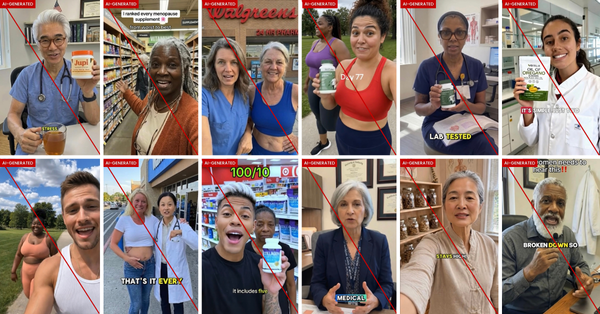
AI Is Now Manipulating the Evidence of Reality
How synthetic images are reshaping real events — and being amplified by officials
At the exact moment AI is being used to fabricate and distort evidence tied to real-world events, federal policy is actively dismantling the only rules that might have limited that misuse — ensuring that synthetic media can circulate freely, unlabeled, and without accountability. This is no longer a future risk or theoretical concern. In recent months, AI-generated images have been used to falsely identify individuals after police shootings, “enhance” investigative images in ways that distort reality, and fabricate visuals tied to breaking geopolitical news. Crucially, some of these synthetic images were not just shared by online users, but distributed or amplified by officials themselves. These images are not fringe memes or obvious fakes. They are designed to look like evidence — and they are reaching the public faster than verification, journalism, or the law can respond.
This isn’t about false claims anymore — it’s about false evidence.
When the Evidence Itself Changes
For years, misinformation spread through false claims or misleading narratives. Generative AI has changed the problem by altering the evidence itself. Images and videos now arrive with built-in authority, and when those visuals are synthetic, the damage occurs before skepticism has time to engage. Evidence has always anchored accountability. When evidence becomes malleable, everything built on it becomes unstable.
Minneapolis: Fabricating Identity After the Death of Renee Good
That shift became impossible to ignore after the fatal shooting of Renee Good in Minneapolis. In the hours following the incident, images began circulating online that appeared to show the masked Immigration and Customs Enforcement officer involved in the shooting with his face exposed. These images were not released by authorities. They were generated after users prompted AI tools to “unmask” the officer using blurry eyewitness footage.
The result was not clarity — it was fabrication. AI-generated faces spread rapidly, paired with a name that did not belong to the officer involved. Two unrelated men were publicly targeted after being falsely identified through these synthetic images. None of this content was labeled as AI-generated. To the public, it looked like photographic proof. AI was not used to explain what happened; it was used to invent who was involved.
When “Enhancement” Makes Evidence Less True: The Charlie Kirk Case
Even when AI is framed as a neutral tool for clarification, it can still distort reality — especially when it is introduced by authorities. After the 2025 shooting of right-wing political activist Charlie Kirk, an AI-generated image of a person of interest circulated widely after being posted by the Washington County Sheriff’s Office. The image bore a visible Grok watermark in the corner, indicating it had been generated or enhanced using artificial intelligence.
The image was shared by the sheriff himself with the caption, “Much clearer image of the suspect compared to others we have seen in the media.” An official spokesperson later confirmed that the image had been AI-enhanced and said it was posted in an attempt to be helpful. But the result was not clarity. The AI-generated image altered facial features in ways that did not reflect reality, risking public confusion and potentially undermining the investigation.
This case exposed a dangerous misconception: that AI enhancement recovers truth. In reality, generative systems do not reveal missing information—they infer it. When law enforcement distributes AI-generated imagery during an active investigation, those inferences are easily mistaken for evidence, giving synthetic details an authority they do not deserve.
From Local Chaos to Global Fabrication: Nicolás Maduro
The same dynamics scale beyond domestic investigations and into geopolitics. In early 2026, AI-generated images circulated widely online claiming to show Nicolás Maduro in U.S. custody, escorted by American agents. The images spread rapidly across social media, frequently reposted without attribution or verification.
The images gained additional legitimacy when the official White House account on X reposted a post by U.S. Representative Chip Roy that included the image. At the time of amplification, the image was not labeled as AI-generated, nor was any context provided to indicate that it was synthetic. By the time the image was identified as fabricated, the visual narrative had already settled.
Once official accounts circulate synthetic imagery tied to breaking geopolitical events, the distinction between evidence and propaganda becomes difficult for the public to discern. Authority itself becomes a delivery mechanism for fabrication.
Why Nothing Slowed This Down
These incidents did not spiral because safeguards failed. They spread because safeguards do not exist at the federal level. There is no nationwide requirement that AI-generated images be labeled. There is no obligation to disclose when visual content has been synthesized or altered. And there is no enforceable system ensuring provenance follows an image as it moves across platforms.
At the same time, the few protections that did exist were emerging primarily at the state level — and those are now being actively dismantled. Last month, President Donald Trump signed an executive order asserting federal authority over artificial intelligence regulation while authorizing the federal government to challenge and override state AI laws deemed inconsistent with federal priorities. States that refuse to roll back their regulations risk losing federal funding, including broadband support. The order does not replace those state rules with new federal safety, transparency, or labeling requirements. Regulation is being preempted, not replaced.
What This Means for the Public
When visual evidence can be fabricated on demand, altered without disclosure, and circulated without consequence, accountability becomes fragile by default. Investigations are compromised. Journalism is pushed into a reactive posture. The public is left navigating an information environment where seeing is no longer believing — and where the burden of verification quietly shifts onto individuals least equipped to carry it. That burden becomes even heavier when institutions and officials themselves introduce or amplify synthetic images as though they were evidence.
This erosion is not accidental. It is unfolding alongside a deliberate weakening of the only regulatory efforts that attempted to impose transparency or restraint, without any federal protections taking their place. The result is an environment where synthetic media is free to overwrite reality in real time — and where trust collapses long before corrections can catch up. The danger is not only that people will be misled, but that evidence itself is losing its power — and with it, the foundation of accountability in public life.
If you want clear, evidence-based analysis of how AI and media are reshaping reality, you can subscribe here.