Altered, Exposed, and Forgotten
What happens when manipulated government images disappear from the news cycle?
You’ve probably noticed a pattern: something disturbing happens, journalists report it, people react, and then it’s gone. Not resolved — just absorbed into the endless scroll. On January 22, 2026, the White House posted a digitally altered image of civil rights attorney Nekima Levy Armstrong being arrested at an ICE protest in Minnesota. In the original photo posted by Homeland Security Secretary Kristi Noem, Armstrong appeared calm and composed. In the version the White House shared 30 minutes later, her face was altered to show her crying, with tears streaming down her cheeks. Her skin also appeared darker.
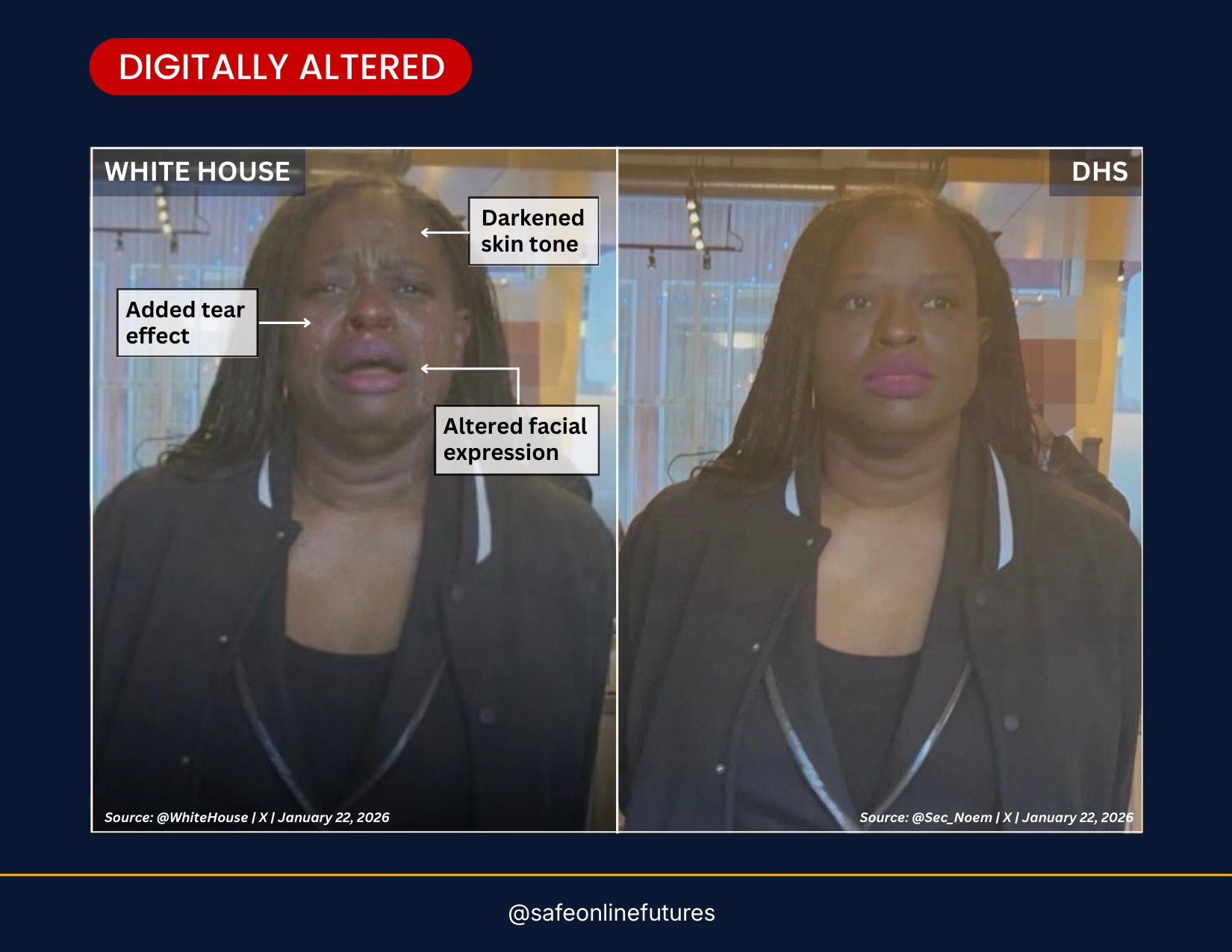
Digital forensics experts confirmed the manipulation. The New York Times ran both images through AI detection systems and found signs of manipulation on Armstrong’s face in the White House version. The Times was able to recreate nearly identical alterations using Google’s Gemini and Elon Musk’s Grok. The White House didn’t deny it. When asked for comment, a deputy communications director responded: “Enforcement of the law will continue. The memes will continue.”
Then the story vanished from the news cycle.
This is what I want you to understand: the danger isn’t just that official government channels are releasing manipulated images to shape public perception of arrests and protests. The danger is that we’re being trained to watch it happen and move on.
The Mechanics of Disappearance
Armstrong was arrested for participating in a peaceful demonstration at a St. Paul church whose pastor protesters identified as an ICE field director. The altered image served a specific function: it reframed her arrest from civil disobedience into emotional weakness. Attorney Jordan Kushner, who was present, told reporters: “She definitely wasn’t crying — she was calm, rational, and dignified.” But the manipulated version circulated on the official White House account to 3.5 million followers. Vice President JD Vance reposted it.
Here’s what happened next: major outlets covered the alteration. Fact-checkers confirmed it. Legal experts raised concerns. And then the conversation shifted to the next controversy. There was no sustained inquiry. No correction in how official images are disclosed or verified going forward. No consequences.
The story didn’t resolve. It dissolved.
What Gets Normalized When Nothing Sticks
Modern news cycles aren’t designed for follow-through. They’re optimized for volume, novelty, and speed. Once a story loses its initial momentum—once it stops generating clicks or outrage — it gets deprioritized regardless of its implications. This creates a structural accountability problem: institutions learn that serious breaches generate only brief scrutiny before fading away.
The lesson internalized isn’t “this crossed a line.” It’s “this passed.”
That recalibration matters because images tied to arrests, protests, and state power aren’t neutral documentation. They predispose judgment. When the White House alters an arrest photo to make someone appear emotionally weak or guilty, it’s not creating a meme—it’s manufacturing evidence of character. The manipulation works on viewers even after it’s been exposed, because the altered version spreads faster and wider than the correction.
Armstrong later told CNN that an FBI agent filming her arrest assured her the footage wouldn’t be posted on social media. “At the time when I questioned the FBI agent about why he was recording, he had a smirk on his face,” she said. “He said, ‘Oh, it’s not going to go on Twitter or anything. I was just asked to record this video.’” Hours later, altered arrest imagery from that day appeared on the White House account.
Ask yourself: who benefits from this pattern? Who gains when altered official images circulate without disclosure, generate brief controversy, and then fade before establishing clear standards about what’s acceptable?
Why Pattern Recognition Matters More Than Outrage
This wasn’t the first time the Trump administration posted AI-manipulated content from official accounts. Digital forensics expert Hany Farid told CBS News: “This is not the first time that the White House has shared AI-manipulated or AI-generated content. This trend is troubling on several levels. Not only are they sharing deceptive content, they are making it increasingly more difficult for the public to trust anything they share with us.”
The pattern is consistent: manipulated images are released, briefly challenged, defended as “memes” or dismissed as unimportant, and then replaced in the news cycle by the next incident. Each instance lowers the threshold for the next because attention moves faster than accountability.
Federal judges later found that prosecutors failed to establish legal grounds for Armstrong’s continued detention. She was released. But by then, the altered image had already done its work — shaping initial perceptions of her arrest, her credibility, her legitimacy as a protester.
What We’re Being Conditioned to Accept
The problem isn’t just that a government agency manipulated an arrest photo. It’s that the manipulation carried no lasting consequence. No change in disclosure standards. No clear articulation of what’s permissible when official images are modified. No durable examination of how such practices should be governed.
This matters because images released by government agencies during arrests function as evidence in the court of public opinion before cases ever reach trial. Subtle alterations — expression, lighting, skin tone — shift perception in ways that are difficult to reverse once the image circulates. When those alterations go unexamined and undisclosed, they quietly set precedent.
You might feel unease without resolution: something important happened, it felt wrong, and then it disappeared. That’s not apathy. That’s the byproduct of a system that offers exposure without closure, controversy without accountability, awareness without change.
Over time, that cycle reshapes what both institutions and the public are conditioned to accept. The boundary between documentation and narrative control erodes — not through policy change or public debate, but through neglect. Through the accumulated weight of forgotten incidents.
Building Resistance Through Recognition
Recognizing this pattern is the first step toward resisting it. When you see a controversial image from an official source, ask:
• Has this been verified by independent sources?
• Who benefits from this framing?
• Did the story fade before establishing clear standards?
Individual awareness connects to collective power when enough people recognize the pattern and refuse to let it normalize. When we demand disclosure. When we remember what institutions hoped we’d forget. When we understand that disappearance isn’t the same as resolution.
The Armstrong case should have triggered an examination of how government agencies handle visual evidence, what disclosure requirements exist, and what happens when officials deliberately manipulate images of arrests. Instead, it followed the familiar arc: initial coverage, minimal explanation, rapid absorption into the next cycle.
That arc is a choice, not an inevitability. News organizations can choose to follow up. Platforms can require disclosure when official accounts post altered images. The public can demand accountability that extends beyond a 48-hour window. Standards can be established and enforced.
But only if we recognize what’s happening and refuse to let it continue.
What Settling Looks Like
The most dangerous stories aren’t the loud ones. They’re the ones that fade. Because when they fade, they don’t disappear — they settle into what institutions believe they can do and what the public is conditioned to accept.
The White House posting a digitally altered arrest photo should have been a breaking point. Instead, it became another data point in an ongoing pattern. In an information environment where visual evidence increasingly shapes how we understand arrests, protests, and state power, institutions are learning they can operate in the gap between what happened and what we’re shown — as long as our attention moves fast enough.
Nekima Levy Armstrong was calm and dignified during her arrest. The White House altered that reality. And now we get to decide whether that matters enough to remember.
For clear, evidence-based analysis of how AI and media are reshaping politics and reality, subscribe here.