Attention Is Now Political Power
Part 6: The Algorithm Fired a General
This is Part 6 of the Attention Is Now Political Power series. New here, start with Part 1 .
On March 25, 2026, a post appeared on X claiming that Defense Secretary Pete Hegseth was “seriously considering” replacing the Army’s top general. The account that posted it holds no government position, no security clearance, and no elected office. The post got one million views.
Nine days later, General Randy George, the Army’s chief of staff, was fired.
If you’ve been following this series, you already know that this is not a story about the person who published the post. The person is a symptom. The system is the disease. What happened to Gen. George is the clearest illustration yet of how far that disease has spread, because this time it didn’t just pollute the information environment or destroy a private citizen’s reputation. This time, it reached into the United States military and removed one of its most accomplished leaders at a moment when the Army is actively modernizing for a new era of warfare.
To understand what was lost, you need to know who Gen. George was and what he was building. He spent decades learning how to keep soldiers alive in places where the rules kept changing. He cut a billion-dollar tank because a five-hundred-dollar drone could destroy it. He invested in AI-powered targeting systems and pushed brigades to experiment in real time with new weapons and new tactics. He led the Army out of one of its worst recruiting crises in a generation. By every institutional measure, he was doing exactly what the job required.
He learned he was being replaced via a 4 p.m. phone call from Hegseth on April 2nd. The tension driving his dismissal, according to the New York Times, was not rooted in substantive disagreements over the direction of the Army. It was the product of long-running grievances, personnel battles, and a social media ecosystem that had been building pressure on Gen. George for weeks.
Which brings us back to that X post. And the one million people who saw it.
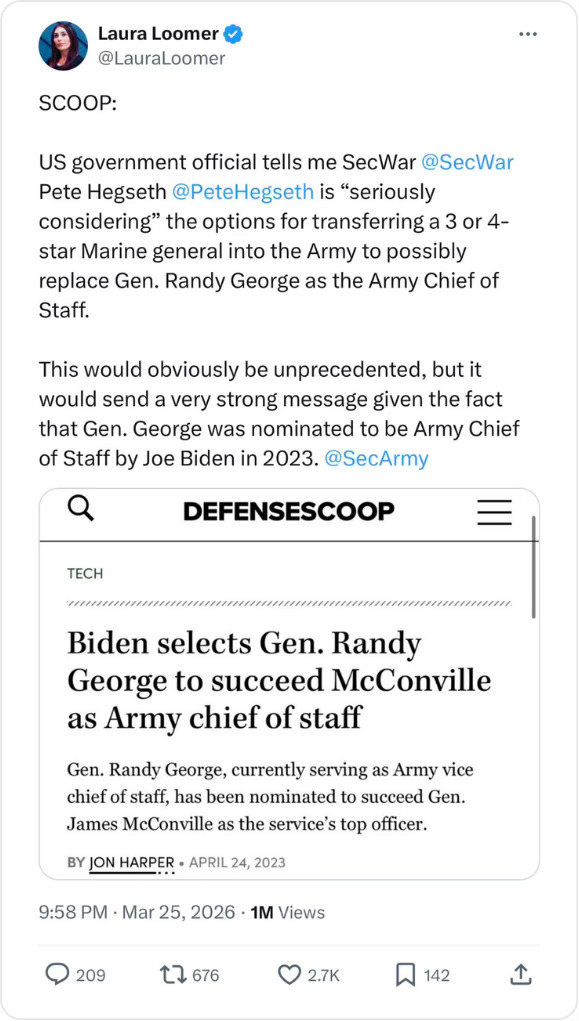
The author of that post is Laura Loomer — a far-right activist and self-described “loyalty enforcer” who holds no government position, no security clearance, and no formal role in the Trump administration. If her name means nothing to you, by the end of this piece you’ll understand exactly how someone you’ve never heard of came to have this much influence over who leads the United States Army. And if it does mean something to you, that recognition is itself evidence of how the system works.
Loomer did not fire Gen. George. But the sequence of events between that March 25th post and the April 2nd phone call is worth paying attention to, because it reveals something about how power actually moves in the current information environment.
The post was framed as a scoop from a “US government official,” carrying the implicit authority of insider access, and distributed on a platform that rewards inflammatory content with reach. It wasn’t published in a newspaper. It wasn’t sourced through an editor. It wasn’t subject to any of the institutional checks that exist, however imperfectly, to separate credible information from speculation. It was a post on X that got one million views because the platform’s engagement model was built to amplify exactly this kind of content — high-stakes, inflammatory, impossible to look away from.
This is what I call the Outrage Pipeline.
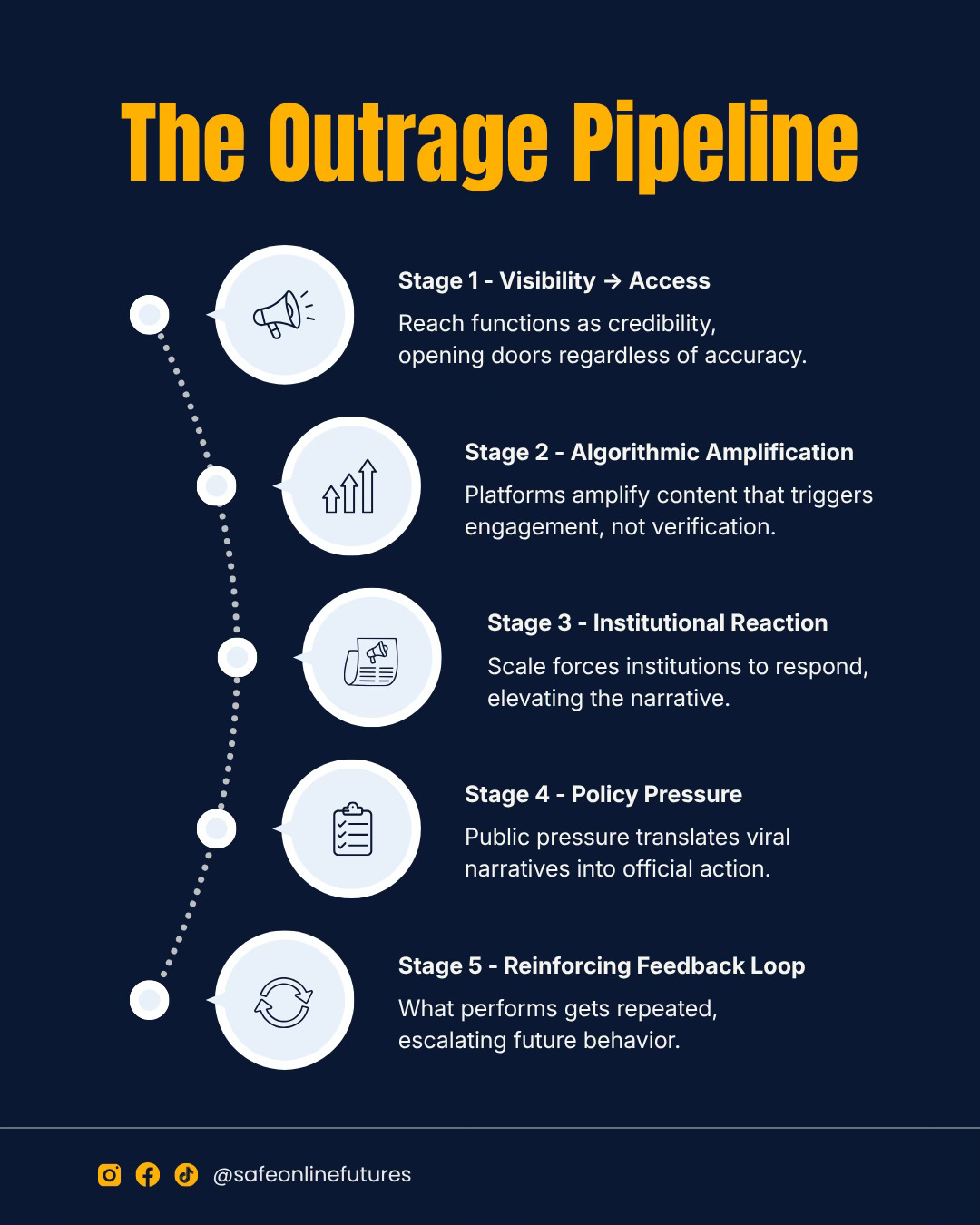
For those new to this series: the Outrage Pipeline is the infrastructure through which inflammatory content moves from a single account, through algorithmic amplification, and into real-world consequence. The pipeline doesn’t require the content to be accurate. It doesn’t require the person posting to have institutional authority. It requires only that the content generate enough engagement to keep moving. One million views is not just a vanity metric. In the current political environment, it is a signal to people in power about what their base is watching, what it’s angry about, and who it has decided to distrust.
Loomer understood this earlier and more deliberately than most. David Gilbert, who covers her for Wired, has described her strategy plainly: she went further than anyone else — more extreme claims, more inflammatory content — specifically to accumulate the reach that would eventually convert into access. The platform didn’t just amplify her voice. It converted her attention into proximity to power. And proximity to power, it turns out, is its own kind of power.
By the time that March 25th post went up, she already had Trump’s cell phone number. She already had a Pentagon press pass. She had already been credited with influencing the removal of more than a dozen government officials across national security, the Justice Department, the FDA, and the CIA. The post about Gen. George didn’t come from nowhere. It came from a system that had spent years rewarding exactly this kind of behavior with exactly this kind of reach.
What makes Gen. George’s firing something other than a one-off political dispute is the paper trail that precedes it. This is not the first time a Loomer post has been followed by an official losing their job. It is not the second time, or the fifth. At this point it is a documented, timestamped pattern that spans more than a year and reaches across some of the most consequential institutions in the federal government.
In March 2025, Adam Schleifer, an assistant U.S. attorney in Los Angeles, was fired exactly one hour after Loomer posted about him on X. One hour. No investigation, no process, no public explanation. A post, then a firing.
The following month, she walked into the Oval Office with a dossier of what she called opposition research and presented it directly to President Trump, with the Vice President, the Chief of Staff, the National Security Adviser, and the director of the Presidential Personnel Office in the room. Six National Security Council officials were fired in the aftermath.
By summer, the pattern had extended further. In May, Trump withdrew the nomination of his surgeon general pick after Loomer criticized her publicly. In July, she took credit for the firing of a Justice Department official after what she described as a two-month pressure campaign on Attorney General Pam Bondi. Later that month, the general counsel of the National Security Agency was fired after Loomer retweeted an article attacking her. In late July, the director of a key FDA division was dismissed despite opposition from both the HHS Secretary and the FDA Commissioner — after Loomer called for his removal.
By November, she had been granted a Pentagon press pass.
Her name, at this point, has become a verb. To be ”Loomered” means to be fired or otherwise damaged for alleged disloyalty — not to the Constitution, not to the institution you serve, but to the president. She has described her own role as similar to Joseph McCarthy, the anti-communist senator whose name became synonymous with politically motivated persecution. Inside the administration, people who are wary of her influence have called her a ”one-person wrecking crew.” One Trump adviser, speaking anonymously to CNN, put it more simply: “She’s a loose cannon. But she has a following. It is what it is.”
That quote is the whole story. Not the person. The following. The platform that built it. The algorithm that rewarded it. The system that converted it into institutional power over who leads the United States Army.
There is a legitimate counterpoint that deserves to be made.
Hegseth did not need Loomer to dislike Gen. George. The New York Times reported that the tension between them was longstanding. It was rooted in his grievances over personnel decisions and his battles with Army Secretary Daniel Driscoll. It also stemmed from Hegseth’s highly unusual decision to block the promotion of four Army officers from a list of thirty-three — two of whom are Black and two of whom are women, in a group consisting mostly of white men. Gen. George and Secretary Driscoll had refused to remove those officers, citing their exemplary service records. Hegseth had refused to even meet with Gen. George to discuss it. The friction was real, it was documented, and it predated any social media post.
There is also the broader context of an administration that has been systematically purging officials it views as insufficiently loyal since its first days in office. Gen. George was appointed by President Joe Biden. He had a close relationship with former Defense Secretary Lloyd Austin. In this administration, that biography alone is enough to make you a target. Loomer or no Loomer, Gen. George may well have been removed eventually.
But it doesn’t explain why a post from an unelected activist with no security clearance got one million views and functioned, in the words of multiple sources, as a pressure campaign that reached all the way to the Pentagon. It doesn’t explain why the timing — post, then firing — has repeated itself so many times across so many institutions that her name became a verb. And it doesn’t explain the most important thing: even if Hegseth was going to fire Gen. George eventually, the system we’re living in allowed an algorithmically amplified social media account to accelerate that outcome, shape its public framing, and signal to everyone watching that this is how power works now.
If Loomer’s influence only works because it aligns with what people in power already want to do, then what the Outrage Pipeline has built is not a rogue actor with outsized power — it’s an accountability-free accelerant. A way to do politically convenient things while the algorithm absorbs the attribution. That is not a more comforting conclusion. It is a more alarming one.
Here is the part where this stops being about them and starts being about us.
That number — one million views — did not happen by accident, and it did not happen in a vacuum. It happened because a platform built to maximize engagement served that content to people who clicked on it, lingered on it, shared it, and argued about it — and then served it to more people because of those responses. The algorithm does not distinguish between engagement driven by agreement and engagement driven by outrage. It counts all of it. It rewards all of it. And every person who interacted with that post, for any reason, contributed to the signal that told the platform to keep amplifying it.
This is not an accusation. Most of the people who saw that post were not Loomer supporters. Many of them encountered it precisely because the algorithm decided their outrage, curiosity, or disagreement was just as valuable as anyone's approval. The Outrage Pipeline was not designed to require your agreement. It was designed to require only your attention. And attention, as this series has argued from the beginning, is now political power.
You are on these platforms. So am I. We are not passive observers of a system that operates somewhere above us. We are participants in the infrastructure that made this possible. The views that preceded a general’s firing were not generated by one million true believers. They were generated by one million people doing what the platform was designed to make them do: stop scrolling, look, react, engage. The platform monetized that attention. The reach that resulted gave an unelected activist with no formal authority a credible claim to influence over United States military leadership.
That is the system. And the system is not going to change itself.
We are approaching a midterm election cycle in which Big Tech accountability is on the table as a concrete political issue, not an abstract one. The platforms that made this possible are not going to regulate themselves. We have watched them dismantle their own content moderation systems, abandon their own safety commitments, and consolidate political relationships with the current administration that make meaningful self-regulation even less likely than it was before. The evidence is not ambiguous at this point. The only external pressure that has ever moved platforms to change their behavior in any durable way has come from the threat — or the reality — of government accountability.
Which means the people who write the rules matter. Enormously. There are candidates at the federal level who understand that algorithmic regulation is a national security issue — because Gen. George’s firing is evidence that it is. There are candidates who don’t. That difference is worth knowing, and worth voting on.
I am not telling you who to vote for. I am telling you that the infrastructure behind this story was built by companies whose business model depends on regulatory inaction, and that regulatory inaction is a policy choice made by people you can vote out of office.
The algorithm fired a general. The question is whether we’re going to let it keep going.
This is part of an ongoing series on how attention becomes power — and what it will take to change the system that makes it possible. If you think algorithmic regulation should be a ballot issue, share this piece with someone who needs to read it.