Attention Is Now Political Power
Part 2: How the System Manufactures Influencers
If you’re looking for villains, this isn’t that piece.
What follows is not a story about belief, ideology, or even persuasion. It’s a story about incentives — and what happens when a system reliably rewards the same behavior, over and over again.
In the online attention economy, outrage is not a side effect. It is the product. Platforms elevate content that provokes emotion, accelerates engagement, and keeps audiences reacting. Accuracy is optional. Context is friction. And verification, when it arrives at all, usually comes too late to matter.
So when influencers rise by spreading unverified claims or conspiracy-laced narratives, the question isn’t why they do it. The question is why the system keeps selecting them.
This essay examines that selection process. How attention turns into legitimacy. How legitimacy turns into access. And how access turns into real-world power. Once the mechanics are visible, individual personalities stop looking exceptional — and start looking inevitable.
This is the machine. Here’s how it works.
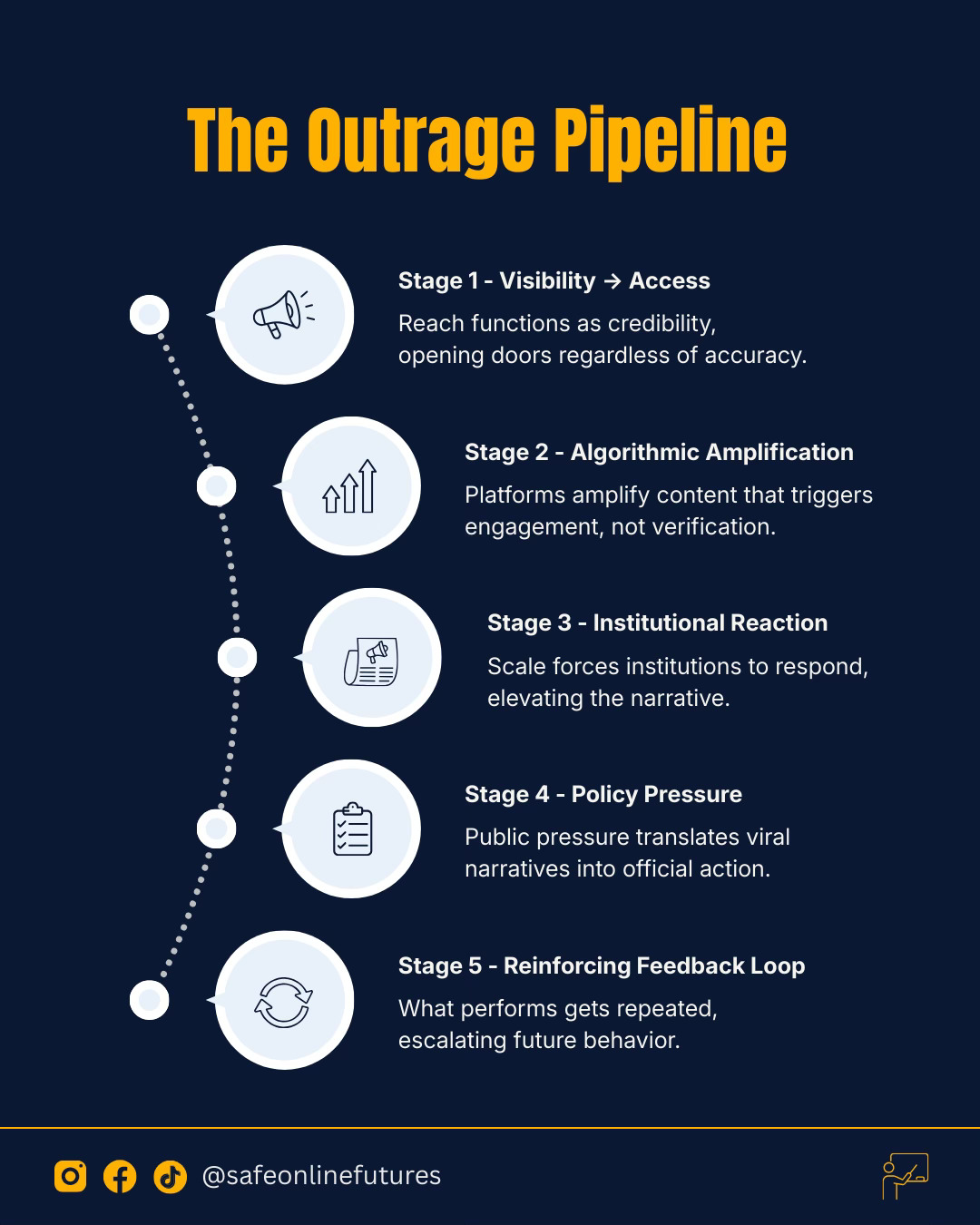
Stage 1 — Access
Influencers gain access not by demonstrating accuracy, expertise, or accountability, but by demonstrating reach.
In an attention-driven system, visibility functions as credibility. Proximity to power is granted to those who can reliably command an audience, regardless of how that audience was assembled or what claims brought it together.
Access confers legitimacy without verification. It turns an online personality into a “relevant actor.” It signals to audiences that this person matters — that they are close to power, in the room, worth listening to. Once access is obtained, or even publicly implied, skepticism drops and authority rises.
Access is not a reward for being right. It is a reward for being seen.
Stage 2 — Amplification
Platform algorithms amplify content that generates engagement, not content that withstands scrutiny.
Outrage, fear, and grievance reliably produce faster reactions, longer watch times, and higher sharing rates — signals the system interprets as value.
Emotion outperforms nuance. Repetition outperforms correction. Context slows distribution.
As a result, the most inflammatory framing is consistently rewarded with wider reach. Over time, creators learn — quickly and efficiently — what kinds of claims travel farthest and which ones stall.
Truth is not a ranking signal. Engagement is.
Stage 3 — Institutional Response
Institutions respond to scale, not accuracy, because scale creates pressure. When viral narratives reach a certain threshold, government agencies, public officials, and media organizations are compelled to address them — whether to deny, contextualize, or “set the record straight.”
But in a high-velocity information environment, response itself functions as elevation. To audiences, being addressed reads as being important. Rebuttal becomes relevance. Attention from institutions — regardless of intent — can be converted into perceived validation.
The attempt to contain a claim often ends up confirming its significance.
Stage 4 — Policy Consequences
Viral narratives shape policy environments by making inaction costly.
As public agitation intensifies, institutions face mounting pressure to demonstrate responsiveness. That pressure can produce statements, hearings, enforcement gestures, or symbolic actions designed to show control — even when underlying claims remain unverified.
Policy does not move because a claim is accurate. It moves because ignoring it becomes politically or reputationally untenable.
At this stage, influencer content crosses a threshold: it is no longer just media. It becomes input into institutional decision-making.
Stage 5 — Feedback Loops
Each successful cycle trains both the influencer and the platform.
Creators learn which emotional triggers produce the greatest reach and escalate accordingly. Platforms reinforce these patterns by continuing to distribute high-engagement content at scale.
The loop closes, then accelerates. Escalation becomes necessary to maintain visibility. Correction becomes irrelevant. Extremity becomes normalized — not because it is persuasive, but because it performs.
The system does not self-correct. It compounds.
The System, Not the Exception
Taken together, these stages describe a closed loop, not a series of accidents.
This is not a failure of individual judgment alone. It is a structural outcome of platforms designed to monetize attention while remaining legally insulated from the consequences of amplification.
Calling this a “misinformation problem” understates what is happening. This is a power problem — one in which unverified claims are routinely routed into legitimacy, access, and institutional impact.
What Comes Next
By now, the pattern should be clear.
Influencers who traffic in unverified claims do not gain influence because they are persuasive or insightful. They gain influence because they are optimized for a system that rewards emotional activation and treats engagement as importance.
This is not about a handful of bad actors. It is about a machine that reliably produces the same results when fed the same inputs. A system that monetizes outrage, shields amplification from liability, and converts reaction into relevance will continue to elevate the people most willing to exploit it.
The next step is to stop discussing this in the abstract.
In the essays that follow, I’ll apply this framework to specific influencers — not to debate their beliefs or speculate about motives, but to show, concretely, how this system operates in the real world. Same incentives. Same stages. Same outcomes.
Once you see the pattern play out in practice, it becomes much harder to dismiss — and much harder to ignore.
This is part of an ongoing series examining how attention becomes power in the modern information system.