Attention Is Now Political Power
Part 4: Nick Sortor and the Outrage Pipeline
Editor's note: This piece is one of two case studies examining how the Outrage Pipeline operates in practice. Part 5 of this series draws the larger conclusion.
In January 2026, Nick Sortor posted a video on X which he claimed showed “anti-ICE rioters SURROUNDING my vehicle, smashing my windows, and attempting to kiII” him and fellow right-wing influencer Cam Higby. He framed the incident as proof that he was under attack — not just personally, but as a journalist operating on the front lines of a national conflict.
The footage spread quickly. Within hours, it moved beyond Sortor’s account and into partisan media spaces, where it was treated as evidence that “independent journalists” were being targeted. Little effort was made to verify what happened. The visuals were treated as sufficient on their own.
This is where authority is claimed.
This essay does not attempt to determine whether the incident occurred exactly as Sortor described, or whether any individual clip was fabricated. It examines how moments like this — emotionally charged, visually compelling, and rapidly shared — are converted into credibility, and how that credibility is then used to shape political and federal action.
Sortor is a full-time content producer operating inside a system where influencer footage regularly migrates into partisan media and is echoed by political actors. In that environment, video is no longer just documentation. It becomes leverage.
This case study applies the Outrage Pipeline framework to Sortor’s content specifically, showing how authority is built through repetition, monetization, amplification, and proximity to power.
What follows traces how that initial claim of authority does not remain personal, but moves outward — first through media systems, then into federal response, and finally into policy justification.
A Pattern, Not a One-Off
The Minneapolis incident follows a pattern Sortor has repeated across multiple cities, including Portland and Chicago.
The structure is consistent: a volatile encounter is captured on video; the footage is framed as proof that Sortor is under threat; the clip spreads rapidly with little context; skepticism is discouraged; and the video itself is positioned as the final word.
What changes over time is intensity. Language escalates. Stakes rise. Repetition replaces verification. The audience is trained not to ask what happened, but what the footage proves about who Sortor is — and who his opponents are.
That structure is not accidental. It is the entry point of the Outrage Pipeline.
Stage One: Provocation
How Video Becomes “Proof”
Stage One is about trust.
Point-of-view footage places the audience inside the moment and encourages them to adopt Sortor’s perspective. The message is simple: I was there. You can see it yourself.
Sortor’s self-branding as an “independent journalist” matters here. The framing relies on immediacy, not editorial oversight. Because the footage feels raw and firsthand, it is treated as neutral — even when embedded in a partisan narrative.
This is also where visual scrutiny matters most.
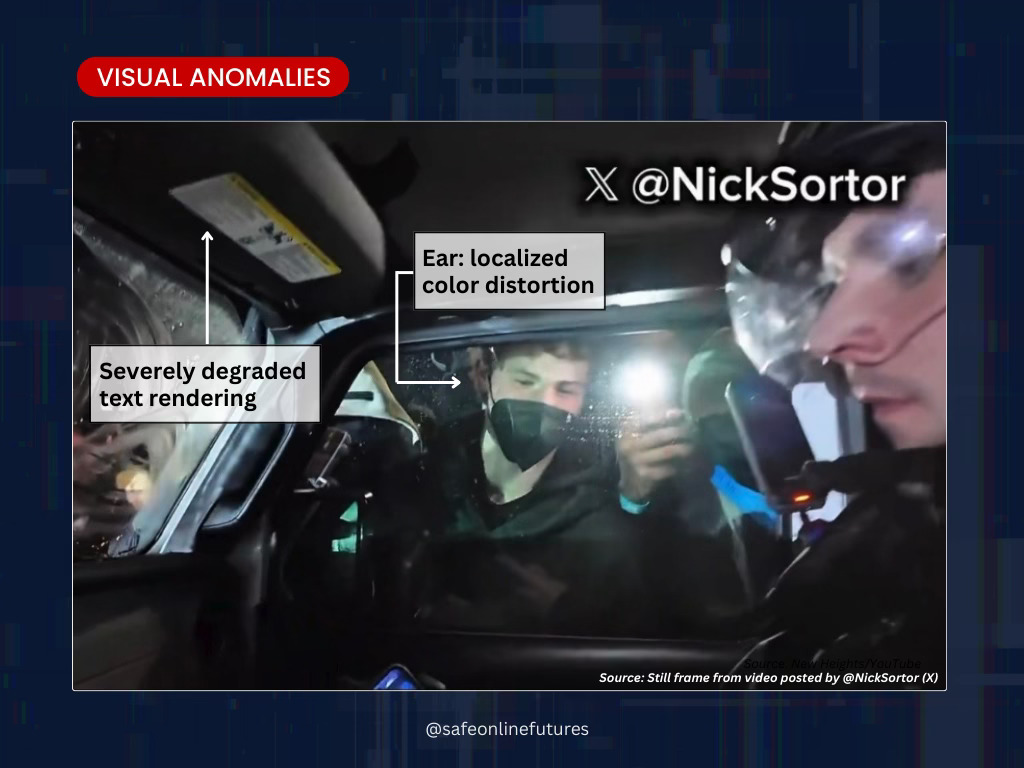
Some frames, circulated after the incident by Sortor, contain visible irregularities — protesters with blurred and distorted facial features, warped hands, and blurred visor warning label text that complicate the assumption that the visuals should be accepted without question. These anomalies do not prove fabrication. They do, however, introduce uncertainty, as such artifacts can arise from compression, AI-assisted enhancement, or partially AI-generated media — distinctions that cannot be resolved from circulated frames alone.
That uncertainty is never addressed.
Speed matters more than clarity. Once sharing begins, unresolved questions are treated as distractions and requests for verification are framed as hostility.
By the end of Stage One, the audience is no longer evaluating footage. They are deciding who to trust.
Once trust is established at the visual level, the footage no longer needs to withstand scrutiny. It only needs to circulate. At that point, the question is no longer whether the content is accurate, but how far it will travel.
Stage Two: Amplification
How Sortor’s Content Becomes Evidence
Sortor’s Minneapolis footage did not spread because it was verified. It spread because it was useful.
Clips he filmed were rapidly reposted by larger partisan accounts and media figures, circulating across X, Telegram, YouTube, and cable news. The same images were repeated with stronger language, framed as proof that Minneapolis was lawless and federal agents were under attack.
Nothing new was added.
As reporting has shown, short clips from right-wing creators in Minnesota, including Sortor, became primary evidence used to justify ICE’s surge into American cities. Influencer footage filled the gap before official investigations could catch up.
This stage is shaped by monetization.
Sortor’s content exists in a system that rewards engagement. Confrontation and danger perform better than restraint or context. This does not necessarily mean incidents are staged. It means there is continuous pressure to frame events in ways that maximize attention. In this system, outrage is profitable.
By the end of Stage Two, Sortor’s footage no longer functions as personal documentation. It becomes shared proof.
Amplification alone does not create power. What matters is who responds. When influencer content begins to trigger action from institutions with formal authority, repetition hardens into something else entirely.
Stage Three: Normalization
When State Response Makes the Narrative Feel Settled
Stage Three is where amplification begins to feel like confirmation.
After Sortor’s October 2025 arrest in Portland, he posted video of the incident and framed it as political persecution — not a routine arrest, but an example of a conservative journalist being targeted by local authorities. That framing did not remain confined to social media. It was followed by a rapid and visible federal response.
The U.S. Department of Justice launched a Civil Rights investigation into the Portland Police Bureau, examining whether officers engaged in viewpoint discrimination. Federal officials requested documentation and body-camera footage. The Trump administration publicly reviewed federal aid to Portland and signaled the possible deployment of additional federal agents.
These actions did not follow a judicial finding of misconduct. Local prosecutors had already stated police had probable cause for the arrest, even as they declined to pursue charges. The federal response followed Sortor’s content — and, crucially, his framing of it.
This pattern has repeated. Sortor’s posts have been boosted by senior administration figures, including Stephen Miller, the White House deputy chief of staff for policy and homeland security advisor. He has received public support from the White House, attended an influencer roundtable, and posted a personally addressed letter from Donald Trump praising him as a “social media warrior.”
At this stage, the effect is normalization. When federal institutions respond as if an influencer’s narrative already carries weight, that narrative begins to feel settled. The question is no longer whether Sortor should be taken seriously, but why anyone would doubt him.
Stage Four: Legitimization
When Escalation Feels Reasonable
Once state institutions respond as if an influencer’s narrative is credible, the frame itself becomes legitimate.
In Minneapolis, Sortor framed protesters as violent criminals and federal agents as under siege. He celebrated pepper spraying and arrests, mocked injured protesters, and praised escalation. He has also repeatedly called for the Insurrection Act and for troops to be deployed in American cities.
What matters here is not just what Sortor said, but how it was received. His framing was no longer treated as partisan commentary. It functioned as an authoritative interpretation of events, one that made force feel justified and restraint feel naive.
Context fell away. Videos showing only moments of force circulated as sufficient evidence. Questions about what preceded those moments were dismissed. Skepticism was reframed as hostility.
This is what legitimization looks like. Escalation does not arrive as a radical proposal. It arrives as common sense. Federal power is no longer something to question; it is something to endorse.
At that point, belief gives way to action.
Stage Five: Power Translation
When Content Justifies Federal Action
At Stage Five, the narrative is no longer just accepted. It is used.
Influencer footage, including Sortor’s, did not merely comment on ICE activity in Minneapolis. It circulated as proof that conditions required a forceful federal response. Clips were treated as evidence that escalation was necessary, not political.
Federal agencies have since moved to formalize this dynamic. ICE has announced plans to spend significant sums on influencer partnerships and targeted advertising, effectively embedding content creators into the enforcement narrative itself.
By the time federal action occurs — agents deployed, investigations launched, funding threatened — the narrative groundwork has already been laid. The public has been prepared to accept escalation as response rather than choice.
At this point, accuracy matters less than readiness. The system no longer asks whether the story is true. It asks whether it is useful.
This is the final conversion point of the Outrage Pipeline. Attention becomes leverage. Visibility becomes power.
What This Case Shows
This case shows what happens after an influencer crosses from attention into consequence.
Nick Sortor’s content illustrates how visibility, once normalized and legitimized, can shape federal response in real time. Influencer footage is treated as evidence before facts are settled. Amplification replaces verification. Monetization rewards escalation. State response follows visibility.
This does not require conspiracy. It relies on incentives.
Sortor is not an anomaly. He is a clear example of what happens when influencer media, partisan amplification, and federal enforcement converge.
This is what it looks like when attention becomes political power.
This is part of an ongoing series examining how attention becomes power in the modern information system.
Related Reading:
The Portland Playbook
When Influencers Become the Press