Attention Is Now Political Power
Part 7: What you watched wasn't a conservative revolt. It was a content cycle.
This is Part 7 of the Attention Is Now Political Power series. New here, start with Part 1.
On Easter Sunday, April 5th, 2026, the President of the United States posted the following on Truth Social:
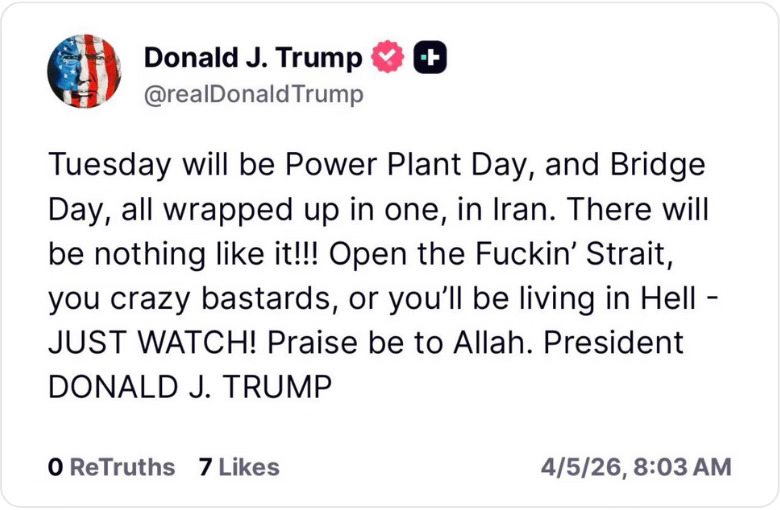
The post went up at 8:03 a.m. Church services were starting across the country. The Strait of Hormuz, the narrow waterway through which roughly a fifth of the world’s oil and natural gas normally passes, had been effectively closed since late February, when the United States and Israel launched a military campaign against Iran. Thousands of people were already dead. Global energy prices had been rising for weeks. Two U.S. airmen had been shot down inside Iranian territory two days earlier, and rescue operations were still underway in the mountains where one of them had gone down.
None of that context traveled with the post.
What traveled was the post itself: the expletives, the deadline, the “Praise be to Allah” sign-off that read simultaneously as mockery and provocation. It moved through feeds the way content moves when the algorithm decides it has found something too inflammatory to stop. By the time most people encountered the post, it had already been screenshotted, quote-tweeted, clipped, captioned, and redistributed across every major platform. The engagement numbers climbed. The outrage infrastructure did what it was built to do.
Two days later, on Tuesday morning, before his self-imposed 8 p.m. deadline for Iran to reopen the strait or face large-scale strikes on its civilian infrastructure, Trump posted again:
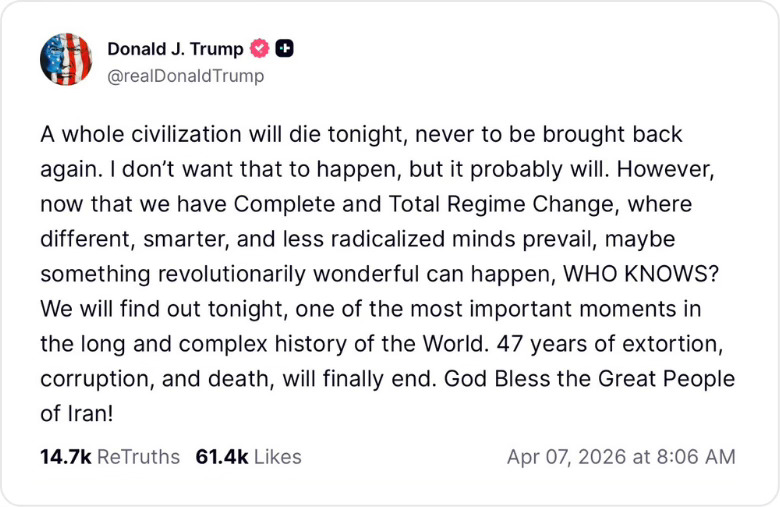
By that evening, a two-week ceasefire had been announced, also via Truth Social.
Most people experienced these three days as a series of alarming posts. What they were also watching, without knowing it, was something else entirely.
The people who responded fastest were not journalists. They were not foreign policy analysts or members of congressional armed services committees. They were the most sophisticated operators in the attention economy — men and women who had built audiences in the millions by understanding, earlier and more deliberately than almost anyone else, exactly how the system they lived inside actually worked.
Tucker Carlson, fired from Fox News in 2023, had built a media operation with one of the largest audiences in political media. Megyn Kelly, a former Fox News host, had been fired from NBC and rebuilt herself as an independent podcaster with a loyal following large enough to make her show a significant commercial enterprise. Candace Owens, one of the most prominent pro-Trump commentators of the past decade, had turned a series of provocative political pivots into a personal brand worth millions. Alex Jones, the conspiracy theorist and Infowars founder, had survived de-platforming, a $1.5 billion defamation judgment, and a bankruptcy filing, and was still broadcasting to an audience of millions. These are not accidental audiences. You do not accumulate millions of followers without understanding the infrastructure that delivers them to you. They are good at their jobs. And their jobs, fundamentally, are about one thing: capturing and holding attention at scale.
When Trump’s Easter Sunday post landed in their feeds, they recognized something.
Not necessarily a moral emergency — though it may have been that too. What they recognized, whether consciously or not, was a high-value moment. A viral object of enormous reach, generating outrage across the ideological spectrum, attached to a news cycle that was already dominating every platform simultaneously. And they recognized something else: that their existing position — loyalty to Trump, defense of his administration, amplification of his brand — was, in this particular moment, the low-value position. The algorithm does not reward loyalty. It rewards novelty, conflict, and surprise. And nothing in the attention economy is more surprising than a pivot.
Carlson moved first. In a video posted to X, he addressed not his audience but the people inside the Trump administration directly. “Now it’s time to say no, absolutely not,” he said, “and say it directly to the President: No.” He described Trump’s threats as “evil” and called on administration officials to stand up to him. The framing was deliberate — not a political attack, but a moral intervention, addressed to insiders, delivered in public. It was engineered to travel, and it did.
Kelly followed on her weekly podcast, The Megyn Kelly Show. “I don’t know about you, but I am sick of this shit,” she said. “I’m just — I’m sick of it. Can’t he just behave like a normal human?” The clip moved immediately. The combination of exhaustion, profanity, and the specific register of someone who had been defending this man for years and had simply had enough — it was, whether by instinct or design, exactly what the moment required to generate maximum engagement.
Jones, on air, said Trump sounded “like an unhinged super villain from a Marvel comic movie.” He later posted a video in which he asked, plainly, “How do we 25th Amendment his ass?” And in a separate post: “That is the definition of genocide.”
Owens was more surgical. “The 25th amendment needs to be invoked,” she wrote on X. “He is a genocidal lunatic. We are beyond madness.”
The posts compounded each other. Each new reaction from a former ally became the raw material for the next cycle of coverage. Cable news ran segments on the conservative revolt. X’s algorithm surfaced the conflict to users who had never followed any of the four accounts. YouTube clipped and redistributed the videos. The story was no longer about what Trump had threatened to do to Iran. The story was about the fracture — “loyal MAGA allies turn on Trump” — and that story was significantly more algorithmically valuable than the underlying one.
This is not a coincidence. It is how the system works. And these four people knew it.
On Thursday, April 9th, Trump responded.
Not to Iran. Not to the diplomatic negotiations still unfolding around the ceasefire. To them.
In a 482-word Truth Social post, the President of the United States attacked Tucker Carlson, Megyn Kelly, Candace Owens, and Alex Jones by name, in starkly personal terms. “They have one thing in common, Low IQs,” he wrote of the four. “They’re stupid people, they know it, their families know it, and everyone else knows it, too!” He described Carlson as a “broken man” who had “never been the same” since his firing from Fox News in 2023. He revived a decade-old feud with Kelly over a question she had asked him during a 2015 debate about statements he had made about women, writing that she had treated him “nastily.” He commented on Owens’ appearance. He said Jones “says some of the dumbest things.”
Trump also said, in the same post, that nobody was talking about them.
That contradiction, 482 words devoted to people nobody is talking about, exposes something important about how this system operates even at its highest levels. Trump is, by any measure, the most sophisticated attention economy operator in the history of American politics. He knows reach, he knows provocation, and he knows that naming someone is the fastest way to hand them an audience. He knew exactly what he was doing when he wrote that post. And he did it anyway — because the loop required it, because the narrative “Trump attacks former allies” was the next cycle of content the system was waiting to produce, and the system rewarded participation from everyone involved, including him.
The responses came immediately.
Owens posted an 11-word statement: “It may be time to put Grandpa up in a home.” Eleven words. No policy argument, no elaboration, no context. Pure engagement engineering. The kind of response that takes thirty seconds to write and generates hours of downstream coverage.
Jones said in a video that he “supported the old Trump that got so many good things done” and that he “just felt sorry for him.” The framing of pity — not anger, not betrayal, but sorrow — was its own kind of provocation. It positioned Jones as the reasonable one.
Trump himself, in the same post where he attacked them, complained that news outlets were paying too much attention to Jones and Owens, giving them “positive press for the first time in their lives.” He was narrating the mechanism of the loop he was actively participating in. He saw it. He named it. He fed it anyway.
That detail is the most revealing thing in this entire story. Because it means no one in this cycle — not the operators, not the president, not the platforms — was confused about what was happening. They all understood the transaction. They all participated. And the attention kept compounding, exactly as the system was designed to ensure it would.
What you watched was a transaction. The currency was attention. The product was engagement. The infrastructure that processed it — Truth Social, X, YouTube, podcast platforms, the algorithmic recommendation systems running underneath all of them — was indifferent to the underlying reality. It did not distinguish between a post threatening to destroy a civilization and a post calling a podcaster stupid. It did not distinguish between a former ally’s genuine moral alarm and a former ally’s calculated brand pivot. It counted the engagement, it rewarded the reach, and it served more of whatever was generating the most heat to the most people. This is the attention economy. Not as a metaphor. As a business model.
Jones, Owens, Carlson, and Kelly had each built something that functioned less like a media career and more like an attention economy business — and attention economy businesses run on a single operating principle: relevance is not a fixed state. It is something you have to keep earning, cycle by cycle, news event by news event, outrage moment by outrage moment. Loyalty to any position, including loyalty to a president, is only valuable as long as it keeps generating engagement. The moment loyalty becomes the expected, the predictable, the unremarkable thing, it stops feeding the algorithm. And when something stops feeding the algorithm, the algorithm stops feeding you.
Trump’s Easter Sunday post handed each of them the same thing: a moment of maximum cultural salience attached to a position that was rapidly becoming the low-engagement choice. The people defending him were invisible. The people breaking with him were everywhere. The algorithm was already showing them the data in real time. They are professionals. They read those signals for a living. Whether any of them also meant what they said is a question this piece cannot answer, because the architecture of the attention economy is specifically designed to make that question unanswerable. Genuine moral conviction and calculated brand positioning look exactly the same in a feed. The infrastructure does not require sincerity. It requires only participation.
This is not a malfunction. This is the system working exactly as designed, by platforms whose business model depends on keeping every participant, including the ones who hate each other, inside the loop.
The next time a prominent figure you have spent years watching defend a position suddenly abandons it in public — loudly, emotionally, and in the middle of a high-stakes news cycle — pause before you share it. Not because they are necessarily wrong. Not because the underlying issue doesn’t deserve your attention. But because the system that delivered that pivot to your feed was not designed to help you evaluate it. It was designed to make you react to it. And your reaction, whatever form it takes — agreement, outrage, mockery, relief — is the product the platform is selling.
Carlson’s video is not the war. Owens’ eleven words are not a policy position. These are content events, produced by attention economy professionals, optimized for the infrastructure that rewards them, delivered to your phone by an algorithm that does not know or care about the difference between information and engagement. The infrastructure doesn’t traffic in genuine feeling. It traffics in reach.
What happened across those three days in April was not a conservative revolt. It was not a moral awakening. It may have been both of those things somewhere underneath but in reality it was a loop. Trump posted. The operators pivoted. The algorithm amplified. Trump responded. The operators responded. The engagement compounded. And somewhere in the middle of all of it, an active war with thousands of casualties became the backdrop for a content cycle that generated more heat than any single piece of reporting on what was actually happening on the ground in Iran.
That is the transaction you were inside. Knowing you were inside it does not make you immune to the next one. But it is the only starting point that matters.
This series has argued from the beginning that attention is now political power. That the infrastructure determining what you see, what you share, and what you believe deserves the same scrutiny we apply to any other system that shapes democratic life. The platforms that made this loop possible are not going to dismantle it. The operators who profit from it are not going to explain it. The algorithm is not going to pause and give you a moment to think.
That pause is yours to take. And what you do with it — who you listen to, what you amplify, whose signals you refuse to feed — is, in the current information environment, a political act whether you intend it to be or not.
The loop keeps running as long as everyone stays inside it.
This is part of an ongoing series on how attention becomes power — and what it will take to change the system that makes it possible. If you think the infrastructure behind your feed is a political issue, share this piece with someone who needs to read it.