Big Tech Is Building More Than a Ballroom
The same companies that shape your screen are now shaping state power.
Big Tech’s fingerprints are all over Trump’s latest project. What they’re building together goes far beyond architecture.
When Trump ordered the demolition of the White House’s East Wing, the outrage was instant and loud. The East Wing, home to decades of history, First Ladies’ offices, and public tours, was being ripped apart to make room for a $300 million “grand ballroom” designed in Trump’s image.
Marble dust rising from the rubble. Gold renderings circulating online. A leader rebuilding the symbol of American power in his own style.
What looks like construction is really consolidation — the merging of political power with the corporate systems that decide what Americans see and believe.
The Outrage Was Always Part of the Plan
The headlines did exactly what you’d expect: Trump Destroys East Wing! White House Heritage Erased! Social feeds filled with fury. Outrage drives clicks, and Trump has always understood that outrage is a weapon. Keep the public emotionally fixated on spectacle, and they won’t look at what’s happening in the background.
Outrage doesn’t just distract — it programs. The more often you see a story framed a certain way, the more your brain accepts that framing as truth. That’s the illusion of truth: familiarity feels factual.
While people argued about aesthetics and ego, the donor list made headlines. Amazon, Apple, Google, Meta, Palantir, Comcast: the leaderboard of the AI gold rush. Reporters noted the access these companies might gain, the contracts they might win, the regulations they might shape.
Who’s Paying and What They Want
Look closer at who’s writing the checks, because their names tell you what this alliance is really about. Amazon, Apple, Google, Meta, and Comcast control the flow of information and commerce. Their fortunes rise and fall with how regulation shapes data, privacy, and market access. Palantir sells surveillance and predictive-policing systems to federal agencies.
Here’s how direct this gets: Google is paying $22 million toward the ballroom as part of a legal settlement with Trump. YouTube, which Google owns, suspended Trump’s account after January 6. Trump sued. The settlement requires that $22 million of the $24.5 million payout goes specifically to building this ballroom. A platform that once banned the president for inciting violence is now funding his presidential architecture.
Trump didn’t just accept donations. He personally hosted company representatives at White House dinners to solicit contributions. Columbia law professor Richard Briffault, who studies government ethics, told TIME that this kind of direct presidential fundraising from companies holding federal contracts is “quasi-coercive.” The message to donors is clear: give, and the administration looks favorably on you. Don’t give and draw your own conclusions.
Beyond Contracts: The Infrastructure of Attention
That’s the obvious read. But it still undersells what’s happening. These aren’t just companies lobbying for favorable terms. Some control the algorithms that decide what you see and for how long. Others collect the data that makes those algorithms work. Still others own the pipes that deliver it all to your screen.
Together, they don’t just influence public opinion — they engineer it. What we see, repeat, and emotionally react to becomes what we believe. When companies with that kind of reach fund the physical stage of American governance, they’re not just buying influence. They’re weaving their systems directly into the machinery of power.
The real story is about a deepening alliance between private tech and state power.
When the Spectacle Becomes the Story
Even the images released to the public looked strange. Gleaming machinery, perfect lighting, Trump in the Oval Office talking about “modernization.” Everything polished to the point of simulation.
The demolition happened. That part is real. But the way it was presented to the world suggests visible AI manipulation: distorted edges, blended textures, inconsistent lighting, surfaces that look rendered rather than photographed.
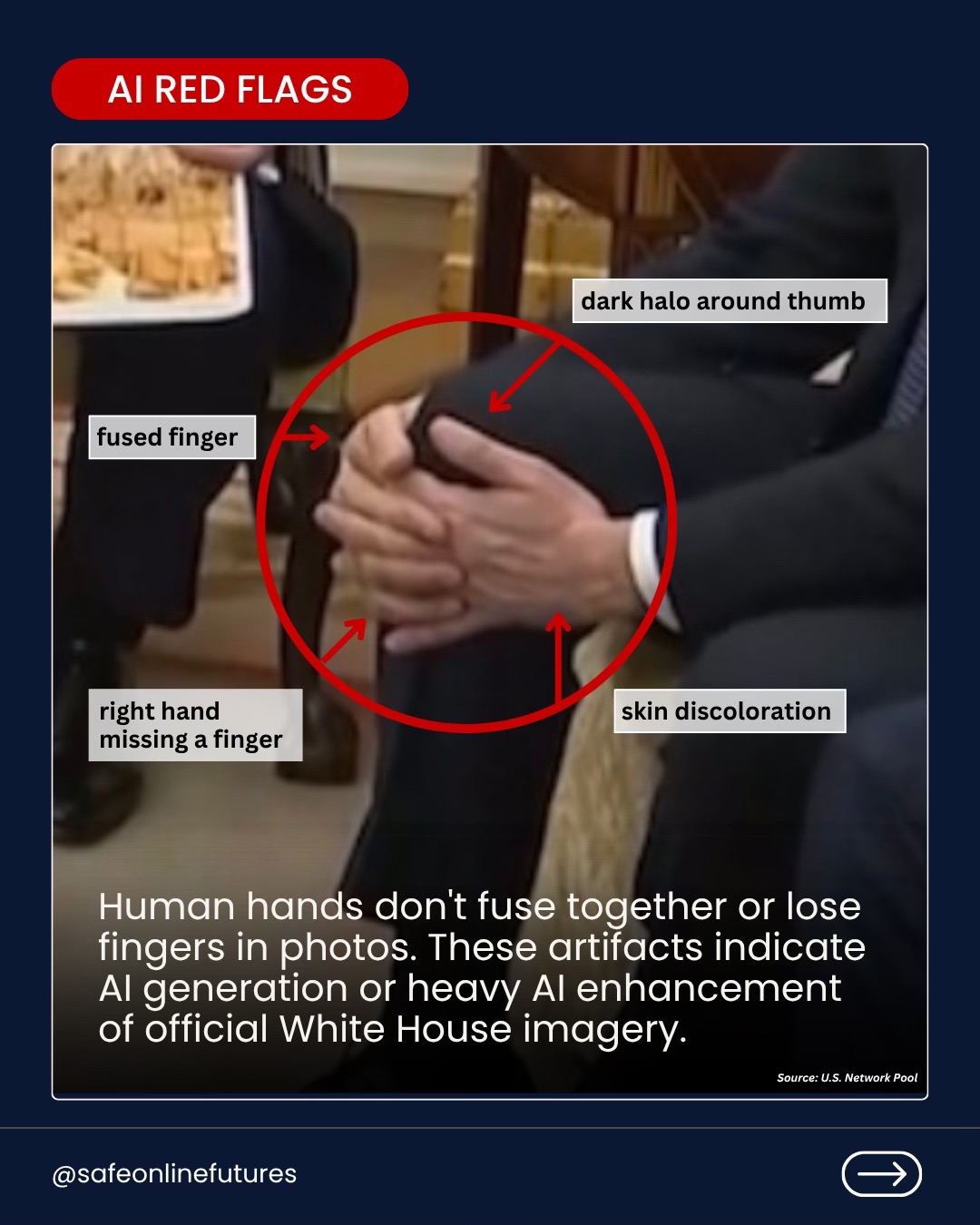
Two things can be true simultaneously: the event occurred, and the visuals distributed to shape how we saw it were digitally manufactured or enhanced by AI. Whether by design or optimization, the result is the same — a spectacle engineered for belief.
And here’s where the donor list and the imagery converge. The same companies funding this ballroom, Google and Meta especially, build the AI tools that generate and optimize these kinds of images. They control the platforms where these images spread. They design the algorithms that decide how long you look at them and what you see next. When power can design its own imagery using tools built by its funders and distribute that imagery through platforms owned by those same funders, there’s no need to convince you — only to immerse you.
Control what people see on their screens, and you don’t need to control reality. You only need to control perception.
Why This Should Worry You
There’s almost no real regulation on AI right now. No rules requiring companies to disclose when content is synthetic. No penalties for flooding social feeds with algorithmically generated images or videos that distort reality.
Here’s the part most people miss: media companies and social platforms have every incentive to push that content anyway. AI-generated visuals drive engagement. Engagement drives ad revenue. Accuracy doesn’t pay. Outrage does.
Algorithms don’t reward truth. They reward fear, loyalty, and emotional reaction. The more polarized you are, the longer you stay online and the more data they harvest about what keeps you there.
That feedback loop trains both people and machines: the more emotional the reaction, the more the system learns to feed you more of it. Over time, outrage becomes the shape of truth.
AI doesn’t just make fake images. It makes behavior. It gives those who control the narrative the power to shape what people believe — not by force, but by design. Control perception, and you control belief. That’s the quiet deal at the center of this alliance between tech and state power.
This matters because when reality can be designed, democracy depends on discernment.
What You Can Actually Do
Every era builds monuments to its power. The East Wing was built for transparency and public life. The new ballroom is being built for spectacle. Trump gets the outrage he wants. Tech gets the access it needs. And the rest of us get a new kind of illusion, one where the line between governance and influence has been quietly redesigned.
Because in the age of AI, truth competes with design. And whoever controls perception, controls the story.
So what do you do with this information?
Start by paying attention to where images come from. When you see polished visuals of political events, ask who produced them and what tools were used. Look for the telltale signs of AI generation: surfaces that look too smooth, lighting that doesn’t make physical sense, edges that blur in unnatural ways.
Follow the money on major projects like this. When tech companies fund government initiatives, track what contracts, policies, or regulatory decisions follow. The transactions aren’t always immediate, but the patterns emerge.
Most importantly, recognize that engagement is the currency. Every minute you spend outraged by spectacle is a minute you’re not examining the structure beneath it. The algorithm wants your reaction. Give it your attention instead. Question what you’re being shown. Ask who benefits from you seeing it. And remember that in an attention economy, your focus is the most valuable thing you own.
Don’t mistake choreography for truth.
Exposing how media manipulation, AI, algorithms, and the attention economy are rewriting reality. Subscribe for free to receive insights into the forces reshaping truth in the digital age.