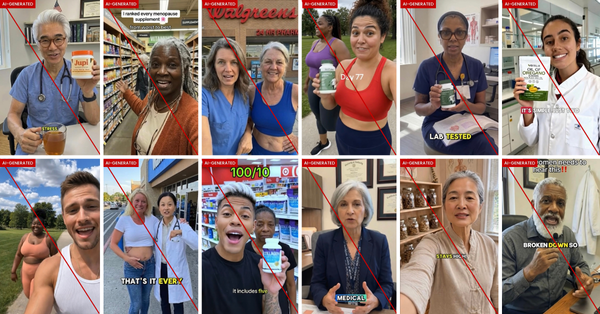
DHS-Released Protester Image Shows Multiple AI Red Flags
What Was Posted
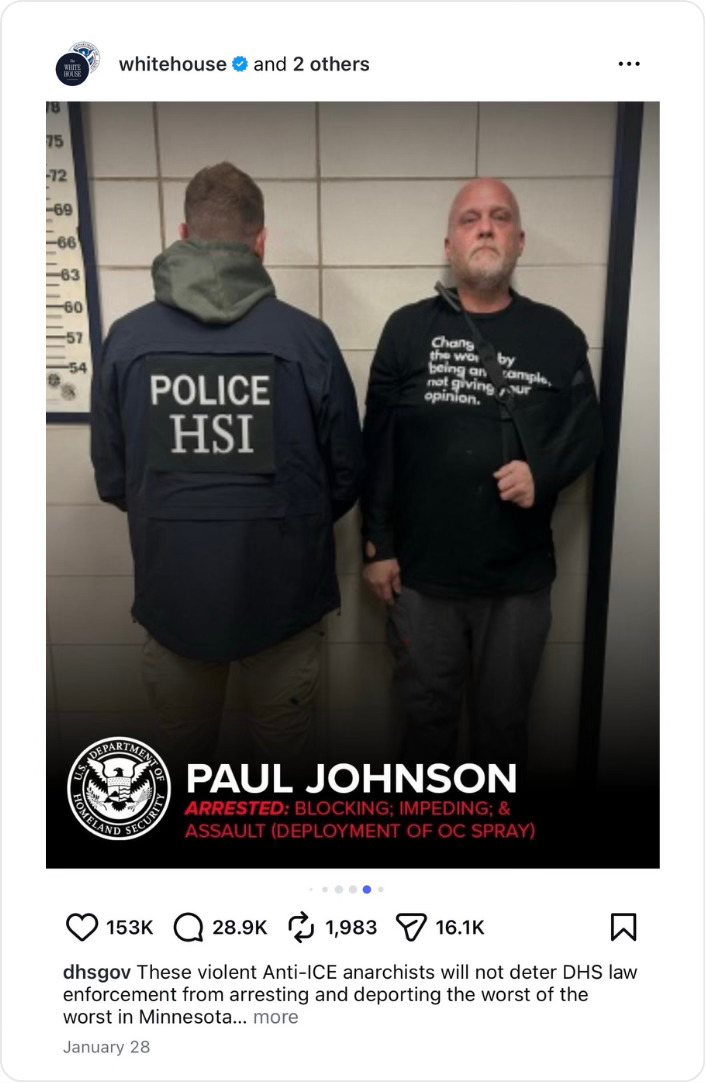
On January 28, 2026, the official Department of Homeland Security (DHS) Instagram account published a carousel of images depicting individuals described as “violent anti-ICE protester anarchists” in Minneapolis.
The same image was also reposted by the official accounts of both the White House and U.S. Immigration and Customs Enforcement, further amplifying the characterization without any disclosure of digital alteration or enhancement.
Because the image was released and amplified by federal executive institutions and used to characterize individuals as violent, it warrants close scrutiny.
What Was Observed
Two distinct visual anomalies are visible in the image:
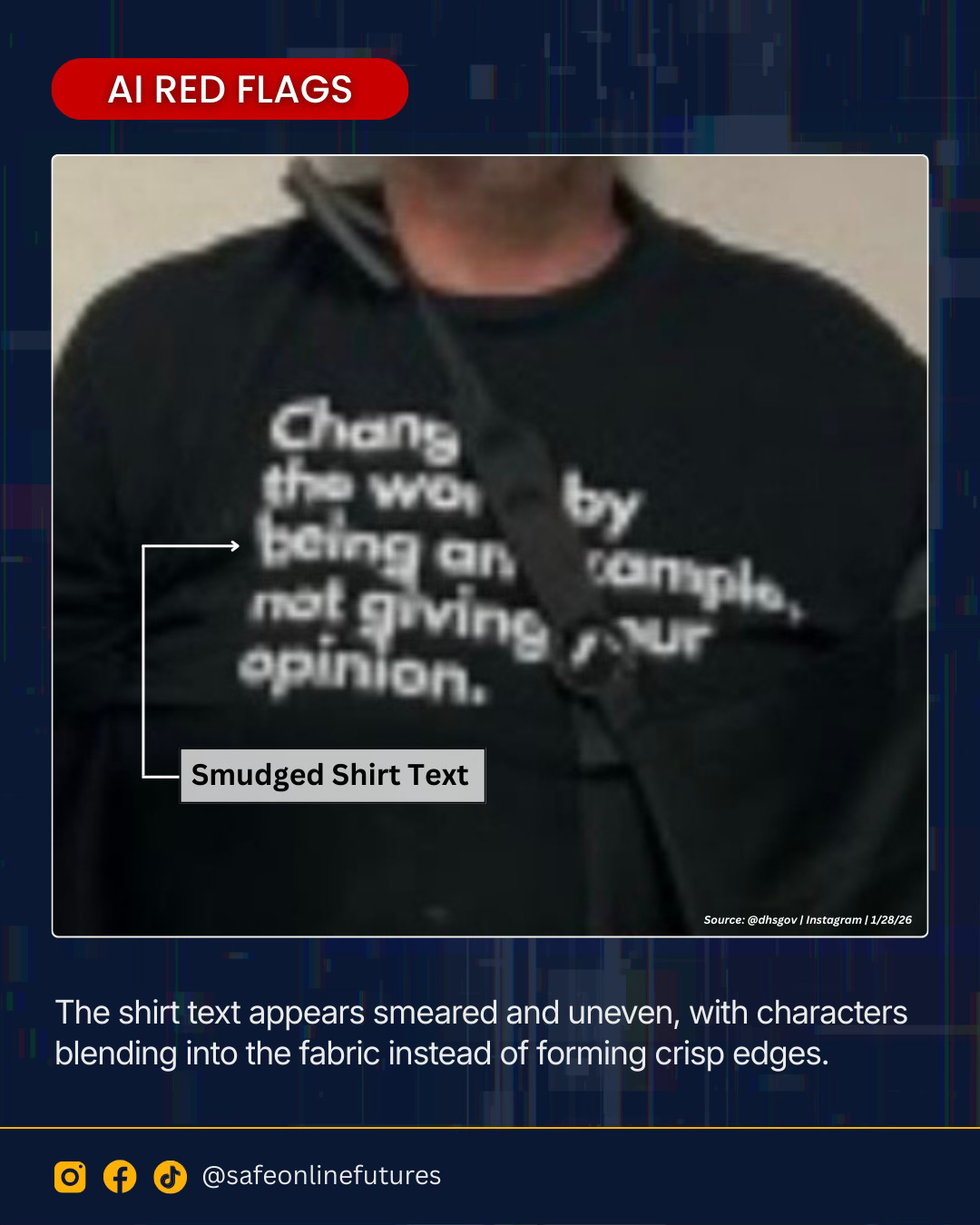
1. Text distortion on clothing
The lettering on the protester’s shirt appears smudged and uneven. Characters fail to resolve into clean letterforms and instead blend into the surrounding fabric, despite the rest of the image appearing relatively sharp.
2. Hand anatomy irregularities
The protester’s left hand shows irregular knuckle geometry in the region where the ring and pinky fingers meet the hand. In this same area, the boundary between the two fingers is poorly defined, creating an unnatural merged appearance near the knuckle.
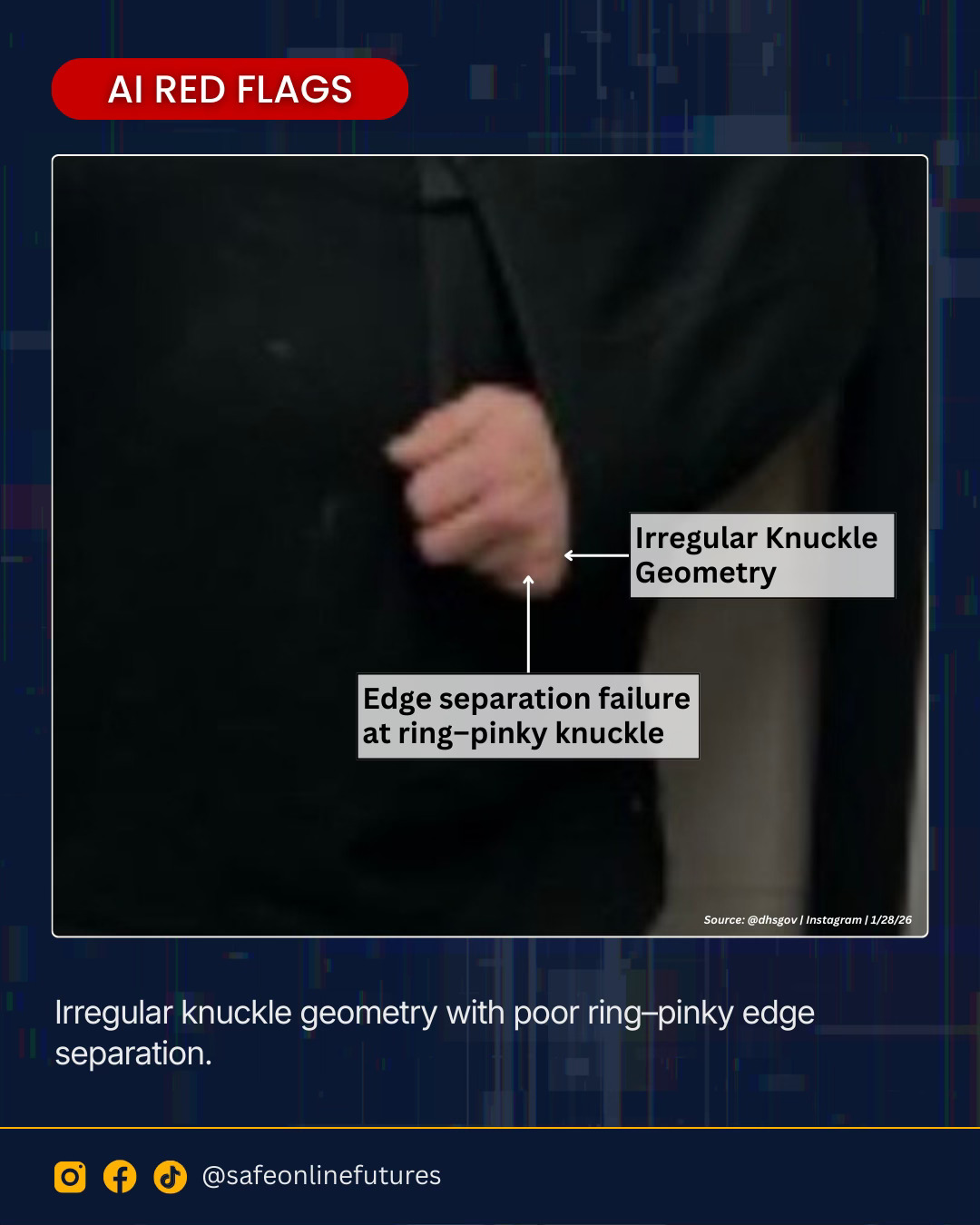
These anomalies are localized rather than scene-wide, affecting specific regions of the image.
Why These Anomalies Matter
Text and hands are well-documented failure points in both AI-generated and AI-assisted imagery.
AI systems frequently struggle to render readable text, often producing smeared, incomplete, or partially reconstructed lettering. Similarly, hands are prone to anatomical distortions such as warped knuckles, irregular joint structure, or poorly resolved finger boundaries — especially when AI tools are applied selectively to parts of an otherwise realistic image.
When multiple independent anomalies appear together, they are less consistent with ordinary photographic issues such as motion blur or compression artifacts, which typically affect images more uniformly.
What This Suggests
Taken together, the observed text distortion and hand anatomy irregularities strongly suggest that this image was either AI-generated or AI-assisted, rather than a straightforward, unaltered photograph.
This assessment does not rely on intent, motive, or speculation — only on observable visual signals that align with known AI failure modes.
Why This Matters
Images released by government agencies do more than document events. They shape public perception. When official imagery is used to label individuals as violent or dangerous, the accuracy and integrity of those visuals are critical.
In an information environment saturated with AI-assisted media, scrutiny of government-released images is not conspiratorial or radical. It is a necessary component of responsible media literacy and democratic accountability.
This post documents observable visual anomalies and their implications. It does not assert intent, only the need for transparency and verification when images are used to influence public understanding.