Government AI Watch
The FBI released this video. The New York Times analyzed it. Nobody asked why a man's forearm vanishes into a door, and reappears a frame later.
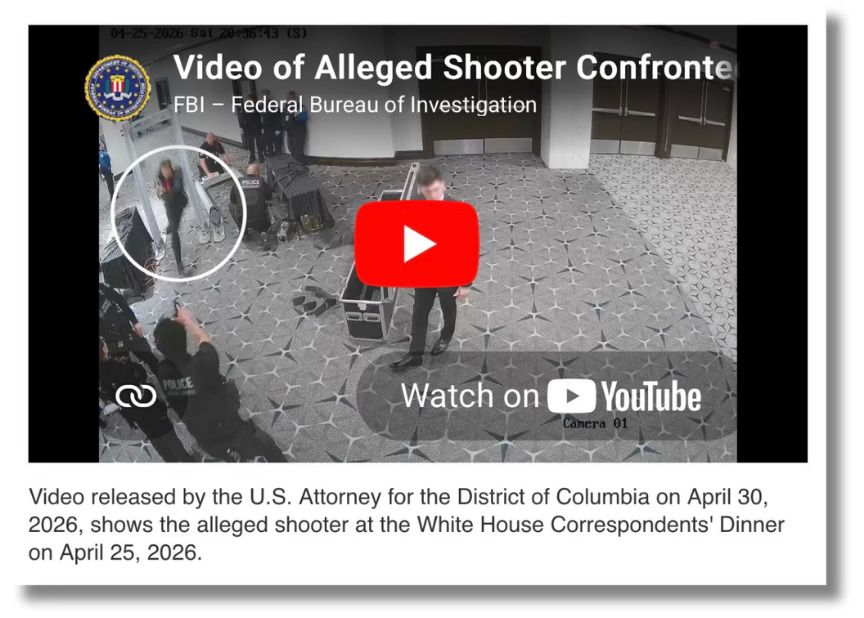
On April 30, 2026, the FBI and U.S. Attorney for the District of Columbia released surveillance footage from inside the Washington Hilton on the night of the White House Correspondents' Dinner shooting. The footage is currently on the FBI's YouTube page and on FBI.gov.
According to the New York Times, the footage was annotated and edited. Other outlets have described it as “higher resolution” and “annotated by the F.B.I. and prosecutors,” with sections sped up or slowed down to highlight the suspect’s movements. The FBI itself does not describe the quality or processing of the footage anywhere on its release page.
The footage was processed. That much is established. What kind of processing, and how much, is not.
I’m not claiming that the video is AI-generated. I cannot established that from freeze frames alone. What can be established is that the footage contains anomalies consistent with AI manipulation — and that no major outlet has published anything examining them.
Watch the full sequence on Instagram here.
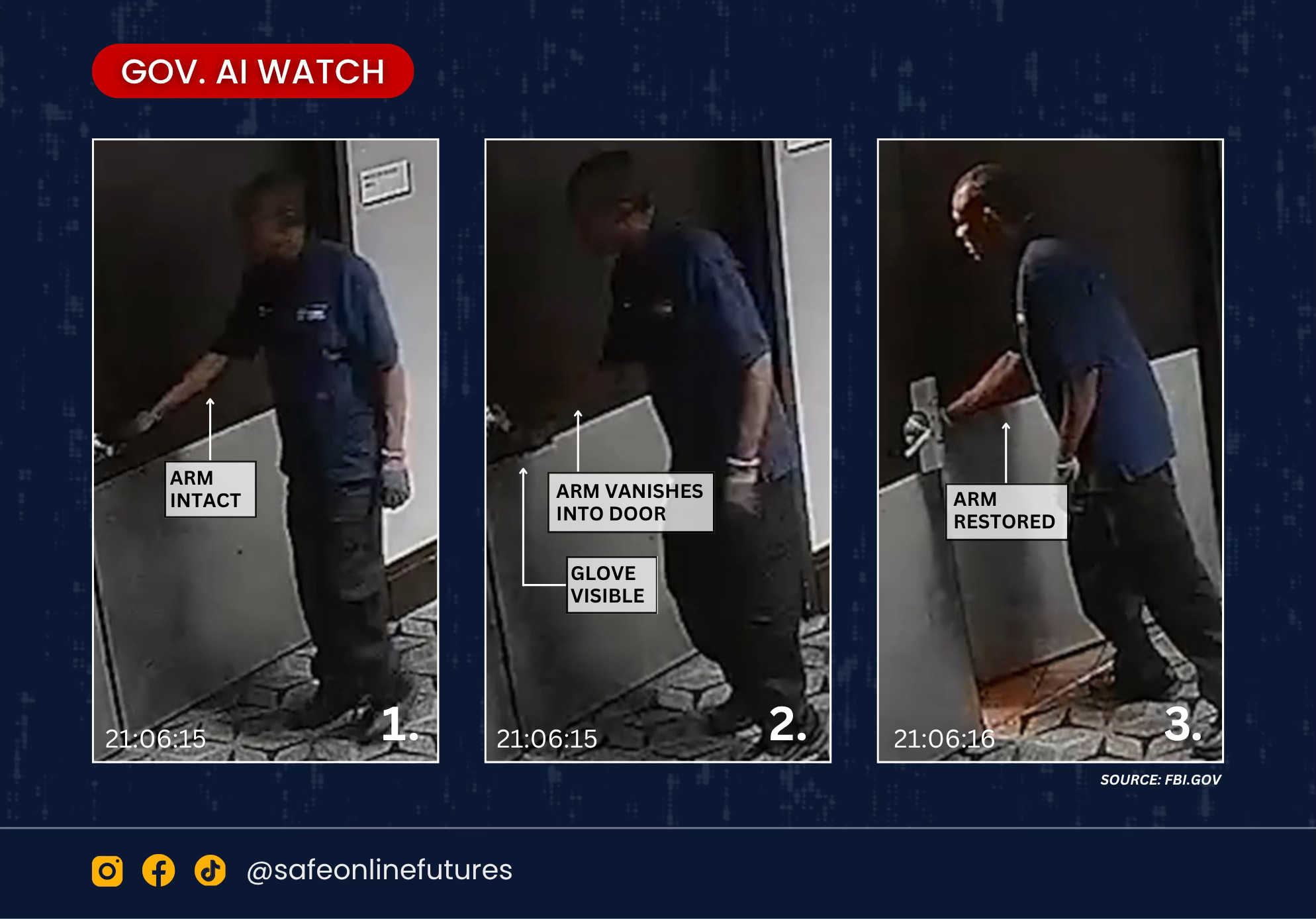
In a sequence spanning roughly one second, a hotel employee's right forearm appears to blend into the door behind him. The gloved hand on the same arm remains clearly visible. A frame later, the arm is fully restored.
This is not what video compression produces. Compression degrades quality. It blurs edges. It does not erase a forearm and leave the glove behind.
The New York Times has a Visual Investigations team whose stated mission is “forensic analysis of visual evidence to find truth, hold the powerful to account and deconstruct important news events.”
On May 2, 2026, that team published an analysis of this exact footage focused on reconstructing the shooting sequence. The analysis did not address the authenticity or processing of the footage itself. It also did not address the hotel employee’s disappearing arm.
In other words: the team specifically equipped to ask this question did not ask it.
The Trump White House has a documented track record of posting AI-generated and AI-altered imagery without disclosure — including a digitally altered photo of a civil rights attorney arrested during an ICE protest, edited to make her appear to be crying. Given that track record, the absence of forensic scrutiny on federally-released video evidence in a high-profile case is not a neutral oversight.
Bottom Line: Federal authorities released this footage. It contains anomalies that anyone can identify watching it on a phone. The press organization most equipped to examine it published an analysis that didn't. There is no requirement that AI use in federal government imagery be labeled or disclosed. Without that requirement — and without forensic scrutiny from the press — the public has no way to know what it is actually looking at.
Follow @safeonlinefutures on Instagram for video analysis of each anomaly in this footage.
If this piece helped you see what’s happening, share it with someone who should be paying attention. To stay ahead of undisclosed AI in official government content, subscribe below.