Government AI Watch: The Selfie
An attempted presidential assassination. A federal court filing. A photograph the government admits was enhanced.
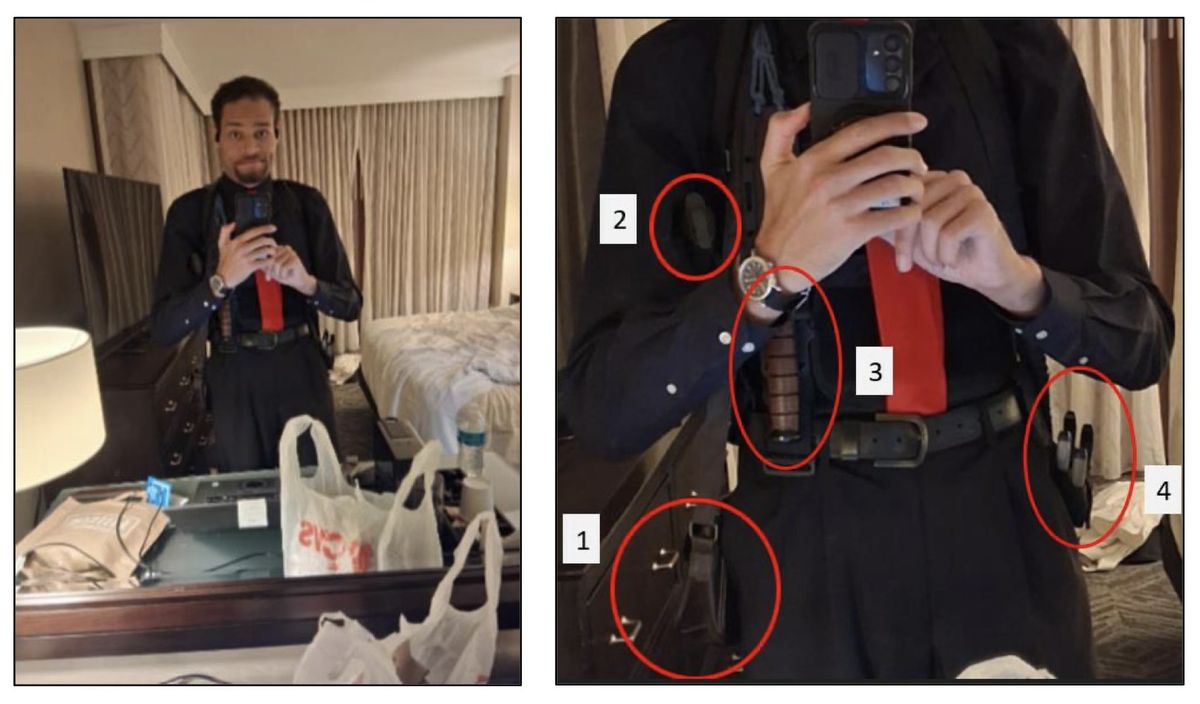
On April 29, 2026, the Department of Justice filed a memorandum supporting pretrial detention of Cole Tomas Allen, the suspect in the April 25 shooting at the White House Correspondents’ Dinner. The filing included a mirror selfie that the DOJ said Allen took at the Washington Hilton roughly thirty minutes before the attack, and a second image the filing describes as “an enhanced version” of that selfie, annotated by the DOJ.
The original selfie contains multiple visual anomalies consistent with AI manipulation. The enhanced version, included alongside it in a federal court filing in an attempted presidential assassination case, was disclosed by the government as enhanced. The method was not specified. No software was named. No process was described.
Of the three articles I reviewed that published the side-by-side photographs from the filing, two from CBS News and one from Fox News, only one included the enhancement disclosure to readers.
What’s in the Original
The image contains at least five visual anomalies consistent with AI manipulation.
Edge blur on the watch. The edge of the watch face dissolves into the wrist. Metal hardware in unaltered photographs has defined edges. This one does not.
Wire discontinuity. A thin wire visible on the desk disappears and then reappears further along its length. Thin, continuous objects are among the most reliable markers of AI manipulation, because generative tools consistently struggle to render them without breaks.
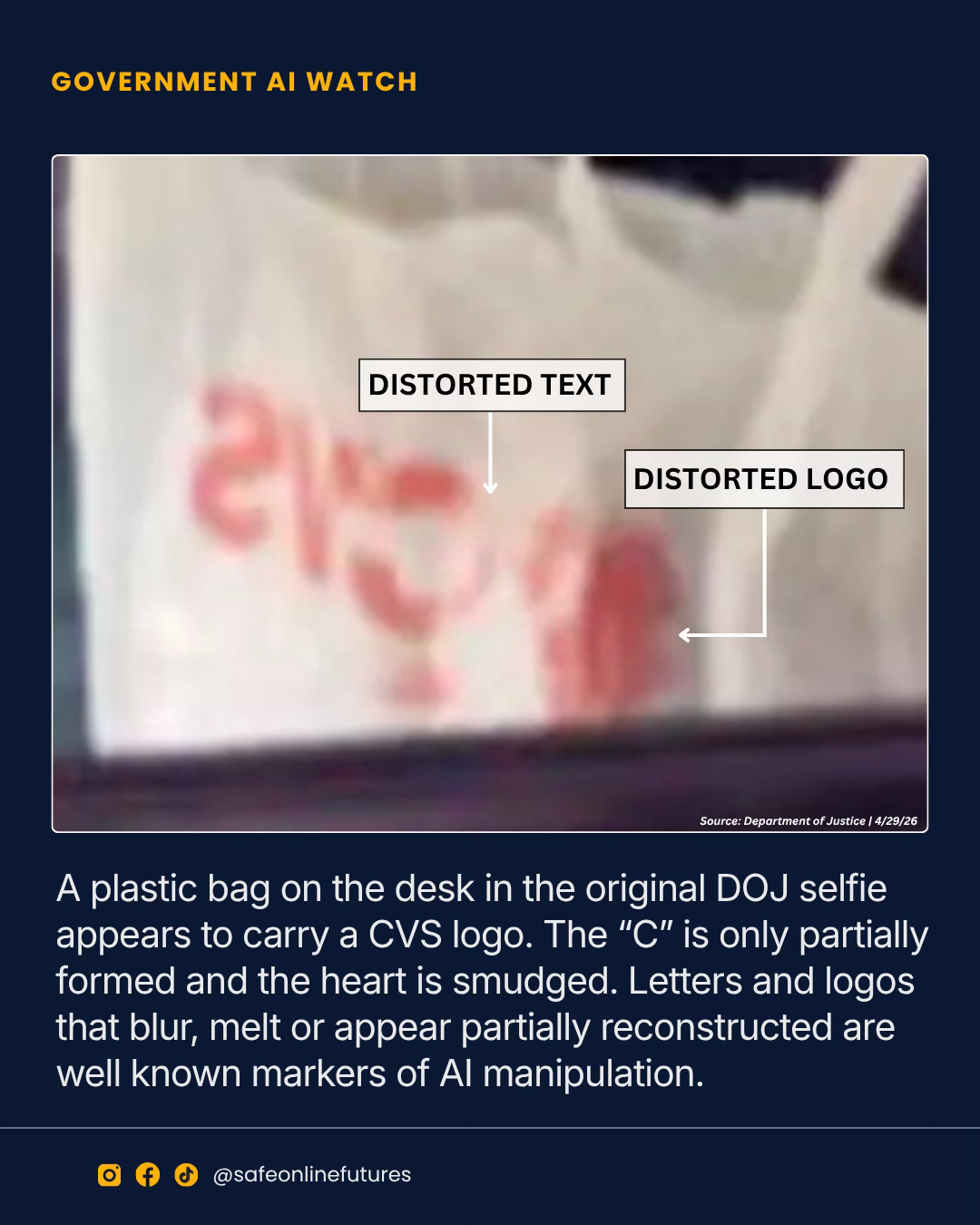
Distorted text and logo. A plastic bag on the desk appears to carry a CVS logo. The letter “C” is only partially formed and the heart icon is smudged. Letters and logos that blur, melt, or appear partially reconstructed are well-documented signs of AI-generated or AI-altered imagery.
Anatomically inaccurate irises. The irises in Allen’s eyes appear oval. Human irises are round.
Edge blur on the ammunition bag. The shoulder strap and the edge of the leather bag visible at Allen’s hip dissolve into the bureau behind him, with no clear separation between the strap and the furniture.
A video walkthrough of each anomaly is available on Instagram here.
I am not claiming this image is AI-generated. I cannot establish that from a single still. What I can establish is that the photograph contains multiple anomalies consistent with AI manipulation, and that the DOJ included it in a federal court filing without any disclosure of how or whether the original image was processed before submission.
The filing then includes a second image alongside the original. That is where the story gets harder to dismiss.
What “Enhanced” Means
The second image in the filing is a zoomed-in, annotated close-up of the original selfie. The DOJ’s memorandum describes it this way:
“An enhanced version of the image (below right) shows that the defendant also appeared to be wearing a small leather bag consistent in appearance with the ammunition-filled bag later recovered from his person (item 1), a shoulder holster (item 2), a sheathed knife consistent in appearance with one of the knives later recovered from his person (item 3), and pliers and wire cutters consistent in appearance with those later recovered from his person (item 4).”
The filing says the image was enhanced. It does not detail the method, software or process used for enhancement. The reader is asked to accept that an image submitted in support of pretrial detention in a federal attempted-assassination case was sharpened, brightened, upscaled, or otherwise altered, without being told which.
In 2026, the word “enhanced” covers a wide range of possibilities. At one end of the spectrum sit traditional forensic techniques: sharpening, contrast adjustment, denoising, color correction. These reveal detail already present in the pixels of the original image. At the other end sit generative AI tools that invent detail that was never there. The two operations produce images that look similar to the untrained eye, and the line between them has become increasingly difficult to identify without disclosure from whoever processed the image.
The risks of generative enhancement are not theoretical. In January 2026, after an ICE agent fatally shot Renee Good in Minneapolis, users on X asked xAI’s chatbot Grok to “unmask” the agent from eyewitness video. Grok produced a face. According to NPR, the image was AI-generated and bore no verified relationship to the actual agent. Hany Farid, a Berkeley professor who specializes in the forensic analysis of digital images, told NPR:
“AI-powered enhancement has a tendency to hallucinate facial details leading to an enhanced image that may be visually clear, but that may also be devoid of reality with respect to biometric identification.”
Farid’s warning applies beyond facial recognition. Any AI-based enhancement tool that generates detail rather than revealing it carries the same risk of producing an image that looks sharper, cleaner, and more authoritative than the original, while drifting away from what was actually in front of the camera.
The DOJ’s filing offers no way to know which kind of enhancement was applied to the close-up of Cole Allen. The defense, the court, and the public are left to assume the most benign interpretation, because no other interpretation has been disclosed.
Why It Matters in Court
The image is not currently being offered as evidence at trial. It appears in a memorandum supporting pretrial detention, which is a lower bar. Detention memos are written to persuade a judge that a defendant should remain in custody before trial, and the standard for what prosecutors can cite at that stage is more permissive than what the rules of evidence require during the trial itself.
Even so, the image is now part of the federal court record in a case that carries a possible life sentence. The government has signaled, in writing, that it views the enhanced version as supportive of its argument that Allen possessed specific items consistent with planning an attack. If the case goes to trial, the enhanced image, or some version of it, may be offered again.
That raises a question the DOJ’s filing does not answer: what was changed, and how?
Courts have long admitted enhanced photographic evidence. Sharpening, contrast adjustment, and forensic zoom are established techniques with decades of case law behind them. What courts are only beginning to address is the difference between enhancement that reveals detail and enhancement that invents it. The two can look identical in the final image, and the method is the only thing that distinguishes them.
Without disclosure of the method, no one outside the DOJ is in a position to answer that question, including the defense, the court, and the public.
What the Press Missed
Of the three articles I reviewed that published the side-by-side photographs from the DOJ filing, two from CBS News and one from Fox News, only one disclosed the enhancement to readers.
The first CBS article, published April 29 at 2:27 PM EDT, described the close-up as “a digitally enhanced close-up version of the photo included in the memorandum, with annotations by the Justice Department.” That phrasing tells readers the image was enhanced and attributes the enhancement to prosecutors. It is the disclosure the filing itself contains, brought up into the article body where readers will see it.
The second CBS article, published the same afternoon at 3:40 PM EDT, includes both images side by side. Its caption reads, “A Justice Department court filing includes images of a selfie Cole Allen allegedly took in his hotel room shortly before the White House Correspondents’ Dinner shooting on April 25, 2026. (Evidence markers added by DOJ.)” The article body makes no mention of enhancement.
The Fox News article, published April 30, also includes both images side by side. The caption reads, “Cole Allen seen in a hotel room before Trump assassination attempt during the White House Correspondents’ Association Dinner. (Justice Department).” The article makes no mention of enhancement.
Anyone looking at the two images side by side can see that the close-up has been processed beyond cropping and includes the addition of red circles. The clarity, sharpness, and quality are visibly different from the original. The DOJ disclosed in its own filing that the image was enhanced. One of the three articles reviewed told readers about it. The other two reproduced both images without flagging that the second one had been altered.
This is a sample of three articles, not a comprehensive review. Other outlets may have disclosed the enhancement. Readers are encouraged to check.
What is documented is this: at least two articles from two major outlets published an image that the government’s own filing describes as enhanced, without telling readers it had been enhanced.
Bottom Line: The Department of Justice submitted a photograph in a federal court filing in the highest-profile attempted presidential assassination case in over forty years. The original image contains multiple anomalies consistent with AI manipulation. Alongside it, the DOJ included an "enhanced version" of the same image, with no disclosure of what enhancement was applied. There is no federal requirement that AI use in government-released imagery be labeled, including in imagery submitted as part of court filings. The press organizations most equipped to flag the enhancement to readers, in two cases out of the three I reviewed, did not. If we cannot trust what the Department of Justice submits to a federal court, and we cannot rely on the press to tell us when a government-released image has been altered, what is left to verify the public record against?
Video walkthrough of each anomaly in the original selfie on Instagram here.
Follow Safe Online Futures for ongoing analysis of undisclosed AI in government-released imagery.