How to Manufacture a Weak President
AI visuals, activist timing, and media complicity turned a real event into a viral humiliation campaign.
The U.S. Army’s 250th Anniversary Parade took place last week, on the same day as Donald Trump’s 79th birthday. The event was real. But the media coverage? That’s where the facts start to blur.
Multiple mainstream outlets posted images of the parade that show clear signs of AI generation — from missing limbs and clothing inconsistencies to abnormal shadows and odd lighting. These weren’t just low-res snapshots or weird angles. They were synthetic visuals. And yet they were used to illustrate a real event.
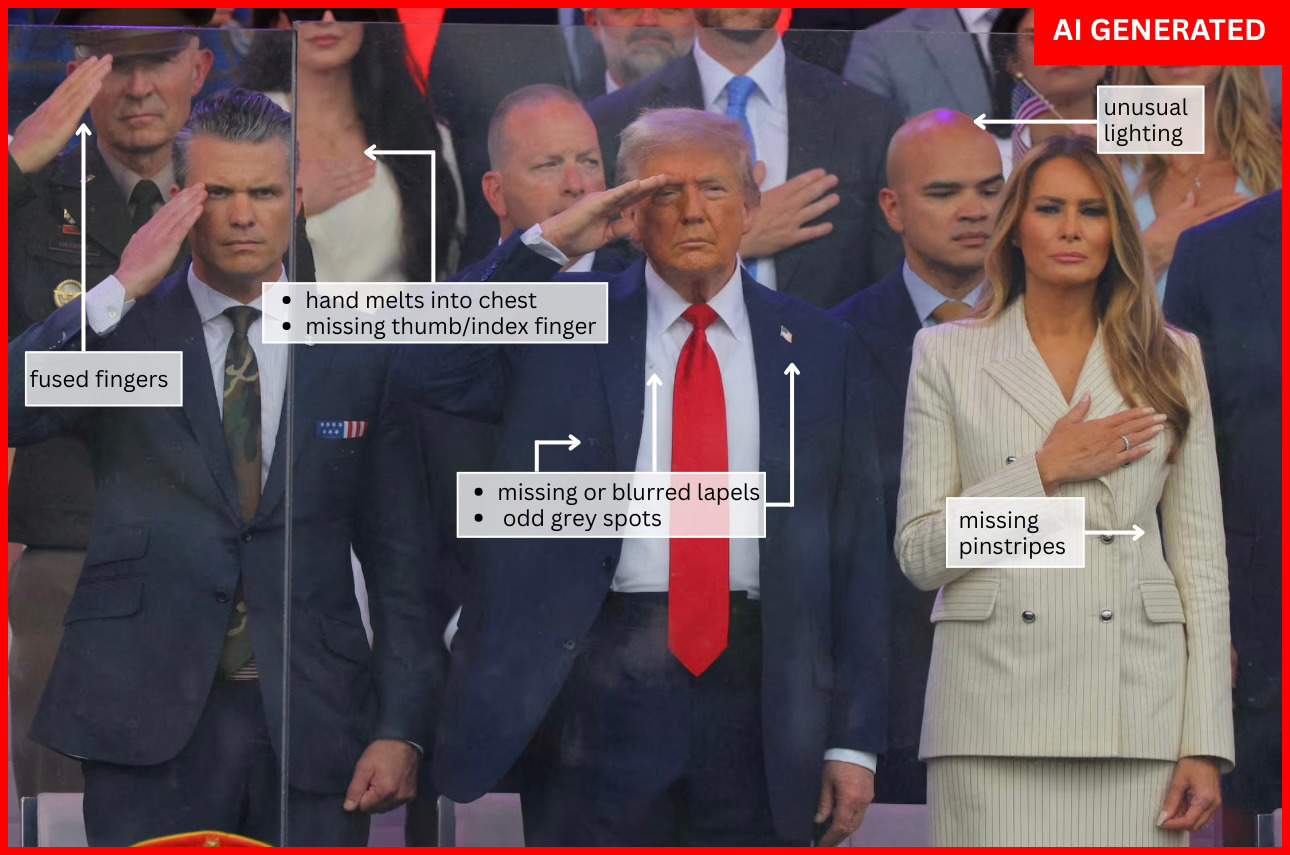
If the parade happened, why use fake images to tell the story?
Because in the Attention Economy, what’s real matters less than what performs.
Just days before the parade, California Governor Gavin Newsom held a press conference, where he aggressively framed the upcoming celebration as a display of authoritarianism. The moment came amid an intensifying public feud between Newsom and Trump, after the president ordered thousands of National Guard troop — and 700 Marines — into Los Angeles to suppress protests sparked by widespread immigration raids. Newsom, who publicly opposed the deployment as a dangerous overreach, used the press conference to deliver a calculated blow:
“It’s a vulgar display,” he said. “It’s the kind of thing you see with Kim Jong-un…with Putin…Weakness masquerading as strength…To fete the dear leader on his birthday? What an embarrassment…That’s about as small as it gets.”
That sound bite exploded online. Headlines followed. Political influencers amplified it. And the message stuck: Trump was staging a military parade to feed his ego — and it was a sign of weakness.
But here’s the twist: that Newsom press conference also shows signs of AI manipulation.
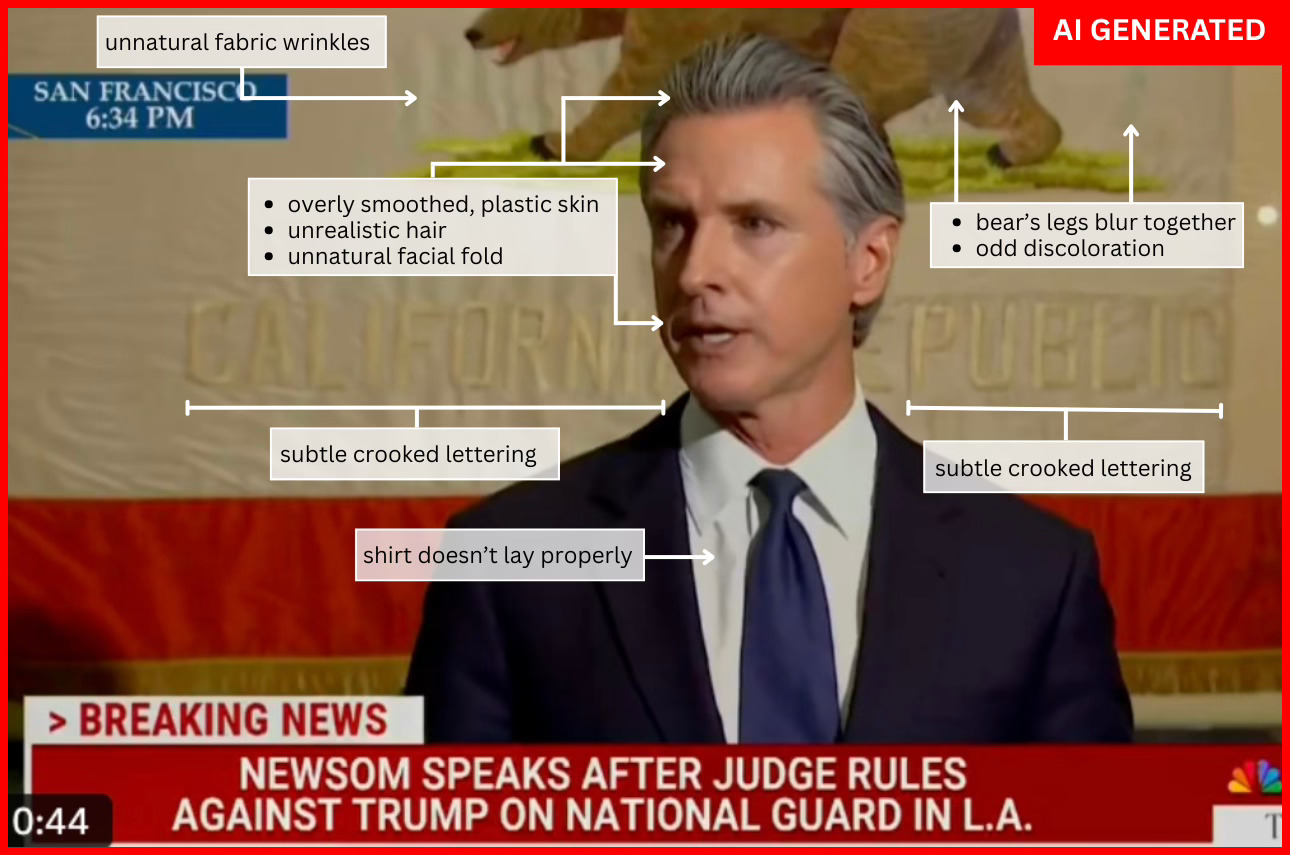
Was it real? Or was it part of a larger, manufactured narrative?
Then came the parade.
Outlets shared glitchy, AI-generated images. Videos circulated showing empty streets. One of the most viral clips came from Newsom himself — a shot of a near-empty lawn above the parade route. It racked up nearly 12 million views on TikTok.
The takeaway was clear and cohesive:
Trump’s big parade flopped.
Nobody showed up.
He looks weak.
And this message didn’t emerge organically. It was orchestrated.
A coalition of over 200 organizations — including Indivisible, MoveOn, and the ACL — intentionally scheduled their “No Kings” protests to counter-program the parade. Their stated aim? To reject “authoritarianism” and “billionaire-first politics.” It was a coordinated media maneuver dressed up as grassroots resistance.
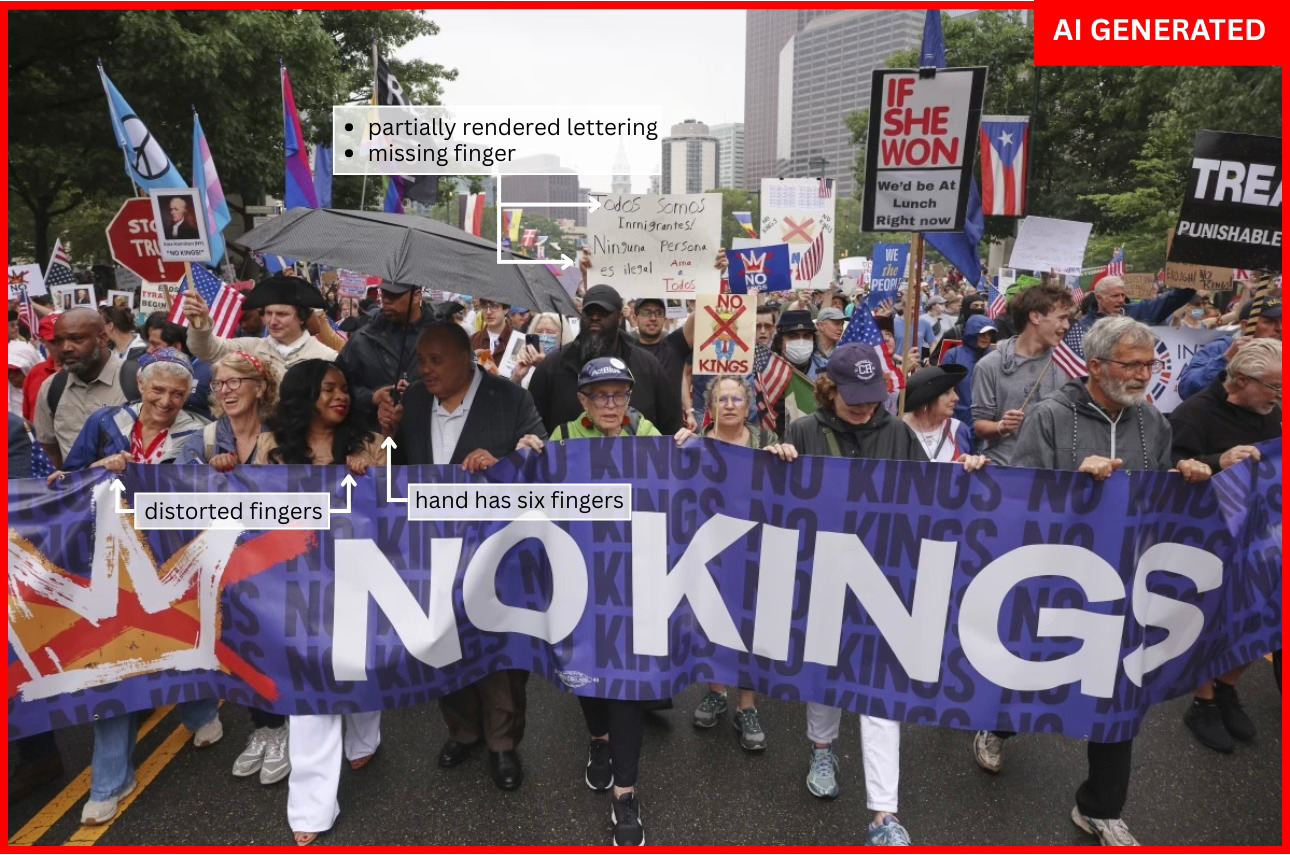
Their strategy worked. The media flooded social channels with protest photos, many of which also show telltale signs of AI manipulation—overfilled crowds, signs that don’t fully render, missing or extra limbs. One widely shared image from the Philadelphia No Kings protest features Martin Luther King III holding an umbrella with a six-fingered hand. But those images weren’t scrutinized. They were celebrated.
Because the narrative had already been seeded:
Trump = authoritarian ego parade, poorly attended.
Protesters = organic uprising, massive success.
All of it driven by:
- AI visuals
- Carefully timed messaging
- Algorithm-juiced clips
- Stakeholder coordination
- A press corps eager for outrage clicks
This wasn’t coverage. It was choreography.
And it leaves us with a critical question: Were we seeing the truth? Or were we just watching a narrative play out — designed by political actors, delivered by synthetic content, and sold by a complicit media system that profits off emotion?
This is what narrative control looks like in the AI era. You don’t need to lie. You just need to flood the zone with content that feels true.
And we’re already drowning in it.
Want to keep your reality check intact?
Subscribe below for weekly breakdowns on AI propaganda, media manipulation, and the narratives shaping your feed.