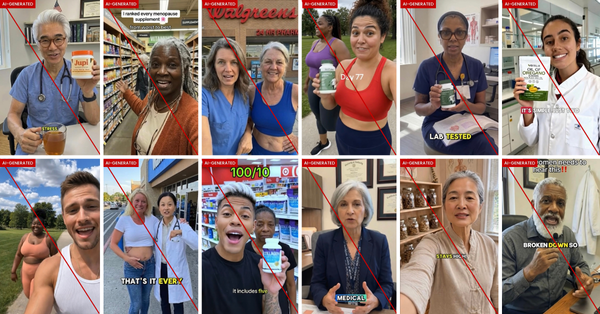
Inside the Lie Factory
How a Vietnamese clickbait operation paired Cole Allen with fifty celebrities, and the 7 billion reasons Meta has to let it happen.
Within hours of authorities naming Cole Tomas Allen as the suspect in the shooting at the White House Correspondents’ Dinner, AI-generated images of him began moving across Facebook and X. Each image paired him with a different public figure. Each came with an almost identical caption: Allen was a former driver, his wife was an assistant, and the celebrity in the photo had employed them both.
One of those images featuring Allen next to NBC anchor Savannah Guthrie went viral on Facebook. The choice of Guthrie was not random. Her 84-year-old mother had disappeared from her Arizona home in February under circumstances that puzzled investigators. A masked, apparently armed man was caught on her security camera around the time she vanished. Pairing Allen with Guthrie used that unresolved tragedy as connective tissue, giving the false story a narrative that felt almost coherent if a reader were inclined to believe it.
The synthetic Guthrie image was not unique. It was one of more than fifty.

AFP traced the same fabricated story to images pairing Allen with Tom Hanks, Sydney Sweeney, Bad Bunny, Tom Cruise, Chris Brown, Taylor Swift, Barack Obama, and Pope Leo XIV, among others. Lead Stories found additional variants placing him in the gear of professional and college sports teams across multiple leagues. The suspect’s face and clothes stayed roughly the same across all of them. The captions followed a template with a single editable field for the celebrity's name.
A Vietnamese clickbait operation built that template to generate ad revenue. Lead Stories has published a primer on identifying its output, which they call “Viet Spam.” Fake Facebook fan pages target North American and European users with AI-generated content tied to whatever personality or news event happens to be drawing attention, and the posts link out to advertisement-filled websites that pay the operators per click. The operation has no political agenda. Whatever face fits the moment gets slotted in. Many of the pages claim Los Angeles addresses but list phone numbers with Vietnamese area codes. The articles linked from the posts use Cyrillic characters in place of similar-looking Latin letters, an evasion technique designed to slip past automated moderation.
Google’s SynthID watermark detection confirmed the Guthrie image was AI-generated. Hive Moderation flagged a different version pairing Allen with actor Henry Cavill at 99.9 percent confidence.
The pipeline is industrial. The templates exist before the news event does. When a story breaks, the operators slot in a face, a name, and a caption, and ship the variants out across dozens of pages.
In an email to AFP, a Meta spokesperson said “it is reprehensible when opportunists seek to exploit moments of tragedy.” The company said it had begun removing posts it found violated its policies.
A Reuters investigation published in November 2025 contradicts that statement. Based on internal company documents, Meta projected roughly $16 billion in 2024 advertising revenue from ads for scams and banned goods, accounting for about ten percent of the company’s total revenue. A February 2025 document showed Meta capped the team responsible for vetting questionable advertisers at $135 million in lost revenue for the first half of the year, equivalent to 0.15 percent of total company revenue. The cap covered enforcement actions against both scam ads and legitimate ads mistakenly blocked. A $135 million enforcement ceiling is what Meta has chosen as its response to a $16 billion problem.
A separate Meta document from December 2024 estimated that its platforms show users 15 billion scam advertisements a day. Another late-2024 document put Meta’s annualized revenue from scam ads alone at roughly $7 billion.
Internal assessments noted that revenue from risky ads would almost certainly exceed the cost of any regulatory settlement. Fines have been treated as a cost of doing business. The Reuters reporting focused on paid fraudulent ads, mostly originating from China, rather than organic spam pages from Vietnam. The connection between those two stories is the enforcement philosophy Meta’s own documents reveal. When that calculus governs the paid side of the platform, the organic side gets the same posture by default. Clickbait pages running an Allen template are downstream of a company that has already decided how much harm it will accept as the cost of its revenue, and the answer is most of it.
The Allen images will keep traveling. Different fakes will replace them when the next story breaks, manufactured in the same templates by the same kind of operation. The accounts will get faster. The detection will get harder. Fact-checkers will keep doing the work of catching individual examples after the fact, and the corrections will reach a smaller audience than the originals.
What stops this is structural. Platforms will keep enabling these operations as long as the revenue from doing so exceeds the cost of regulatory consequences. Changing that requires legislation that treats platforms as accountable for the systems they profit from, including the foreign content farms that operate inside those systems with near-impunity.
That is a voting question, and the midterms are the next chance to act on it. The lawmakers worth supporting are the ones who can describe how foreign content farms operate inside major platforms, who understand the Reuters numbers and what they reveal about Meta's true priorities, and who are prepared to write rules that change what platforms get to profit from. Until then, the templates stay loaded. The next news event is the only thing missing.
If this piece helped you understand how this infrastructure actually works, share it. Subscribe below to keep tracking how AI-generated content is being industrialized and what platforms are choosing to do about it.