Meghan Markle and the Rise of the Synthetic Self
When even a moment this intimate looks artificial, it’s time to rethink what ‘real’ means in the age of influence.
Four years ago, Meghan Markle gave birth to her second child. Or so the story goes.
On June 4, 2025, Markle posted a dance video to her official Instagram account — a smiling, belly-bearing, full-term Meghan bouncing joyfully beside Prince Harry in what appears to be a hospital room. She captioned it:
“Four years ago today, this also happened. Both of our children were a week past their due dates… so when spicy food, all that walking, and acupuncture didn’t work – there was only one thing left to do!”
The post immediately went viral. But not for the reasons her team likely hoped. Within hours, sharp-eyed viewers began pointing out anomalies:
A belly that shifted in unnatural ways, appearing lumpy and misshapen
Warped or fused fingers
Prince Harry’s oddly featureless, smooth face
Lighting and motion blur inconsistencies that felt more computer-generated than candid
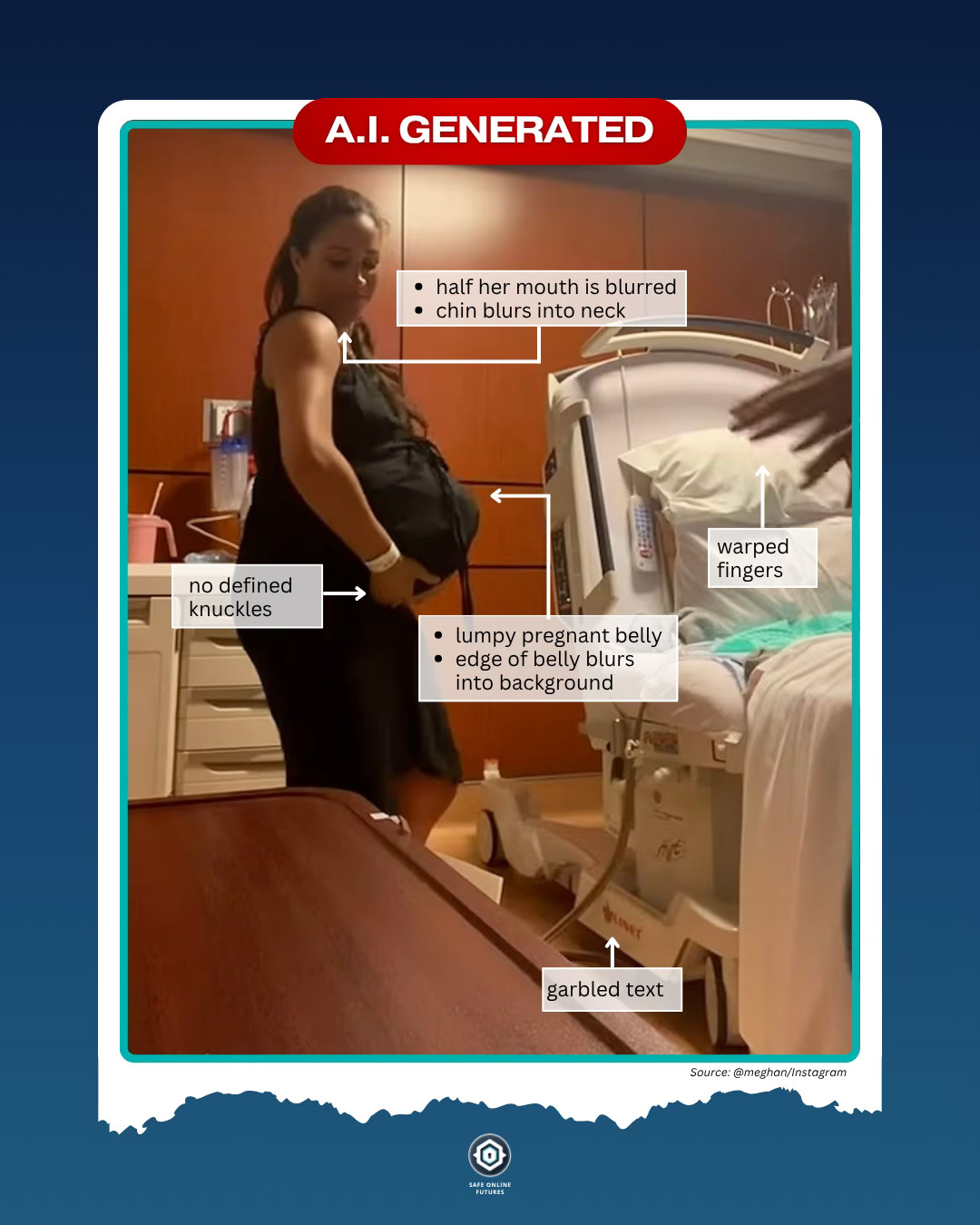
Visual glitches, distorted hands, and a warped belly — this frame from Markle’s labor video shows multiple signs of AI generation.
And then came the clincher: Markle herself, in a podcast days later, laughingly asked, “Did you see my ‘Baby Momma’ dance?” before offering a soundbite about authenticity. It all begs the question: Was this real? And if not — what are we actually looking at?
When the Intimate Is Fabricated
Whether the video was entirely AI-generated or just heavily touched up, one thing is clear: we’re not looking at an unfiltered moment. We’re looking at a curated simulation. Welcome to the age of the Synthetic Self.
Celebrities aren’t just using AI to protect their image. They’re using it to replace real experience with believable fakes. Not because they’re trying to fool us maliciously — but because it works. It satisfies the algorithm, boosts engagement, and feeds the public’s hunger for “relatable” moments. And it does all of that without exposing anything real.
For someone like Markle, who’s spent years criticizing media intrusion and paparazzi harassment, AI offers a clean solution. She can appear vulnerable, joyful, maternal — without actually handing over a raw piece of her life.
The Power of Controlling the Story
Markle and Prince Harry have built their post-royal careers on selective openness. They’ve sued over privacy violations, spoken about media trauma, and rejected the British press. But they’ve also signed podcast deals, inked Netflix contracts, and launched lifestyle brands. They need the spotlight just as much as they resent it.
AI solves that contradiction. Instead of sharing a real hospital moment that might be misinterpreted or mocked, Markle’s team can stage one. The setting looks intimate. The emotion feels spontaneous. But everything’s been run through a filter — sometimes literally.
What she shared wasn’t a memory. It was a message. Controlled, clickable, and engineered to feel authentic without actually being so.
Manufacturing Consensus in Real Time
The reaction to the video said as much as the video itself. When people raised questions — Why does her belly move like that? Why are Harry’s features blurred? — they weren’t met with open debate. They were drowned out. Some users offered medical explanations. Others posted photos of their own pregnancies to argue that lumpy bellies are normal. A few prominent accounts accused critics of “misogynoir,” the specific type of bias Black women face when racism and misogyny collide.
The conversation didn’t grow. It got buried.
We’ve seen this pattern before. It’s what happens when AI meets influence at scale. Bot networks and sock puppet accounts — fake profiles posing as real users — jump in to steer sentiment. Critics get labeled as trolls. Legitimate questions get framed as hate. The public mood shifts, not because minds changed, but because dissent got smothered.
By the time Page Six quoted Markle’s “friends” calling the backlash “sickening,” the damage-control script was already running. Meghan was recast as the victim. The rest of us were supposed to move on.
The Media Won’t Help You See It
Don’t expect the press to ask hard questions about whether the video was real. They’re too busy profiting off the clicks.
Media outlets aren't covering AI manipulation as a threat to truth. They're using it to juice engagement. Stories like this one generate outrage, sympathy, conflict — whatever keeps people scrolling. And because there's no law requiring AI-generated content to be labeled, no platform rules demanding transparency, and no editorial standard for verifying authenticity before publication, they don't have to tell you what’s real. They just have to tell you what performs. In a media ecosystem built on attention, synthetic content isn’t a glitch. It’s the business model.
You Have to Learn to Spot It Yourself
That’s why media literacy isn’t a nice-to-have anymore. It’s survival.
We need to train ourselves — and our audiences — to recognize how AI shapes what we see. Look for warped hands, soft-edged faces, unnatural motion. Ask why a video exists and who benefits from it going viral. Watch how quickly criticism gets shut down, and who’s doing the shutting.
Because if we don’t sharpen those instincts, we’ll keep mistaking synthetic moments for meaningful ones. And we’ll keep getting emotionally manipulated by people — and systems — that know exactly how to manufacture sentiment on demand.
Want to see the signs for yourself? View the full photo post on Instagram / Facebook / TikTok / LinkedIn
This is part of an ongoing series on synthetic celebrity — how AI and algorithmic design are quietly redefining what passes for real. Each week, I break down the mechanics of AI-driven media manipulation: how it works, why it works, and how to spot it before it rewrites what you think you know.