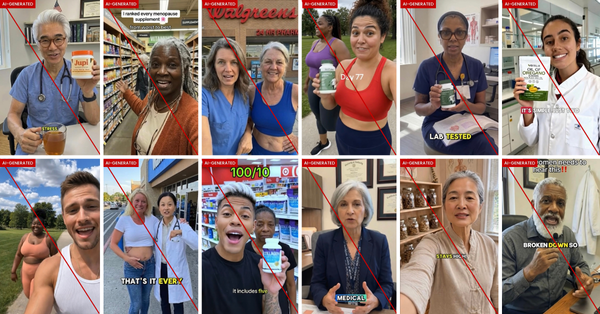
Outrage Won. Reality Lost.
How an AI-touched image went viral while the shutdown disappeared from view.
On November 6, 2025, a man fainted during Donald Trump’s Oval Office announcement on weight-loss drug pricing. The timing couldn’t have been worse for the administration. The country was weeks into a government shutdown, not the theatrical kind that ends in a day, but the grinding type that makes federal workers miss rent payments and turns TSA lines into chaos. Polling showed Republicans absorbing most of the political damage. The drug pricing announcement was supposed to be the way out: look at us solving problems, helping Americans afford medicine, doing the work of government even when government is half-closed.
Then someone collapsed on camera.
Reporters were ushered out. A press statement assured everyone he was fine. By afternoon, the internet had settled into its familiar rhythm: hot takes, reaction threads, moral pronouncements about Trump’s facial expression as others rushed to help.
A single photograph by Andrew Harnik, distributed through Getty Images, became that day’s defining image. It ricocheted across X, TikTok, and Instagram. Commentators dissected Trump’s body language frame by frame. The discourse was immediate and emotional: here was proof, they said, of his indifference to human suffering.
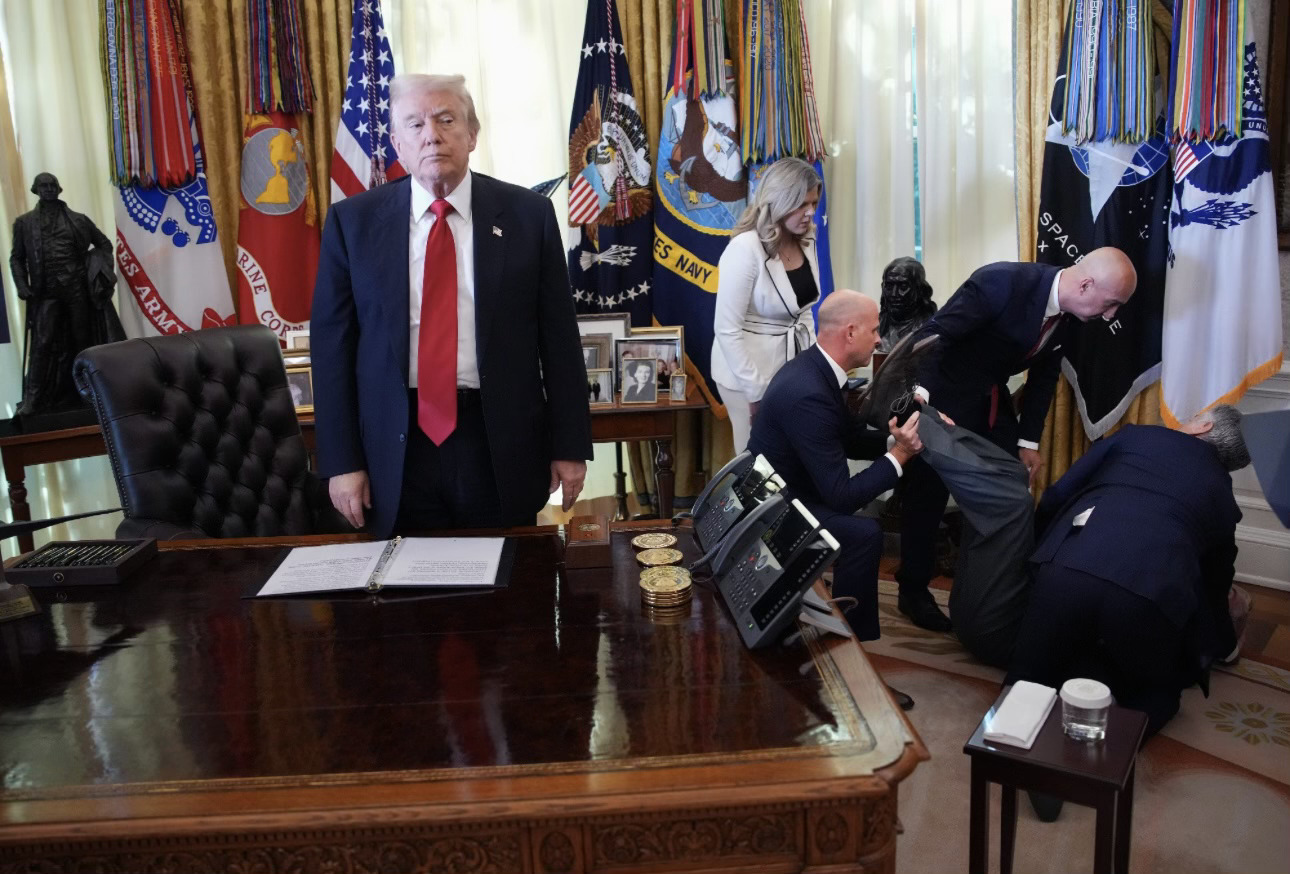
While millions of people argued about what Trump’s face revealed about his character, almost no one noticed what was actually wrong with the image itself.
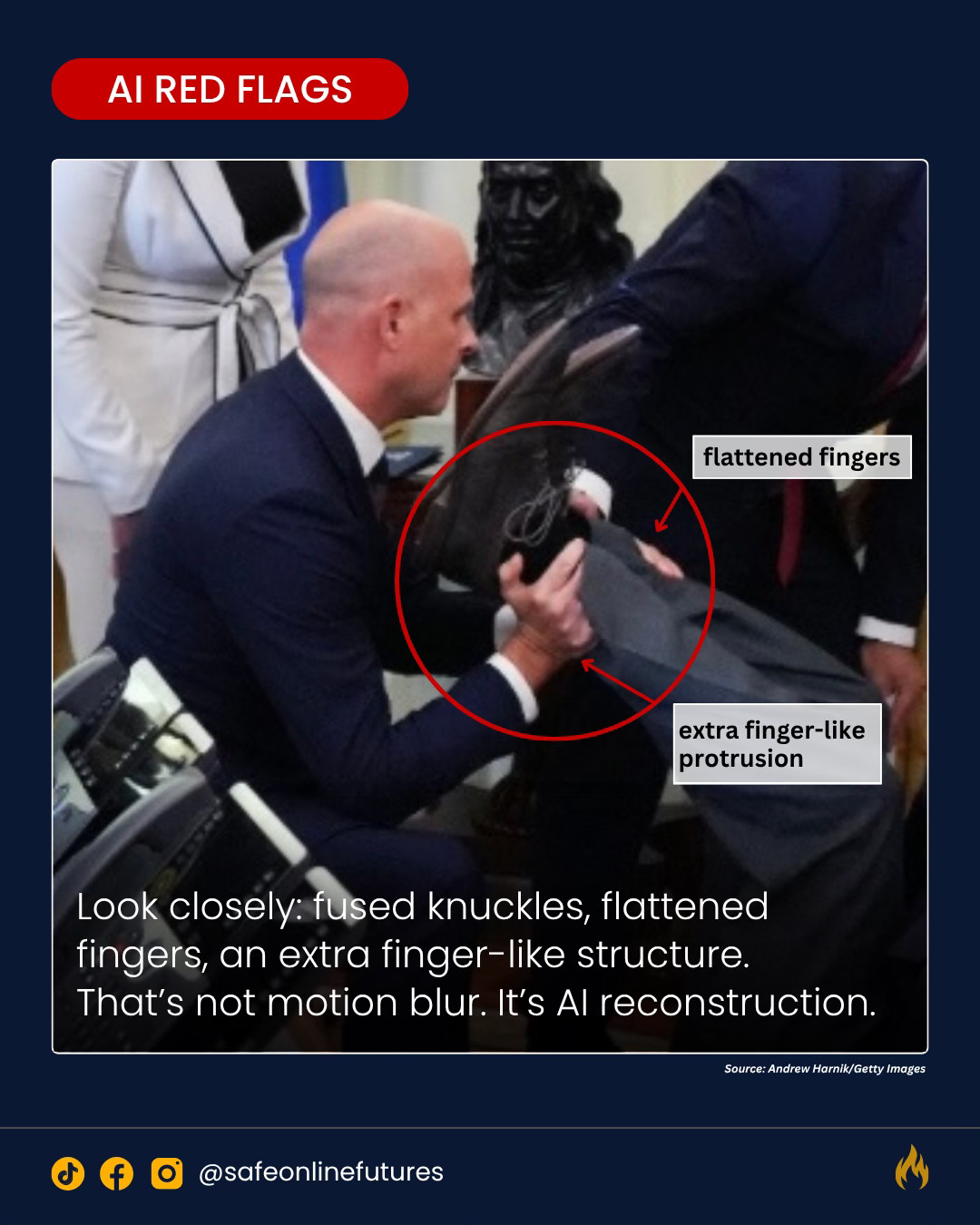
The man helping lift the collapsed guest’s legs has hands that don’t look right. Something about the fingers, the way they’re structured, the way they sit in space. These aren’t the kind of flaws you’d get from a camera lens or motion blur. They’re something else entirely.
And while the nation debated empathy, that grinding government shutdown vanished from the news cycle entirely. Along with it went stories about millions of low-income Americans facing staggering cuts to food stamps, with some families potentially receiving nothing at all because of how the White House had chosen to pay partial benefits during the shutdown. That story, which had been painting Republicans as indifferent to hungry children and families, simply disappeared.
What replaced it? A debate about facial expressions that required no policy knowledge and generated infinite engagement.
What the Photo Replaced
By that evening, the shutdown had effectively disappeared from most news feeds. Gone were the stories about furloughed workers. Gone was the coverage of millions of families facing food stamp cuts. Gone were the political blame games over Republicans choosing budget brinksmanship instead of feeding hungry children. In their place: an endless scroll of commentary about whether Trump had reacted with appropriate concern when a guest needed medical attention.
The story that required you to understand budget politics and legislative procedures got replaced by a story you could understand from a single freeze frame. No context needed. No policy knowledge required. Just a simple emotional read: did this man care or not?
What you need to understand is this: when an AI-touched image can completely redirect what millions of people think happened on a given day, and what they think matters, you’re not just dealing with a misinformation problem. You’re dealing with a reality problem. The image doesn’t just supplement the story anymore. It creates the story, independent of what actually happened or what actually mattered.
I’m not saying someone orchestrated that shift. I’m saying that’s what happened, and the timeline is clear enough that anyone can verify it.
The Hand Nobody Saw
Here’s what you can see if you actually look at the Getty image: the hand lifting the guest’s legs contains an extra finger-like protrusion where no finger should exist. The knuckle line fuses and warps in ways that violate basic anatomy. The other hand shows fingers that look strangely flattened, as if they’d been compressed into two dimensions.
Getty’s official policy prohibits fully AI-generated images. But their guidelines explicitly allow AI-powered tools for retouching, correction, and cleanup work, as long as modifications affect no more than 10% of pixels and don’t add new elements. The assumption seems to be that these tools make surgical, controllable edits, and that photographers and editors can always tell where the camera stopped and the algorithm started.
But here’s the problem: how do you measure 10% of pixels when the tool is reconstructing detail at a microscopic level? How do you prove whether an extra finger-like shape is an “added element” or an artifact of aggressive noise reduction? The policy assumes clear boundaries. The technology has made those boundaries impossible to enforce or even detect.
That assumption is breaking down faster than anyone wants to admit. Modern AI tools don’t just remove noise or sharpen edges anymore. They reconstruct missing information. They invent details based on pattern recognition. An upscaling algorithm looks at a blurry hand and generates what it thinks a hand should look like, pulling from training data of millions of other hands. Sometimes it gets it right. Sometimes you get six fingers.
The result: images that began in a camera but were finished by a machine, leaving distortions so subtle that they slip past editorial review, platform moderation, and millions of casual viewers. We now have a category of media that exists in the uncanny valley between “photographed” and “generated,” and we’re treating it as documentary evidence.
When that evidence shapes public understanding of political events, we have a problem that goes well beyond this one photo.
How the Pattern Works
This isn’t the first time. Just weeks earlier, during the same shutdown, AI-generated images of a bathroom renovation project surfaced and redirected attention, saturating news cycles for days. (I documented that case in detail here.) The pattern is consistent: a real event occurs, a synthetic or synthetic-adjacent image becomes the dominant visual record, public attention locks onto the emotional content of that image, and the larger story dissolves.
I’m not saying this happens on purpose. I’m saying this is how the system behaves when you combine platform algorithms optimized for engagement with AI tools embedded in media production pipelines. The infrastructure produces these outcomes automatically, regardless of anyone’s intentions.
Why It Spreads
Social platforms don’t care about the six-fingered hand. They don’t care about the shutdown grinding on in the background. They don’t care whether Trump actually lacked empathy or whether the photo accurately captured the moment.
They care about one thing: engagement.
Outrage is engagement. Moral clarity is engagement. A frame that lets people confirm what they already believe about Trump’s character is engagement gold. It doesn’t matter if the image contains anatomical impossibilities. It doesn’t matter if it’s been touched by AI tools in ways that compromise its documentary value. What matters is whether it performs, whether it generates clicks, shares and comments, whether it keeps people scrolling.
So the artifact goes unnoticed. The shutdown fades from view. The debate locks onto the easiest possible frame: Trump’s facial expression, Trump’s body language, Trump’s apparent lack of concern.
Your opinion about Trump is beside the point here. The problem is that we’re now operating in an environment where synthetic imagery flows through journalism without disclosure, where audiences have been trained to stop questioning visual evidence, where platforms systematically reward whichever narrative generates the strongest emotional response, and where political figures benefit from the resulting chaos, whether they engineer it deliberately or simply learn to recognize the patterns.
What We’re Left With
The danger isn’t that someone fainted during a press event. The danger is that a machine-altered image quietly became the official public memory of that moment, and it took days before anyone noticed anything was off.
When a single AI-touched photo can redirect national attention from millions of families losing food assistance to a debate about one person’s facial expression, you’re not witnessing deliberate manipulation. You’re watching a system designed to optimize for engagement, not accuracy. The misdirection is structural. It’s automated. It happens because that’s what these systems do when left to operate according to their built-in incentives.
The collapse wasn’t the story. The photo was. And the real manipulation was hiding in plain sight the entire time, in the form of hands that human anatomy cannot produce, attached to an image that shaped reality for millions of people who never thought to question what they were seeing.
Here’s what happens next: more of this. More AI artifacts slipping into news imagery. More emotional frames crowding out policy coverage. More families affected by actual governance decisions while the public argues about things that don’t matter. The infrastructure is already built. The incentives are already aligned. And nobody’s coming to fix it.
The question isn’t whether you believe this photo was manipulated on purpose. The question is whether you can still tell the difference between what happened and what you were shown. And whether that distinction even matters anymore when the image rewrites reality either way.
Exposing how media manipulation, AI, algorithms, and the attention economy are rewriting reality. Subscribe for free to receive insights into the forces reshaping truth in the digital age.