Quarantined in Nebraska, Brought to You by Heinz
The New York Times called him an influencer. The morning shows that reached millions did not.
Jake Rosmarin, a 28-year-old travel influencer based in Boston, is among a group of American passengers from the MV Hondius cruise ship being monitored at the National Quarantine Unit at the University of Nebraska Medical Center after a hantavirus outbreak killed three people on board. He has been documenting his quarantine experience to a rapidly growing Instagram audience. His footage and story have been picked up by major news outlets including the New York Times, NBC’s TODAY Show, ABC’s Good Morning America, and CNN. The story has been framed as a young American’s brush with a rare and dangerous virus. It is also a sustained influencer marketing operation, visible to anyone who watches more than one of his recent posts.
This essay does not contest the reported facts of the medical event. It examines what is being layered on top of them.
The public’s only access to confirmation of any of this comes through the same media outlets and institutional sources whose editorial choices the rest of this essay examines.
Rosmarin’s social media posts are particularly revealing. He has shared multiple ‘unboxing’ videos from quarantine, walking his audience through care packages and Amazon deliveries from family and friends, that include Hanes apparel, Q-tips, Gillette razors, Swedish Fish, Heinz ketchup, Native body wash, Pop Chips, Silk vanilla almond milk, and IQ protein bars. One video features a Starbucks order delivered to his room while another shows him exercising on a stationary bike and promoting Orange Theory Fitness. Across other posts, he appears on camera wearing an Oceanwide Expeditions sweatshirt, advertising the cruise company whose ship is the source of the outbreak being covered. During his television interviews, Rosmarin also name-dropped Google when describing how he first researched hantavirus. The anchors interviewing him even did some of the brand work themselves: Anderson Cooper mentioned Amazon during the CNN segment, and Savannah Guthrie mentioned Uber Eats during the TODAY Show interview. The pattern is not subtle. The pattern is the product.
Watch the Starbucks video closely. The drink he names on camera is not just a “coffee.” It is an iced horchata shaken espresso with oat milk and vanilla cold foam. That is the full menu specification, with modifiers. A person describing a surprise gift from a kind stranger says they brought me Starbucks. A person describing a deliverable says the SKU. That distinction becomes obvious once you know to listen for it. Whether Starbucks paid for that placement, whether an agency arranged the delivery on his behalf, or whether Rosmarin recited the order out of professional habit, the outcome for the brand is identical: premium product placement inside a heartwarming national news story, delivered with no disclosure and no friction.
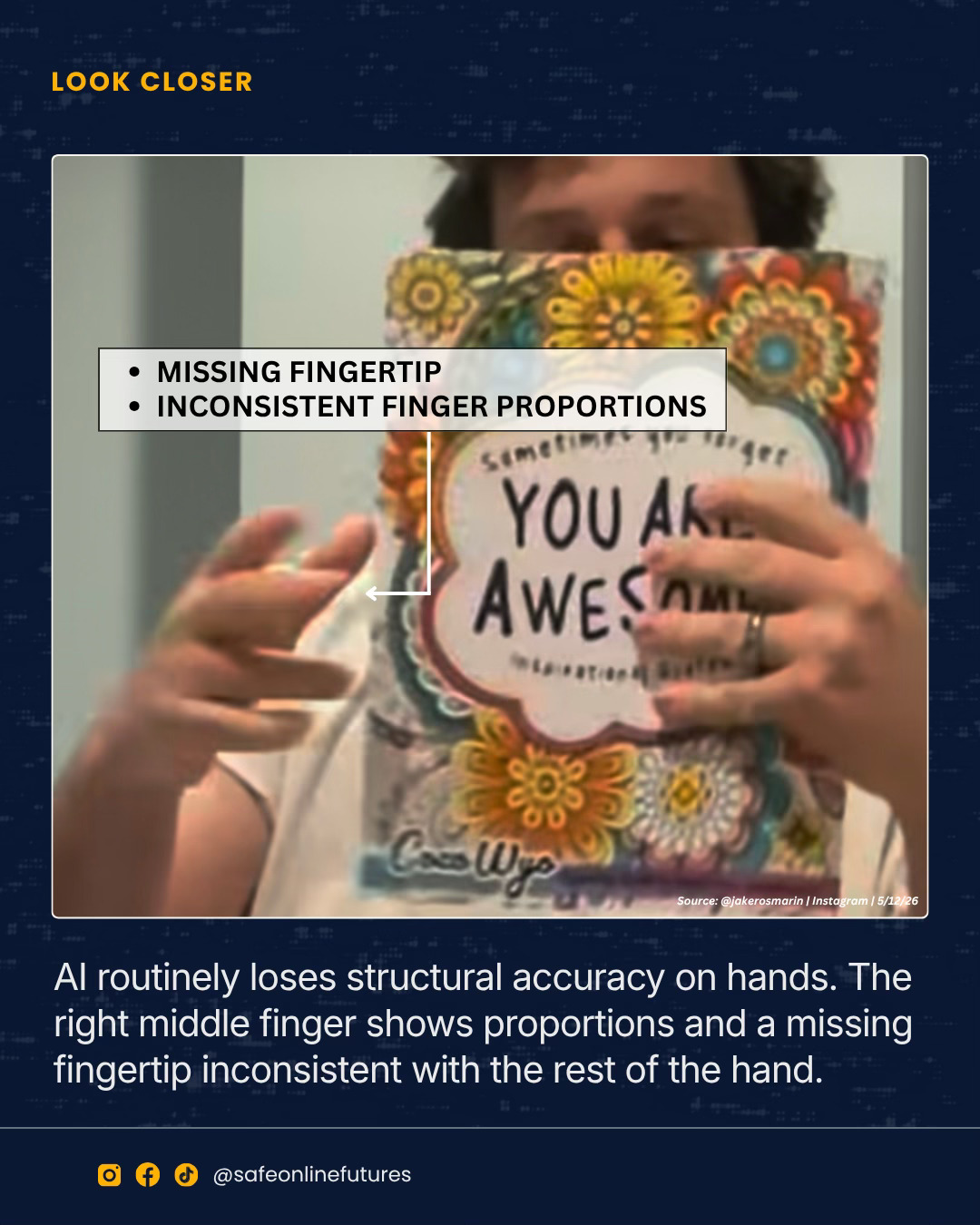
Several of Rosmarin’s videos also contain visual anomalies consistent with AI image or video manipulation. In one unboxing video featuring an adult coloring book, his right middle finger appears distorted and proportionally inconsistent with the rest of his hand. The fingertip is also missing.
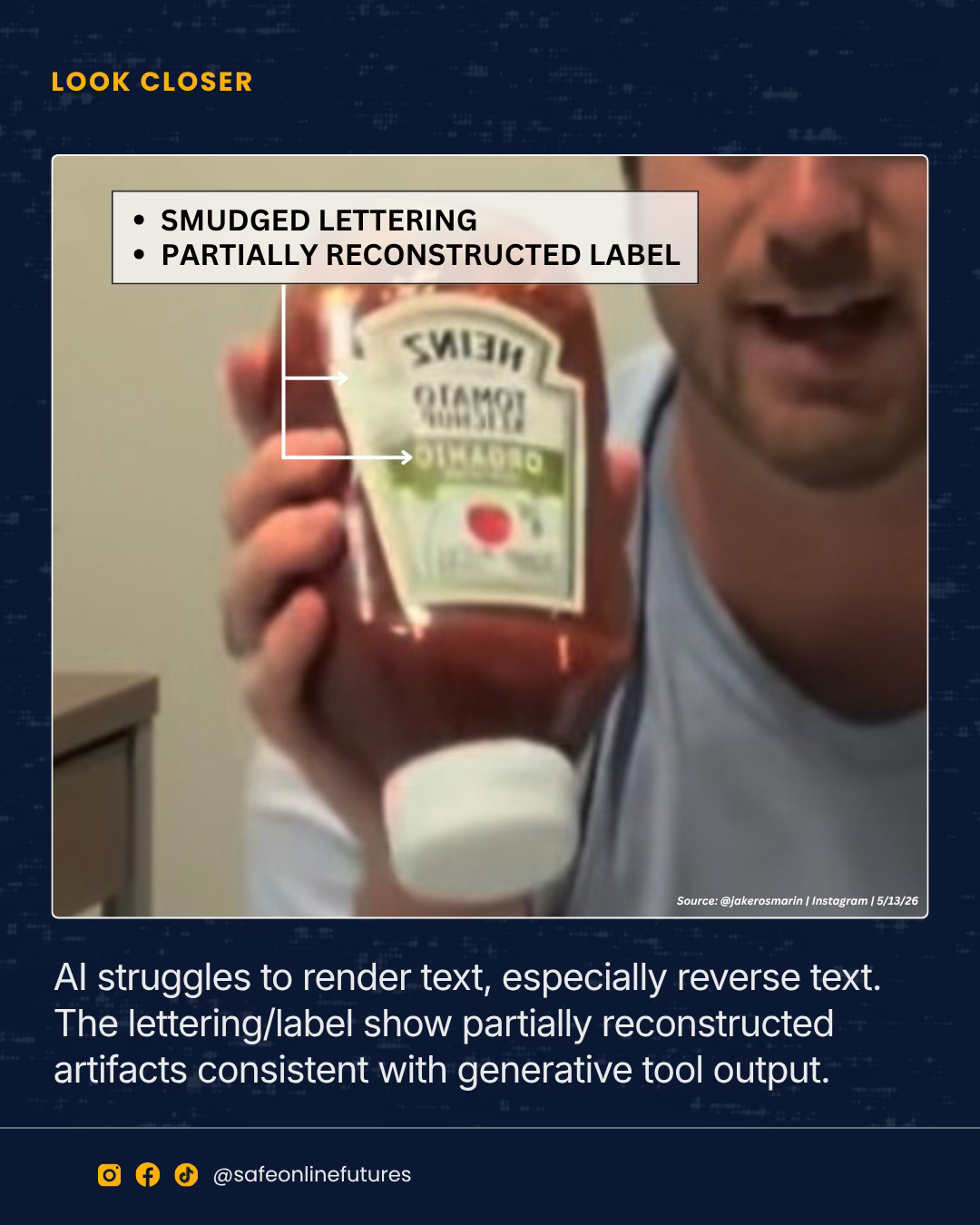
The Heinz ketchup bottle held up in a separate video shows partially reconstructed lettering on the label, the kind of artifact generative tools commonly produce when rendering text, especially reversed text.
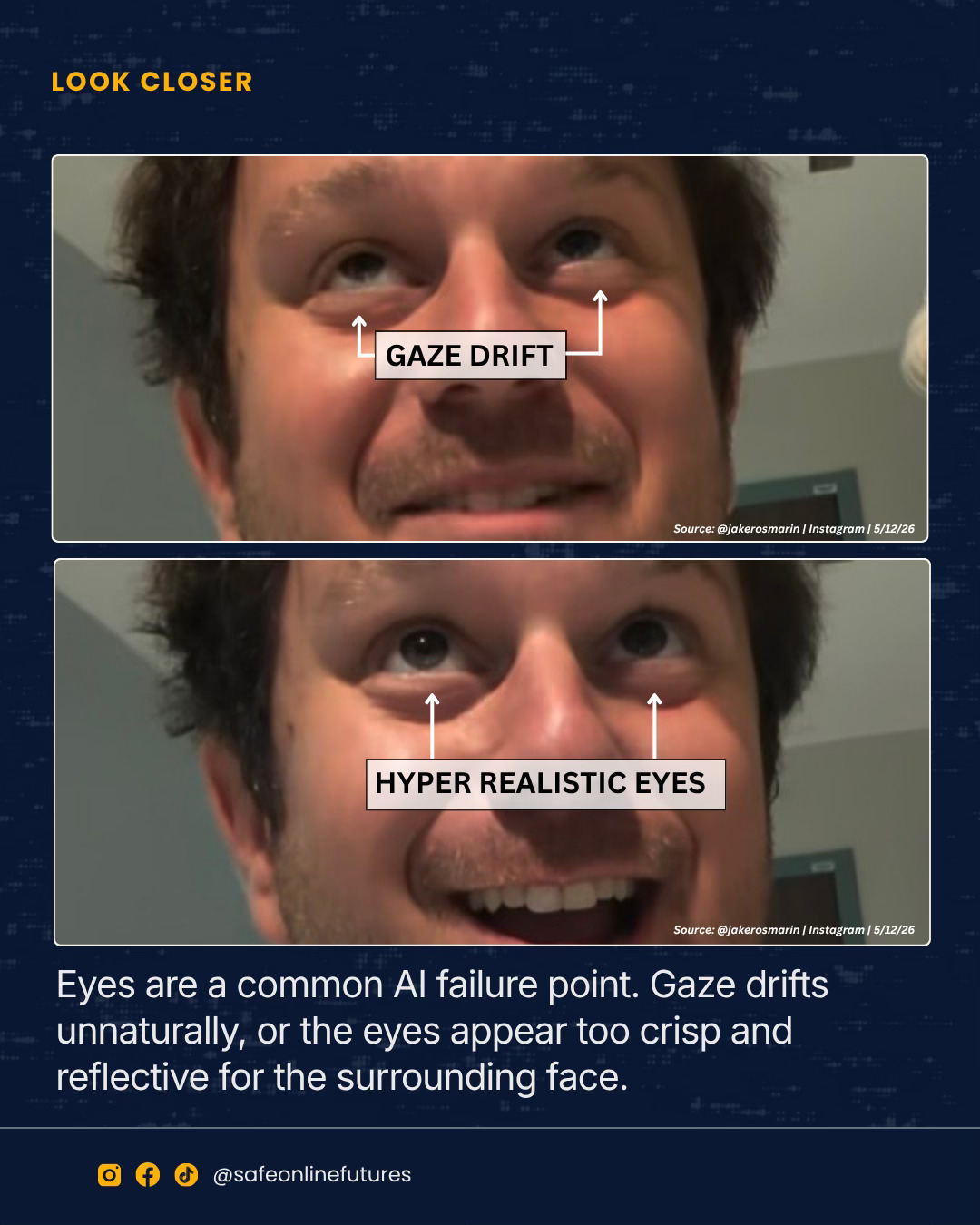
In the Starbucks selfie, his eyes show gaze drift and an unnatural hyper-realism that together produce what researchers call the uncanny valley effect: the creepy, unsettling feeling you get when looking at an AI-generated face that looks almost, but not quite, right.
I cannot prove his videos are AI-generated. Neither can anyone else from the outside. What can be said with confidence is that markers commonly associated with AI manipulation are present, they repeat across multiple posts, no disclosure of any AI involvement exists on the account, and no disclosure is required by any platform, regulator, or news outlet currently featuring his footage. The same regulatory vacuum that allows AI manipulation to go unlabeled also allows undisclosed brand relationships to operate behind the appearance of personal sharing, and the public has no reliable way to tell either apart from authentic life. In a media environment without enforceable disclosure requirements, the public also has no way to confirm whether any social media account belongs to a real person. That uncertainty is the default condition of online information in 2026, and it applies to every piece of content in every feed, not only his.
This is where the network decisions become impossible to ignore. The New York Times called him a travel influencer. The TODAY Show article on its website used a similar descriptor. In a segment posted to CNN’s Instagram, the outlet referred to him as a content creator. Three outlets, three acknowledgments that the subject of their story makes his living producing branded content. The two morning network broadcasts, with the largest audiences of any outlets covering him, used neither word. Both the The TODAY Show broadcast and ABC’s Good Morning America referred to him only as an American passenger.
The choice of descriptor follows the audience. Print readers and digital readers tolerate complication, and the commercial context survives in their version of the story. Morning broadcast viewers receive a cleaner emotional register, and the word that would puncture that register is removed. Influencer and content creator are words that introduce a question the segment is not built to answer in three minutes. They suggest the subject has reasons to be on camera beyond the ones the human-interest frame provides. The content creator/influencer descriptors were stripped out because they did editorial work the broadcasts did not want done. The larger audiences got the version with the commercial scaffolding removed.
The CNN segment is the place where the editorial failure becomes most visible. During the CNN interview, Anderson Cooper said to Rosmarin, “You took video from inside your quarantine unit.” That sentence is not a question. It is a sourcing claim, made by one of the most established journalists in American broadcasting, on behalf of one of the largest news networks in the world. It tells viewers that the footage Rosmarin produced is what it appears to be: authentic documentation by him, of him, from inside the federal quarantine facility. That representation carries the weight of CNN’s editorial standards, whatever those standards currently are.
The problem is what becomes visible when the same footage is slowed down. The visual anomalies described earlier in this essay are not hidden in metadata or detectable only through forensic software. They are in the frame, available to anyone with a pause button. A network the size of CNN, preparing a segment with one of its most senior anchors, presumably reviewed the footage before airing it. If the vetting happened and the anomalies were noted, CNN chose to vouch for the footage anyway. If the vetting did not happen, CNN aired a sourcing claim it had not done the work to support. Viewers have no way of knowing which is true. They also have no way of knowing whether the same calculation was made at NBC and ABC, who also licensed and embedded his footage. All the public can know is that the videos are available to watch, the anomalies are available to see, and the networks chose to present the material as authentic documentation regardless.
That choice raises a structural question about how legacy news outlets now operate. Influencers arrive pre-packaged for television. They are camera-ready, articulate, willing to be interviewed, and producing their own footage that networks can embed at no production cost. They solve problems that traditional news bookings create. Platforms surface trending subjects, networks ratify them. NBC, ABC, CNN, and the New York Times did not discover Rosmarin. The algorithm did. They booked him because he was already viral, and the bookings delivered something the algorithm cannot: the imprimatur of legacy news brands. As seen on TODAY and as seen on CNN are now deliverables an influencer can extract from a news cycle, and the cost of those deliverables to the networks was negligible because his footage filled the segments.
The loop is visible in real time. Following his appearances on TODAY, Good Morning America, and CNN, Rosmarin posted a new video and tagged Cooper’s Instagram account in the caption. The creator is actively working to extend the attention the networks gave him, channeling their reach back into his own. His follower count, which sat in the low six figures before the broadcast bookings began, has climbed by thousands in the days since. The networks elevated him. He is now using that elevation to grow the audience the brands in his videos are reaching.
Step back and consider who actually benefits from the ambiguity at each layer of this arrangement. Rosmarin benefits from undisclosed brand integrations reaching millions through legacy news distribution. Oceanwide Expeditions, the cruise company with which he has an existing paid relationship, benefits from continued positive brand visibility during a crisis news cycle centered on its own ship. The consumer brands featured in his unboxing videos and surrounding posts benefit from organic-seeming product placement inside a human-interest story. The brands the anchors themselves named during the interviews, Amazon and Uber Eats among them, benefit from placement that arrived through the journalist’s mouth rather than the subject’s. NBC, ABC, and CNN benefit from polished, audience-tested content produced at zero cost to the networks and delivered by a subject grateful for the platform. The social media platforms benefit from the engagement loop the bookings generate as the segments flow back into feeds. The only party in this arrangement with no upside from the ambiguity is the public.
Every layer of the operation depends on the public not asking the questions that would unravel it. The absence of disclosure is the design.
A real federal medical event is reportedly unfolding in Nebraska. According to reporting, eighteen Americans are in isolation, three people on board the MV Hondius have died, and a rare and dangerous virus is being monitored by federal authorities. Wrapped around that event, broadcast onto the screens of millions of Americans, is a content stream featuring undisclosed brand integrations, visible markers consistent with AI manipulation, a documented commercial relationship with the cruise company being covered, and a subject whose influencer descriptor was stripped out of the broadcasts that reached the largest audiences. None of the brands paid for the placement, as far as the public has been told. None of the AI markers have been labeled, because no labeling is required. None of the editorial choices that shaped the broadcasts have been explained, because no explanation is owed. The story arrives polished. The polish is the warning.
WHAT YOU CAN DO NOW
The disclosure infrastructure that should govern this kind of media ecosystem barely exists, and the parts that do exist are inconsistently enforced. Changing that requires pressure on the bodies with the authority to require disclosure and the budgets to enforce it.
Three asks, in order of leverage:
- File a public comment with the FTC. The FTC’s Endorsement Guides require influencers to disclose material connections to brands, but the guidelines do not adequately address what happens when influencer-produced content is licensed, embedded, or amplified by news outlets. Submit a public comment at ftc.gov asking the Commission to clarify disclosure obligations when commercial creator content is featured inside news programming. The comment process is open, public, and on the record.
- Contact the standards desks at NBC, ABC, and CNN directly. Ask whether their morning shows and news anchors vet influencer subjects for undisclosed brand relationships before licensing their footage or conducting interviews. Ask whether the descriptor differences between the network broadcasts and the digital articles published the same week were editorial decisions or oversights. Ask whether brand mentions made by anchors during news segments, such as Amazon during the CNN interview and Uber Eats during the TODAY Show interview, are reviewed for commercial relationships. Public pressure on news ombudspersons and standards desks moves faster than legislation, because it threatens something networks actually fear: the perception that their editorial process has been compromised.
- Support federal AI disclosure legislation. Several federal bills addressing AI content labeling are currently moving through Congress at varying speeds. Contact your House representative and your senators and ask where they stand. For a curated set of action resources, including draft scripts and the relevant legislators by state, visit theaidocgetinvolved.com.
The audience is the only party in the current arrangement with no leverage and no upside. Building that leverage starts with refusing to be the silent participant the system depends on.
The best way to fight a media ecosystem that has stopped doing the work is to demand the work be done. If this piece was useful to you, pass it on. Subscribe to stay ahead of how the attention economy is reshaping what you can trust.