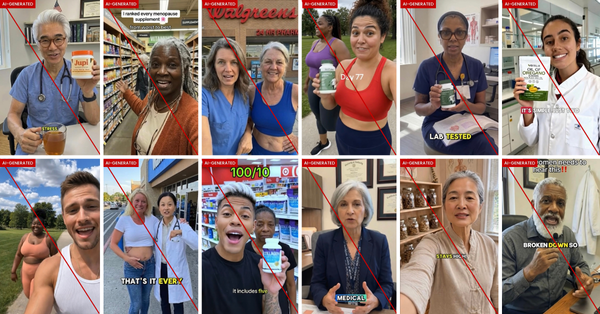
Seeing Is No Longer Believing
Why images and video no longer function as evidence in an AI-assisted media environment
For most of our lives, visual media functioned as evidence.
A photograph documented what was there. A video showed what happened. If something was captured on camera, it carried a basic presumption of truth.
That assumption shaped how we understood news, crime, protests, politics, and public figures. It shaped how journalists reported, how courts evaluated evidence, and how the public formed opinions. Seeing was believing, not because images were perfect, but because they were grounded in reality.
That assumption no longer holds.
Not because people suddenly became dishonest. Not because every image or video is fake. But because the tools used to create, enhance, and distribute visual media have changed faster than our standards for interpreting them.
Today, images and videos circulate in an environment shaped by AI-assisted tools, algorithmic amplification, and powerful incentives to provoke emotion. In that environment, visual media does not function the way it used to, even when it looks real, even when it feels authentic, and even when it comes from sources people recognize.
This explainer is not about telling you to distrust everything you see. It’s about explaining why visual evidence can no longer be taken at face value, and why a higher standard of scrutiny is now necessary.
Why This Matters Now
In a pre-AI media environment, giving visual evidence the benefit of the doubt made sense. Most manipulation required specialized skills, left obvious traces, or was limited to high-budget productions.
That is no longer the case.
Today, AI-assisted tools can subtly alter, enhance, or “repair” images and video in ways that are difficult to detect, especially once content is compressed and shared across social media platforms. These changes don’t need to invent entire scenes to be influential. They only need to adjust details, smooth inconsistencies, or guide perception in emotionally persuasive ways.
At the same time, there is no universal requirement for content creators, media outlets, platforms, influencers, politicians, or celebrities to disclose whether the images or videos they post have been AI-generated or AI-enhanced. The public is rarely told how visual content was produced, and the tools marketed as AI detectors are widely known to be unreliable, particularly for partially synthetic or post-processed media.
As a result, people are being asked to evaluate visual “evidence” without knowing how it was made, whether it was altered, or what incentives shaped its release.
That gap between capability and disclosure is the core problem this explainer addresses. And it begins with a misunderstanding about what AI actually does to visual media.
AI Doesn’t Have to Fake Everything to Change What You See
When most people hear “AI-generated media,” they imagine something obvious: a completely fake image, a deepfake face, or a video that never happened.
That framing is outdated.
The most influential AI-assisted content today is not fully invented from scratch. It is built on real images and real footage that people already trust. Partially synthetic visuals that have been subtly altered, enhanced, or filled in by AI systems.
Modern AI tools don’t need to fabricate an entire scene to shape perception. They can intervene in small but meaningful ways: smoothing or reconstructing faces, altering hands or facial expressions, repairing low-resolution or low-light footage, sharpening details that were never clearly captured, interpolating missing frames in fast-moving video, modifying or reconstructing text and symbols.
These changes often occur in places people instinctively trust: faces, gestures, and visual details that feel human. And because the underlying image or video is real, the result feels authentic, even when it no longer represents what was actually captured.
Modern AI-assisted tools, including generative video and image systems like Sora and Nano Banana, conversational models like Grok, and other current and emerging platforms, can be used to enhance, repair, or reconstruct visuals, blurring the line between what was captured and what was generated.
This is why focusing only on fully synthetic “deepfakes” misses the point. The most dangerous content today isn’t obviously fake. It’s plausible, emotionally resonant, and built on a foundation of reality that has been quietly reshaped.
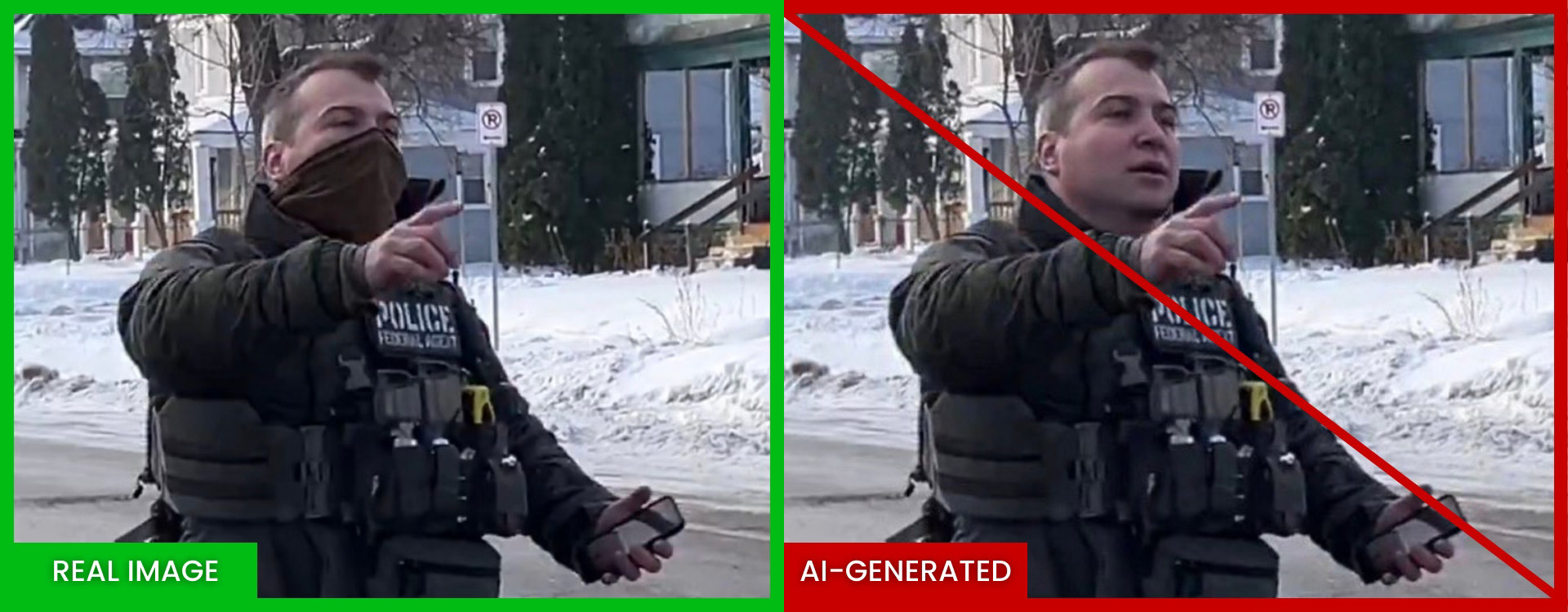
One clear example of this dynamic emerged after the killing of Renee Nicole Good in Minneapolis. A widely circulated video showed a masked ICE agent at the scene. Soon after, users began prompting AI tools to generate “unmasked” images of the agent, even though AI systems cannot reconstruct a real face from masked footage. The resulting images varied widely and had no factual connection to the actual individual, yet they spread rapidly and were treated by many as if they revealed a real identity. In a breaking-news vacuum, fictional visuals filled an information gap, acquiring narrative authority simply by existing and circulating. This is how partially synthetic media manufactures certainty without evidence.
This shift is not limited to one platform or one tool. High-fidelity video generators, image enhancement systems, repair models, and consumer-grade AI editors are now widely accessible. New tools appear constantly, and many are designed specifically to improve realism rather than create something visibly artificial.
In this environment, the question is no longer “Was this entirely made by AI?” The more relevant question is “What parts of this image or video were touched, shaped, or reconstructed, and why?”
That distinction matters, because partial intervention is harder to spot, easier to deny, and far more effective at influencing how people feel about what they’re seeing. And once that partially altered content is compressed and redistributed across social platforms, those interventions become even harder to distinguish from reality.
Why “It’s Just Compression” No Longer Explains What We’re Seeing
When visual anomalies appear in partially altered photos or videos, a familiar explanation is often offered: “It’s just compression.”
For years, that explanation made sense. Social media platforms compress images and video to reduce file size and speed up delivery. In the past, compression typically degraded reality, lowering resolution, blurring edges, or introducing blocky artifacts. When something looked slightly off, compression was often the most reasonable explanation.
That logic no longer holds.
Today, AI-assisted tools are designed to work with compression, not against it. Many image and video models are trained on heavily compressed data and optimized to produce outputs that remain smooth, coherent, and believable after being compressed again for social platforms.
This creates a fundamental shift. Compression no longer exposes manipulation. It conceals it.
Rather than degrading reality, compression now helps mask subtle AI intervention, smoothing transitions, blending altered regions, and preserving overall plausibility even when details don’t quite behave as they should.
This is why dismissing visual inconsistencies as “just compression” is no longer a neutral or responsible default. Compression is not an external flaw layered onto otherwise pristine footage. It is the environment in which modern visual media is created, processed, and distributed. And in that environment, AI-assisted changes can survive, and even benefit from, compression.
All social media video is compressed. That fact does not negate skepticism. It heightens it.
When compressed images or video display anomalies that align with known AI failure patterns, especially in faces, hands, text, or motion, those inconsistencies should not be waved away. They should prompt questions about how the content was produced, processed, and circulated.
Compression is no longer a shield for authenticity. It is a reason to look more closely. And because these interventions often leave no obvious trace after compression, viewers are rarely told, or even able to tell, that anything has changed.
Why the Public Is Flying Blind
At this point, a reasonable question arises: If AI-assisted visuals are so widespread, why aren’t they clearly labeled?
The short answer is that, in most cases, they don’t have to be.
There is no universal legal obligation requiring mainstream media outlets, social media platforms, influencers, politicians, or celebrities to disclose whether the images or videos they post have been AI-generated or AI-enhanced. Subtle forms of intervention like enhancement, repair, smoothing, or partial reconstruction often go entirely unlabeled.
As a result, the public is rarely told how visual content was produced, what tools were involved, or whether any parts of an image or video were altered before being shared.
Some platforms have introduced voluntary labels or policies around synthetic media, but these systems are inconsistent, unevenly enforced, and often limited to fully generated content. They do not reliably address the far more common reality of partially AI-assisted visuals.
It might seem like AI detection tools could solve this problem. In practice, they do not.
Publicly available AI detectors are widely known to be unreliable, especially for compressed video, edited images, or content that has been partially altered rather than fully generated. Detection systems struggle with exactly the kinds of visuals most likely to circulate: short clips, low-resolution footage, screenshots, and re-shared media that has passed through multiple platforms.
This leaves the public in a difficult position. People are expected to assess the authenticity of visual “evidence” without disclosure, without reliable detection tools, and without insight into how or why the content was produced. The responsibility for interpretation has quietly shifted away from platforms and publishers and onto viewers.
That shift is not the result of individual failure or public ignorance. It is a structural gap between what modern AI tools can do and the standards currently in place to govern their use.
And it is precisely why skepticism is no longer optional. When systems provide neither transparency nor verification, interpretation itself has to change.
The Principle Shift: No Image or Video Is Self-Authenticating
Taken together, these changes require a shift in how visual media is interpreted.
In the past, images and video were treated as self-authenticating. If something appeared to be recorded, it carried an automatic presumption of accuracy. Questions about manipulation were the exception, not the rule.
That presumption no longer holds.
In a media environment shaped by AI-assisted tools, algorithmic amplification, and powerful incentives to provoke reaction, no image or video can be treated as evidence simply because it exists.
This does not mean that every image is fake or every video is deceptive. It means that visual media now requires the same scrutiny we already apply to other forms of claims: context, sourcing, incentives, and consistency with observable reality.
This is the core principle behind my work: Visual media is no longer self-authenticating. Skepticism is not cynicism. Scrutiny is not accusation.
Responsible skepticism does not begin with declaring something false. It begins with asking whether the available evidence justifies the conclusions being drawn from it, especially when images or videos are used to shape public opinion, justify authority, or provoke outrage.
In this environment, the burden cannot rest solely on viewers to “prove” that something is AI-generated. When disclosure is absent and detection is unreliable, elevated scrutiny is not optional. It is the only responsible posture.
This principle is not about distrusting everything. It is about refusing to treat unverified visuals as self-evident truth.
Once that shift is made, a different question becomes possible, not “Is this fake?” but “Why is this being treated as evidence, and to what end?”
That shift doesn’t require panic. It requires a change in how we engage with what we see.
What This Means for the Public
This shift does not mean that nothing can be trusted. It means that trust can no longer be automatic.
For decades, people were taught to evaluate visual media passively. If something looked real and came from a familiar source, it was treated as a reasonable representation of events. That habit made sense in an earlier media environment. Today, that same habit creates vulnerability.
When images and video are no longer self-authenticating, and when disclosure and detection cannot be relied upon, the public is asked to do something new: to engage visual media actively rather than absorb it reflexively.
This does not require technical expertise. It requires a different posture.
Instead of asking only “Is this real?” the more useful questions become: Who published this, and why? What claim is this visual being used to support? What is missing from the frame: context, sourcing, or corroboration? Who benefits if this is accepted at face value?
These questions do not accuse. They orient.
It is also important to recognize why this moment feels so destabilizing. Visual media has long functioned as a shortcut to certainty. Losing that shortcut can feel like losing ground. In reality, it is a recalibration, a return to judgment over reflex.
This is not a failure of the public. It is a transition period in which standards have not yet caught up to capability.
Until they do, skepticism is not a sign of paranoia or disengagement. It is a form of media literacy and, increasingly, a form of civic responsibility.
Seeing is no longer believing. But understanding is still possible.
Subscribe for clear, evidence-based analysis of how AI is reshaping visual proof, media trust, and public perception.