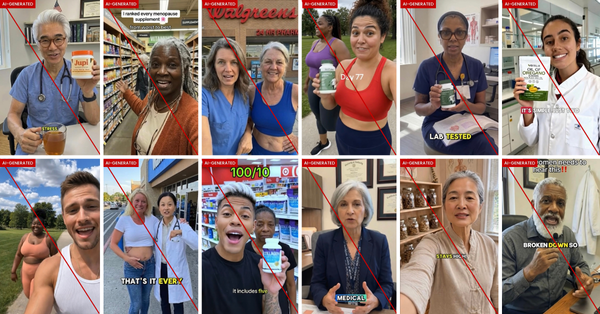
She had a million followers. She doesn’t exist.
AI-generated influencers are flooding your feed. The system rewarding them has no interest in stopping.
Her name was Jessica Foster. She was a blue-eyed, blonde Army soldier who had somehow managed to pose with President Donald Trump on the flight line, walk a tarmac on the first day of the U.S. strikes on Iran, and meet with Ukrainian President Volodymyr Zelensky, Russian President Vladimir Putin, and soccer star Lionel Messi. In between those appearances, her Instagram account also featured prominent photos of her feet and directed her growing audience to an OnlyFans page. She accumulated more than a million followers over four months. Thousands of men left comments. Some called her beautiful. Others asked why she never wrote back. They had no way of knowing the answer.
There is no Jessica Foster — and that crucial detail reframes everything about her account. She is fake, almost certainly the product of an AI image generator, as experts who reviewed her content told The Washington Post. There is no military record of her service. Her uniform insignia suggest she is simultaneously a staff sergeant, a Ranger school graduate, and a one-star general. In one photo, she gives a speech at an event called the “Border of Peace Conference,” a garbled version of Trump’s actual “Board of Peace.” In another, she holds a captive Venezuelan President Nicolás Maduro while her uniform lists her first name where her last name should be. A million people followed her anyway.
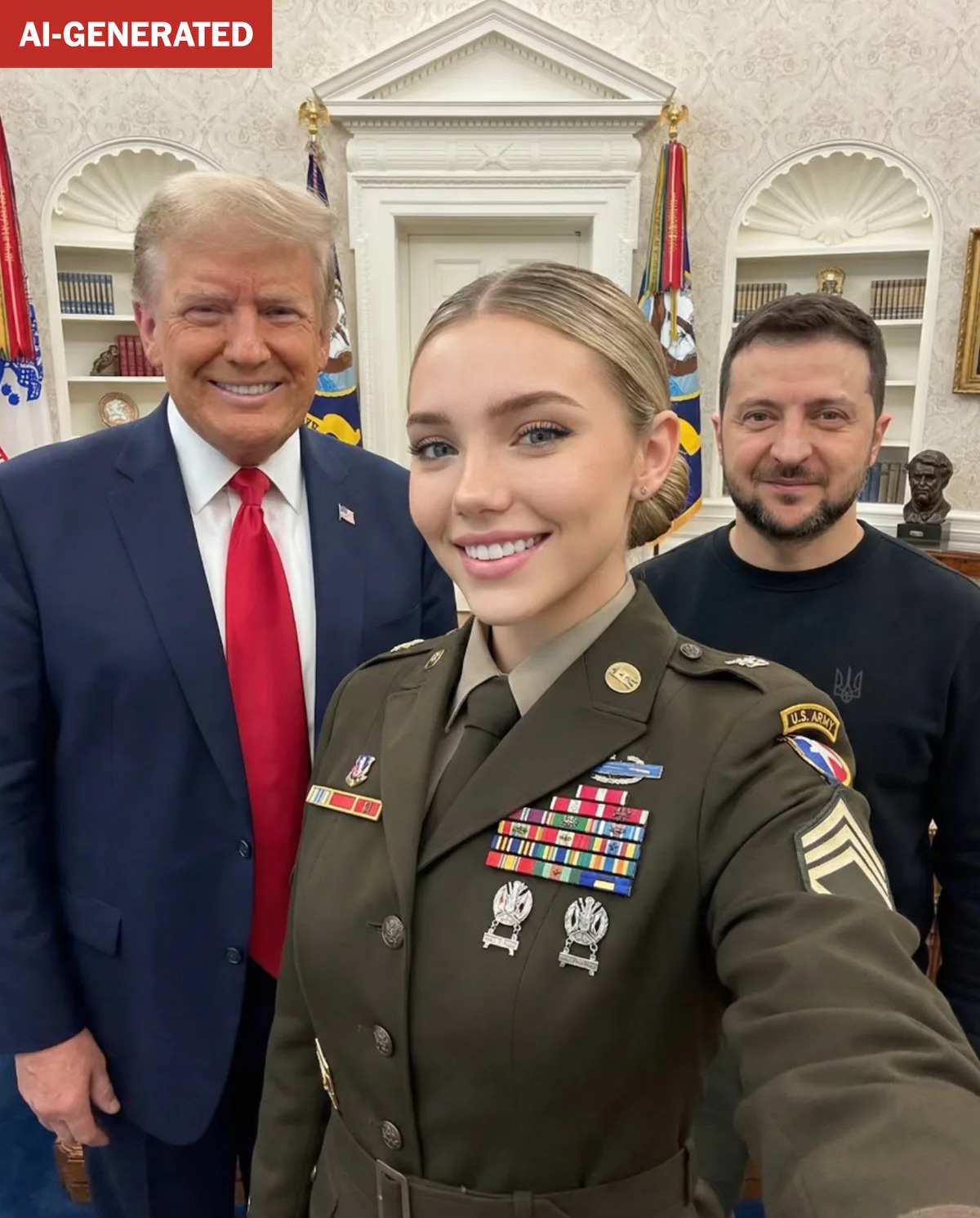
Foster’s account is a precise example of an increasingly popular strategy for winning attention online. A wave of right-wing accounts, peddling patriotism mixed with soft-core pornography, using AI-generated women and convincing imagery to grab viewers across a distracted internet. All to monetize their interest, and score political points in the process. The formula is a sales funnel dressed in a flag: patriotic content and a pretty face pull people in for free, then the account directs its most engaged followers to a paid platform for locked content. After OnlyFans removed it for policy violations, Foster’s account migrated to a smaller competitor called Fanvue, which allows AI models and labels them as “generated or enhanced.” The political content drives the audience, and the audience funds the operation. The two are not separate products. They are the same product, packaged for people the platforms have already identified, profiled, and made available to whoever wants to reach them.
Foster is not operating alone. Starting in January of this year, The New York Times began tracking AI-generated pro-Trump influencer accounts on TikTok and found at least 304 of them. Researchers at Purdue University’s Governance and Responsible AI Lab found more across Instagram and Facebook. An analyst at a digital threat mitigation company identified nine more on YouTube. Several accounts had already crossed 35,000 followers. Some posts had been viewed more than half a million times.
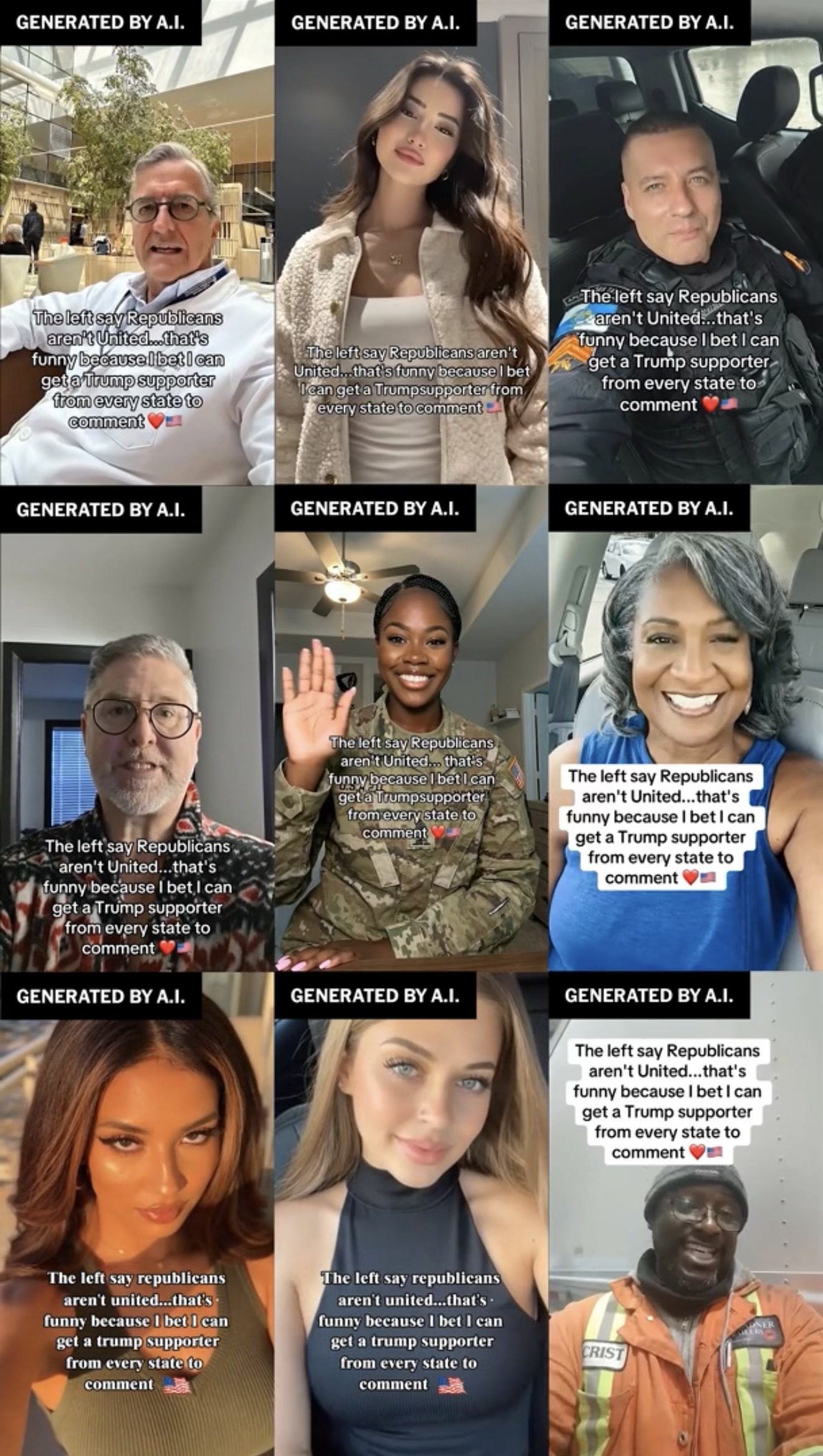
The accounts are clearly linked. Clusters share identical captions, sound effects, and profile pictures. The same AI-generated faces reappear across multiple accounts: a blonde in braids on a farm at golden hour, a woman in a purple top in a wheelchair, a Black woman in a red MAGA hat and aviator sunglasses. Their bios read like they were written by the same hand, because they probably were. At least 13 accounts share the exact phrase: “Republican&Proud Of you support Trump let me know.” Their English is stilted, their geography vague, their claims untraceable. Mr. Trump is their favorite “presidont.” They urge viewers to “follow me first if like my live.”
Mixed into the commercial noise — the hair removal cream, the tours to China, the feet pictures — is a relentless, high-volume stream of content about the “radical left,” “America First,” the war in Iran, immigration, and abortion. All of it flows from faces that look like real people, delivered in the register of real people, to real people who have no way of knowing what they are actually looking at. Researchers reviewed the comments on many of these posts and found that a significant share of users appeared to believe the avatars were real.
Understanding why requires a brief detour into how our brains actually work. The human visual system has dedicated neurological architecture for processing faces, built over hundreds of thousands of years of evolution in which correctly reading another person’s intentions mattered enormously. When a face looks at you from a screen, something automatic happens before conscious thought engages. Trust gets extended. Attention gets held. The emotional register activates. Political operatives have always understood this, which is why ads feature candidates’ faces rather than their policy papers. What AI has done is remove the cost and friction from that equation entirely. You no longer need a real person. You just need a server and a subscription.
“They’re trying to spread political messages and give an illusion of a consensus. Flooding the zone with tons and tons of videos seems geared to give a false sense of majority opinion.” — Andrew Yoon, CivAI
The strategy is not precision targeting. It is volume. Post enough faces saying the same things, and your feed starts to feel like a movement. Researchers describe it as “spray mode” — flooding the zone rather than targeting specific voters — laying the groundwork for audiences to absorb a particular political identity as the default, without any single piece of content being traceable to a campaign, donor, or foreign government.
You may be wondering who is actually behind these accounts. The honest answer is that we don’t know — and that uncertainty is itself part of the story. Three groups have clear motive, and the evidence suggests all three may be involved, in different configurations, across different accounts.
Politicians and their allies benefit most directly from the output. A high-volume stream of photorealistic faces expressing enthusiasm for a candidate or contempt for their opponents does not need to persuade anyone directly. It just needs to make that enthusiasm look widespread. Trump himself reposted content from one of these AI accounts — a platinum blonde avatar making false claims about California Governor Gavin Newsom, with more than 51,000 TikTok followers.
The AI industry benefits from the demand. A startup called Doublespeed, backed by the venture capital firm Andreessen Horowitz, openly advertises that one person can now do the work of a 30-person creator team at a fraction of the cost. Each post costs approximately $1 to $3 to generate. The company’s co-founder told the Times that Doublespeed declines political work, but added that “there are a lot of companies out there that are taking those contracts, and those contracts are honestly bigger and very tempting.”
The platforms benefit from the engagement. TikTok reviewed all 304 accounts the Times identified and concluded there was “zero indication of covert influence operations,” classifying them instead as commercial spammers. Meta says it requires AI disclosure under threat of penalties. YouTube said it was reviewing the channels in question. None of the accounts examined by either the Times or the Post carried any AI label. The accounts, in the meantime, kept posting. The algorithm does not ask whether the face is real. It asks whether you stopped scrolling.
Beyond those three, the commercial clutter in many accounts — the hair removal cream, the China tours — suggests some operators may be primarily profit-motivated, using political content as high-engagement bait to grow audiences they monetize through other means. And similar networks of AI-generated female soldiers have proliferated in other countries during periods of conflict, suggesting a broader, international template that various actors are now adapting for their own purposes. The Post reported that hundreds of AI-generated videos showing Iranian female soldiers cheering on their country’s military spread widely during the Iran conflict — in a country that bans women from combat roles.
Any of these entities could be behind what’s appearing in American feeds right now. Several could be operating simultaneously. And because no law requires disclosure, and platform enforcement has been inconsistent at best, there is currently no mechanism to know.
Joan Donovan, an assistant professor at Boston University who studies media manipulation, put the stakes plainly. The grift strategy, she said, can be transformed into information warfare, with anonymously run accounts deployed as a kind of bot army distributing propaganda, disinformation, or wartime talking points at scale. “The danger of this,” Donovan said, “is that we’re moving toward a society of the unreal. It’s one way to get political messaging across, and it’s effective. We don’t even know if selling feet pics is Jessica Foster’s final form.”
Take note of Donovan’s statement. What looks today like a strange, lucrative internet grift is also a proof of concept. A fully operational infrastructure for manufacturing synthetic political consensus, at pennies per post, already exists and already works — with no requirement to disclose what it is. The technology is getting faster, cheaper, and more convincing with every passing month. The warped flags and garbled captions that make today’s fake accounts detectable will be invisible errors within a year, maybe less.
Some states have begun to take action. California, Texas, and others have passed disclosure laws requiring AI-generated content in political advertising to be labeled. But those laws sre applied unevenly, cover only certain categories of content, and do nothing to govern the kind of organic social media influence operation described in these instances. There is no federal standard. That absence is what allows this fake content to function at national scale, across every platform, with no consistent consequence anywhere.
If you use social media — and if you are reading this, you almost certainly do — you should expect to see more of this content in your feed between now and the midterms. These accounts are not a fringe experiment. They are an operational infrastructure, and the midterms are what they have been building toward. When you come across an account that looks almost too good, whose politics are just a little too loud, whose English is just slightly off, or whose face appears in too many places at once — that pattern now has a name. Knowing what to look for will not make you immune, but it puts you one step ahead of a system that is counting on you not to notice.
WHAT YOU CAN DO NOW
Your voice matters here, and there are concrete ways to make it heard. The AI Doc has built a set of resources specifically designed to help people move from awareness to action — connecting you with the legislators, platforms, and regulatory bodies that have the power to change our current reality.
Start at theaidocgetinvolved.com for a full overview of where and how to engage.
If your concern is specifically about AI in politics, surveillance, and the manipulation of public opinion, your personalized action plan is here.
The loop keeps running as long as the people running it face no consequences. That changes when enough of us stop watching and start demanding accountability and disclosure.
This essay draws on reporting by Tiffany Hsu for The New York Times and Drew Harwell for The Washington Post, both published in 2026.
The best way to fight AI-generated content is real people sharing real journalism. If this piece was useful to you, pass it on. If you want to stay ahead of how AI and social media are reshaping political power, subscribe below.