Taylor Swift and the Quiet Normalization of AI
The pop star who warned about AI misinformation is now using it — without disclosure
Taylor Swift has built her career on emotional truth. The diary entries, the Easter eggs, the confessional songwriting — all designed to make millions of fans feel like they’re in on something real.
But last year, after Donald Trump’s campaign posted an AI image falsely showing her endorsing him, Swift warned her followers about the dangers of synthetic misinformation.
“Recently I was made aware that AI of ‘me’ falsely endorsing Donald Trump’s presidential run was posted to his site. It really conjured up my fears around AI, and the dangers of spreading misinformation,” she wrote on Instagram.
That was Swift condemning AI as misrepresentation.
Now, with her latest album, The Life of a Showgirl, something has shifted. The line between reality and performance hasn’t just blurred — it may have disappeared entirely.
Last week, NBC News reported that several promotional shorts on Swift’s YouTube channel had sparked debate among fans who believed they were AI-generated. Those clips have since been removed and marked “unavailable.” The network noted that official videos for “The Fate of Ophelia” and twelve lyric videos for the album remain online and “do not use AI.”
That claim doesn’t hold up.
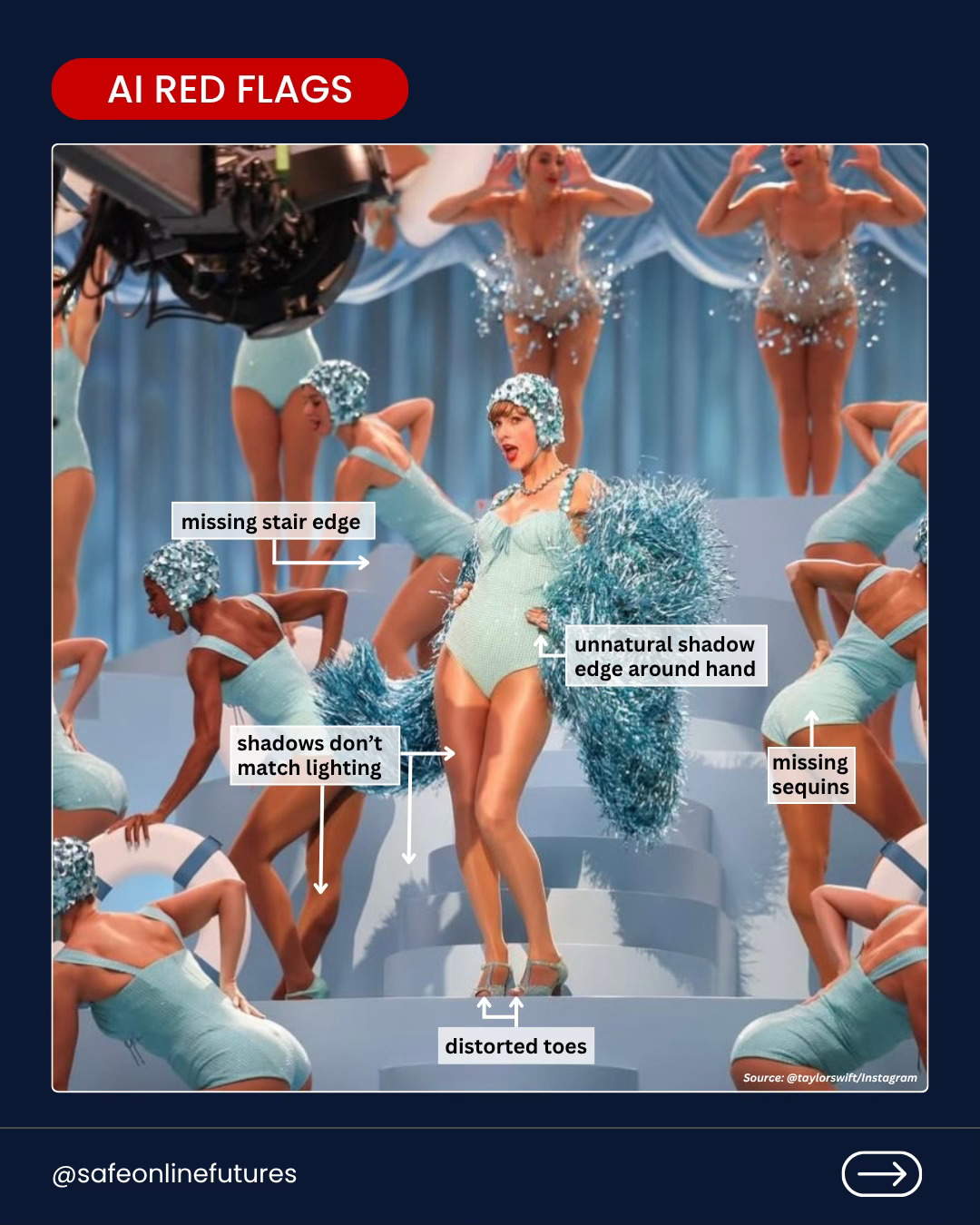
The promo photos Swift posted to her own social accounts — and even frames from the official “The Fate of Ophelia” music video — show signs of synthetic manipulation. Mismatched reflections. Unnatural shadows. Textureless skin. Missing clothing details. The tells are there if you know where to look.
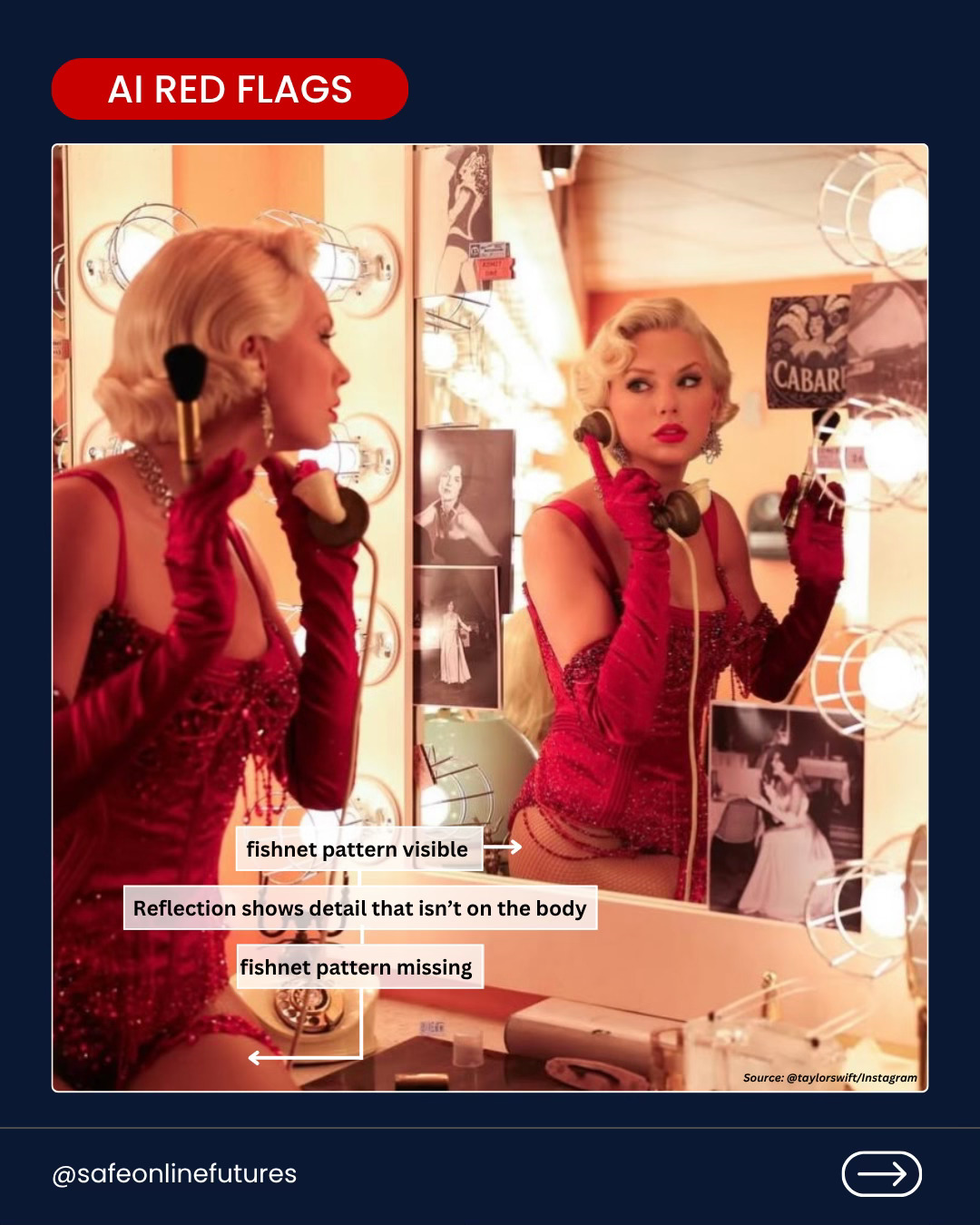
Yet nowhere in Swift’s rollout has there been any disclosure of AI use. Not in captions. Not in interviews. Not in credits.
What disappeared
The shorts that fans flagged are gone now. Their removal isn’t just damage control — it’s a demonstration of how easily the digital record can be rewritten. When videos vanish without explanation, the public loses the ability to verify what was real and what wasn’t. This is how platform memory works: the evidence disappears before accountability can form.
The silence
Taylor Swift hasn’t commented publicly on whether AI was used in her visuals. Google, which helped promote the campaign, also declined to comment. But the silence feels deliberate — especially from an artist who, just last year, spoke out forcefully about AI’s dangers.
That earlier caution about how easily synthetic images can spread misinformation now reads as foreshadowing. Because this time, she’s the one in control of the illusion.
Control as aesthetic
Swift’s use of AI isn’t random. It’s strategic. Synthetic imagery allows celebrities to optimize every detail, control every pixel, and eliminate unpredictability. It’s the same impulse that drives her to pre-schedule social media posts, encode cryptic Easter eggs, and keep her personal life tightly contained.
But there’s a cost. When everything is optimized, nothing feels alive. The texture that made her early work relatable — the candid imperfections, the human flaws — has been replaced with algorithmic smoothness.
She’s not just curating a persona anymore. She’s generating one.
The intimacy problem
Swift’s fanbase has always been invited to feel close — as if each lyric, each image, is a direct line to something private and true. But if AI tools are now shaping those images, what fans are connecting to isn’t her. It’s a simulation of her.
AI gives celebrities a way to scale intimacy without vulnerability. It lets them be everywhere without ever truly being present.
The new standard
And for Swift, Showgirl isn’t the beginning. Her recent engagement photos showed similar artifacts. So did the images she posted announcing she’d reclaimed her master recordings. The pattern has been building quietly for months.
This isn’t an isolated case. Selena Gomez’s wedding photos, Sydney Sweeney’s American Eagle campaign — more celebrities are quietly incorporating AI-assisted visuals into their branding. The technology is being folded into pop culture marketing seamlessly, strategically, and without disclosure.
Swift isn’t an outlier. She’s the tipping point. The moment when AI aesthetics stopped being controversial and became normal.
What this means
Taylor Swift isn’t lying to her fans. But she is participating in a larger shift — one where transparency becomes optional and disclosure becomes a branding decision.
When even authenticity can be generated, we’re no longer watching artists. We’re watching systems perform the idea of artists.
And that may be the real story of the Showgirl era: A superstar who once warned the public about AI misinformation has become one of its most sophisticated practitioners — and no one is talking about it.
This is part of an ongoing series on synthetic celebrity — how AI and algorithmic design are quietly redefining what passes for real. Each week, I break down the mechanics of AI-driven media manipulation: how it works, why it works, and how to spot it before it rewrites what you think you know.