The AI You Don’t See: How Today’s News Footage Is Already Being Altered
A tiny glitch on 60 Minutes exposes how modern broadcasts are quietly reshaping what we think we’re seeing.
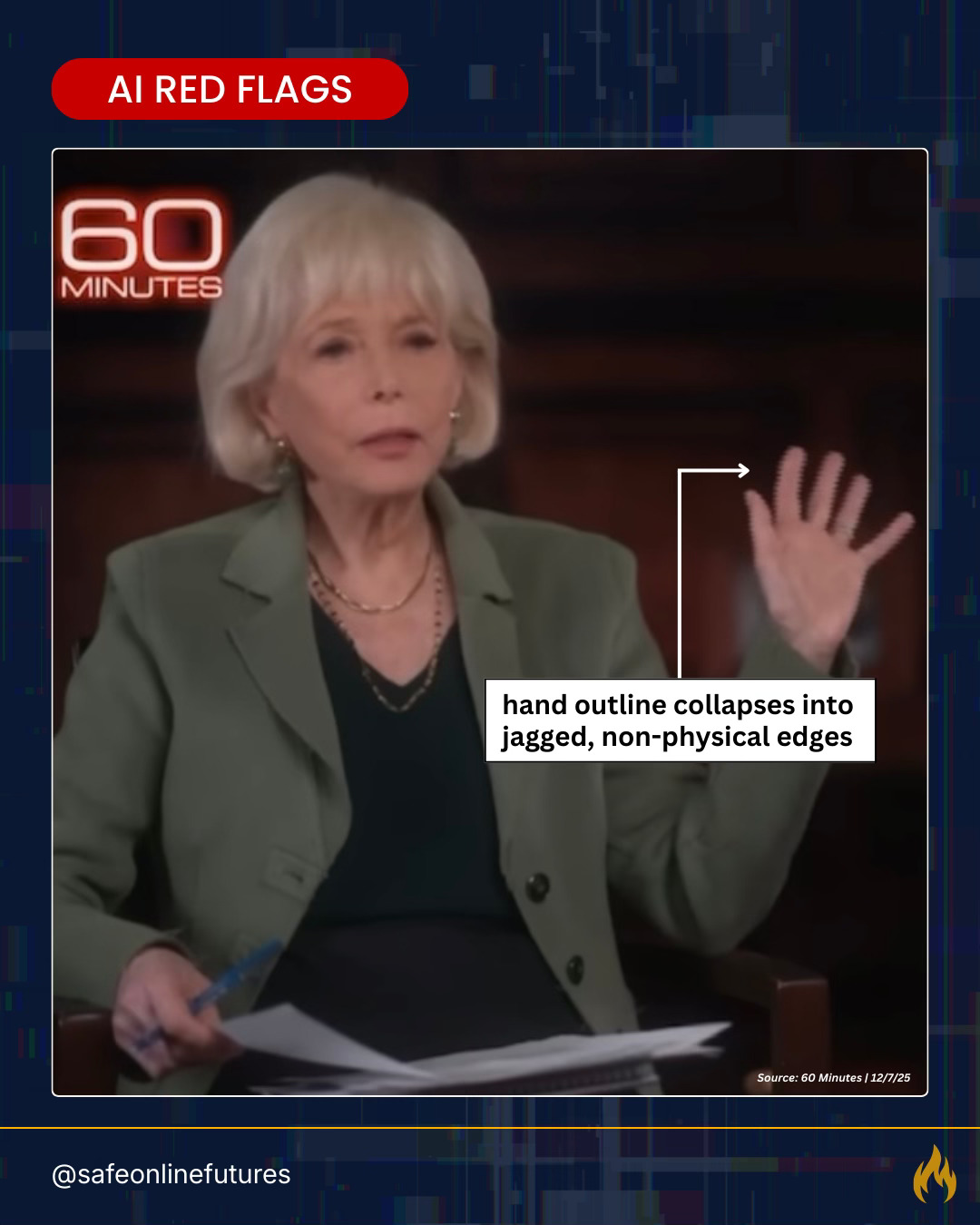
Look at Lesley Stahl’s hand in this freeze frame. Those sharp, jagged edges aren’t a camera glitch. They’re something far more revealing.
The Core Truth
We’re no longer watching raw news footage. We’re watching footage that has already been quietly edited by AI-powered software, sharpening edges, smoothing faces, and sometimes even redrawing parts of the image altogether. Most viewers have no idea this is happening.
This tiny, easy-to-miss glitch from a recent 60 Minutes interview is the perfect example of this new reality.
What Happened
During her interview with Georgia Rep. Marjorie Taylor Greene, Stahl lifted her hand while speaking. In that split second, the outline of her hand broke into sharp, jagged shapes, almost like it was made of cut paper.
This wasn’t camera blur. It wasn’t bad lighting or low-quality video. It wasn’t your phone.
It was something else entirely.
What You Actually Saw
TV networks now run their footage through software that automatically “cleans up” the image. It brightens faces, sharpens details, smooths edges, boosts clarity. But these systems don’t understand the scene the way humans do. They make guesses, frame by frame.
When Stahl moved her hand quickly against a soft background, the software guessed wrong. So instead of showing her real hand, it briefly redrew the edges. Badly. That’s the jagged outline you’re seeing.
Networks don’t announce this enhancement. There’s no disclaimer. The processing happens silently, automatically, invisibly.
Why This Matters
If software can quietly redraw the outline of a hand in a high-profile news interview, what else can it change?
Not intentionally. Not maliciously. But automatically, and invisibly.
A protester’s face, slightly smoothed. A police officer’s gesture, subtly sharpened. A politician’s expression, automatically “corrected” mid-speech.
This is the shift no one is talking about. We’re not seeing events as they were recorded. We’re seeing events after AI processing has already shaped the picture.
Faces can look smoother. Backgrounds can look cleaner. Edges can be corrected. Lighting can be adjusted. Motion can be altered. All before the footage ever reaches you.
The New Media Landscape
This isn’t just about 60 Minutes. If this happens in a controlled studio interview, imagine what happens during protests or breaking news. Fast movement forces the software to guess more aggressively. And when it guesses wrong, the line between what’s real and what’s reconstructed starts to blur.
The Real Question
The danger isn’t that the footage is “fake.” The danger is that the public doesn’t know how much of it is being automatically altered.
A tiny glitch on Stahl’s hand isn’t the whole story. It’s the warning sign.
What This Means
As these AI systems become more common and more invisible, the public needs to understand that the images we rely on for truth may already be filtered, corrected, and partially rewritten by machines.
The footage is still real. But it is no longer untouched.
The next time you watch breaking news, ask yourself: are you seeing what the camera recorded, or what the algorithm decided to show you? That question didn’t used to matter. Now it does.
Exposing how media manipulation, AI, algorithms, and the attention economy are rewriting reality. Subscribe for free to receive insights into the forces reshaping truth in the digital age.