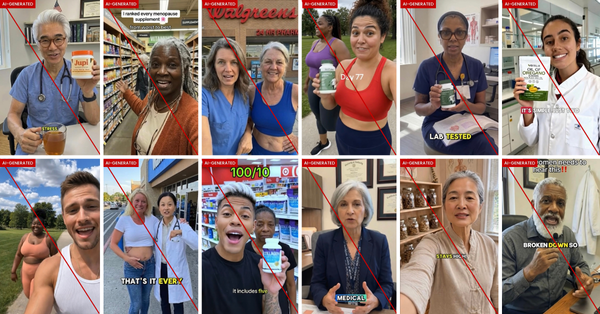
The Amish lady selling you supplements doesn't exist.
Inside the AI-generated influencer operation that hundreds of thousands of people trust for health advice.
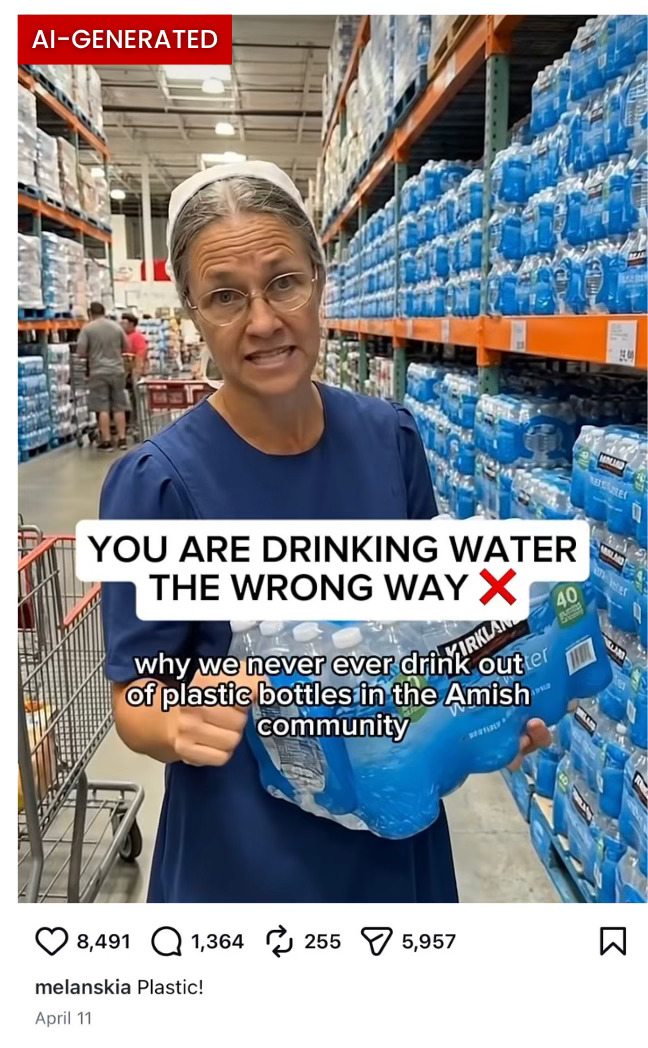
Melanskia is a soft-spoken Amish woman with wire-rim glasses and a white hair-covering. She has more than 350,000 Instagram followers who have come to trust her warnings about the perils of store-bought food. She walks the aisles of a fully stocked Costco, raising her eyebrows at the seed oils. She milks cows and bakes bread. She tells her audience that the modern world is poisoning their bodies, and that she has something that can help — a $50 dietary supplement called Modern Antidote, available on Amazon, which she takes herself.
There’s only one problem: Melanskia is not real.
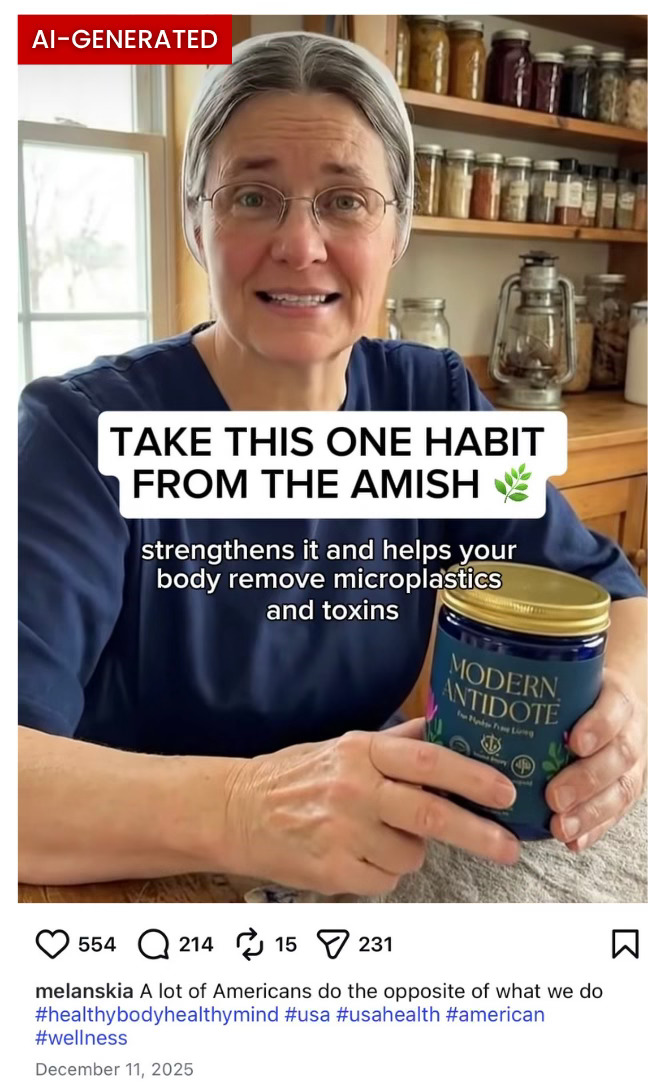
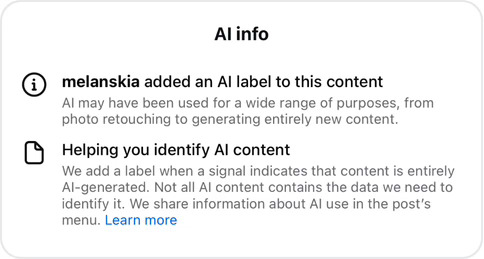
She is one of a growing number of synthetic influencers — entirely AI-generated faces, voices, and lives — being deployed to sell an untested dietary supplement to hundreds of thousands of real people who have no way of knowing what they are actually looking at. Recent posts carry Instagram's generic "AI info" label — the same one applied to retouched photos — but her bio still presents her as a real person, and the posts that built her audience remain unlabeled. The TikTok account of "Farmer Honest," the wholesome white-bearded farmer selling the same product, carries no AI label at all. They are fronts for the same operation. An operation that is working exactly as designed.
Melanskia's Amish costume is not decorative. It is engineered to lower your guard. In the broader American imagination, Amish identity functions as a kind of cultural shorthand for everything synthetic media is not: plain, hand-built, pre-industrial, suspicious of modernity on principle. When you scroll past a woman in a hair covering warning you about industrial food, your brain does not run the same skepticism check it would run on a glossy wellness influencer in a ring light. The hair covering is a trust signal, and that signal is doing most of the persuasion before you’ve even processed what she’s selling.
Then there’s the product. Modern Antidote markets itself as a remedy for modernity: microplastics, seed oils, processed food, the chemical residue of industrial life. The pitch and the persona reinforce each other in a closed loop: a woman who has opted out of the modern world, telling you how to opt out too, by buying a powder made in a California lab and shipped through Amazon. The supplement is sold by the very industrial supply chain it claims to be an alternative to. The face selling it is generated by the very technology it is implicitly indicting.
Behind Melanskia is a 28-year-old Josemaria Silvestrini, who runs the operation from Shanghai while completing a master’s program. He is unusually open about how the business works. “A.I. is a game changer,” he told the New York Times. “Every piece of the business is being A.I.-ified.”
Silvestrini, a chemistry major at Williams College, says he developed the Modern Antidote recipe around sulforaphane, an antioxidant found in broccoli and kale, and contracted a California lab to manufacture it at scale. He used AI to design the logo, the packaging, and the website. The influencers selling the supplement are AI-generated too. So far, he has sold roughly 1,000 jars. There has been no clinical trial. Silvestrini has said he plans to fund one — to test whether his product actually does what he claims it does to microplastics in the body — "as soon as he can afford to.” In other words: the safety and efficacy claims behind a supplement being sold to hundreds of thousands of people rest on the personal finances of one entrepreneur, while the marketing operation is industrial in scale and synthetic at every layer.
Most people picture an “AI influencer” as one fake person operated by one human handler. Melanskia is something stranger. Silvestrini hires more than three dozen independent creators, pays them retainers and commissions, and lets them dream up their own ideas for selling the powder. Different creators puppet different avatars. Some operate Melanskia. Others operate Farmer Honest, or the lookalike muscular middle-aged men, or the wholesome farmer accounts spread across Instagram, Facebook, and TikTok. None of these accounts are labeled as AI. All of them appear to be the personal posts of real people sharing genuine convictions about wellness. The character you think you’re following is not a person. She is a shared costume worn by an unknown number of strangers, all paid to make her look like one.
You may be thinking: surely most people can spot AI when they see it. The research says otherwise. In February, researchers at the University of New South Wales and the Australian National University published a study in the British Journal of Psychology testing how well people could distinguish AI-generated faces from real ones. The study tested 125 participants — 89 average controls and 36 “super-recognizers,” people with documented exceptional face-recognition abilities. Even with obvious visual flaws screened out beforehand, average participants performed “only slightly better than chance.” The super-recognizers did better, but by only a slim margin. “Up until now, people have been confident of their ability to spot a fake face,” the lead author, Dr. James Dunn, said. “But the faces created by the most advanced face-generation systems aren’t so easily detectable anymore.”
The people who follow Melanskia are not gullible. The technology has simply outpaced the human capacity for detection. The cues we evolved to use — the small asymmetries, the strange hands, the dead-eyed stare of an early deepfake — have been engineered out of the latest generation of synthetic media. What’s left looks, to almost everyone, like a person.
We already have a preview of where this leads. In February of this year, the FDA issued a recall on capsules of moringa powder sold under the brand name Rosabella, marketed almost exclusively through TikTok Shop by an array of unlabeled AI-generated influencers — older women promising “age-reversing secrets,” naturopaths and nutritionists with different faces but the same synthetic voice. By the time the recall was issued, the capsules had been linked to a multistate outbreak of extensively drug-resistant salmonella — a strain resistant to all first-line and alternative antibiotics ordinarily used to treat the infection. As of the CDC’s most recent update, the outbreak has been linked to 10 cases across 8 states, with 3 hospitalizations.
The Rosabella and Melanskia playbooks are the same: AI-generated personas, no disclosure, an untested supplement marketed through what appear to be authentic personal accounts. The only meaningful difference is that nobody has gotten sick from Modern Antidote yet. Once you can manufacture trustworthy-looking faces cheaply and at scale,, and pair them with whatever product you want to sell, the only remaining variable is what you put in the jar.
On December 11, 2025, New York signed the first state law in the country explicitly requiring the disclosure of synthetic performers in advertisements — and uniquely, placing the burden on the creators of “synthetic performers” rather than only on platforms. It does not take effect until June 9, 2026. It is also unclear whether a December executive order from President Trump proposing a federal regulatory framework for AI will pre-empt it and similar state laws. For now, there is no federal standard and no requirement that Melanskia identify herself as AI. Instagram's automated "AI info" label, when it appears, is generic and easily missed — and it makes no claim about whether the person on screen exists at all. There is no requirement that the creators puppeting her disclose what they are doing. The only thing standing between her audience and a Rosabella-style outcome is the contents of one entrepreneur’s jar — and the operation will keep running, because the algorithm doesn’t ask whether the face is real. It asks whether you stopped scrolling.
Asked about consumers who react negatively to AI avatars, Silvestrini said he takes their concerns seriously and is “thinking about how to evolve as norms develop around this.” He also predicted that those concerns would fade. “People’s unease about it will, I think, fade more and more away,” he said. “Very soon it’s going to just become so commonplace that it’s just more content.”
He may be right. That is precisely the problem.
WHAT YOU CAN DO NOW
Awareness without action is how this infrastructure keeps growing. The AI Doc has built a set of resources designed to move people from awareness to action — connecting you with the legislators, platforms, and regulatory bodies that have the power to require disclosure, fund enforcement, and hold operators accountable.
Start at theaidocgetinvolved.com/spread-the-word and share what you find. The faster real people share real information about what’s happening, the harder it is for synthetic operations to hide in plain sight.
This essay draws on reporting by Ken Bensinger and Tiffany Hsu for The New York Times, the FDA and CDC’s outbreak investigations into Rosabella-brand moringa capsules, and a study published in the British Journal of Psychology by James Dunn et al. of UNSW Sydney and the Australian National University, all in 2026. It reflects developments since the original NYT reporting on March 9, 2026, including the appearance of Instagram's 'AI info' label on Melanskia posts beginning April 5, 2026.
The best way to fight AI-generated content is real people sharing real journalism. If this piece was useful to you, pass it on. If you want to stay ahead of how AI and social media are reshaping public trust, subscribe below.