The Attention Pipeline
Part 3 of The Manufactured Reality: Engineering Outrage for Political Power
In late October 2025, while millions of Americans lived through a government shutdown, Donald Trump flooded Truth Social with bathroom photos. Two dozen of them. Marble floors, gold fixtures, a chandelier, a bathrobe with the presidential seal.
The internet exploded. Memes, outrage, disbelief. How could a sitting president post luxury bathroom photos while federal workers went unpaid and children’s food assistance froze?
But that question misses the point entirely.
The bathroom wasn’t bad optics. It was a strategic distraction, timed to dominate the news cycle and bury a political liability. And most people never noticed the second layer: the images weren’t entirely real.
The Story That Should Have Been
Nine days before the bathroom photos dropped, a Quinnipiac poll showed 45% of voters blamed Republicans for the shutdown versus 39% blaming Democrats. The narrative momentum was shifting against the administration.
That week should have centered on political accountability. Who caused this crisis? Who’s suffering? What happens next?
Instead, the national conversation became: “Have you seen the bathroom?”
By October 31st, the story of unpaid federal workers and frozen assistance programs had been replaced by a digital guessing game about marble patterns and interior design choices.
What the Images Actually Showed
Look closely at one photo in particular.
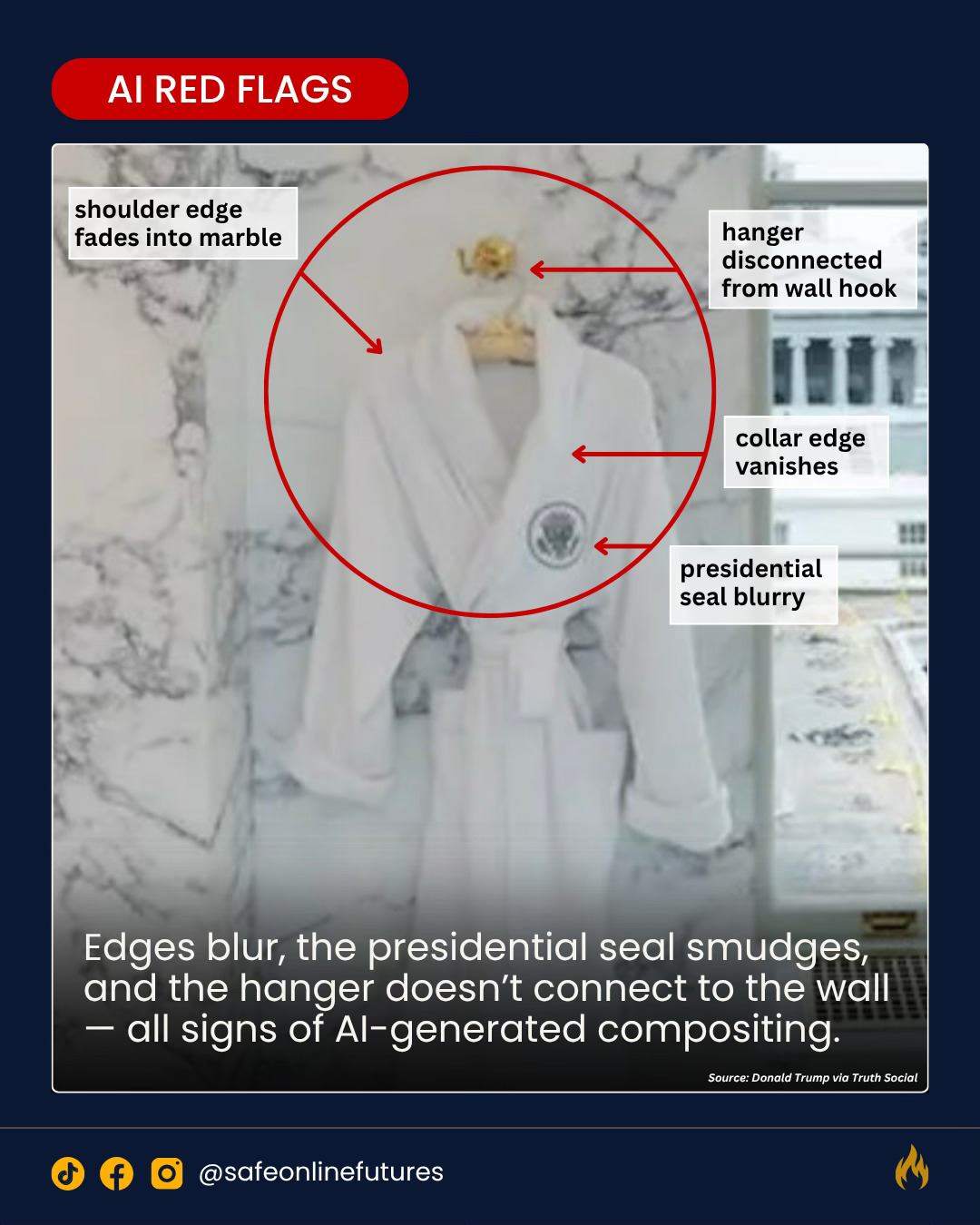
Start with the bathrobe hanging on the wall. The hanger appears to float, disconnected from the wall hook that should be supporting it. Follow the fabric down and watch the right shoulder fade directly into the marble behind it. The collar edge simply vanishes. And that presidential seal, the symbol meant to convey official authority, blurs into illegibility.
Then there’s what the window shows.
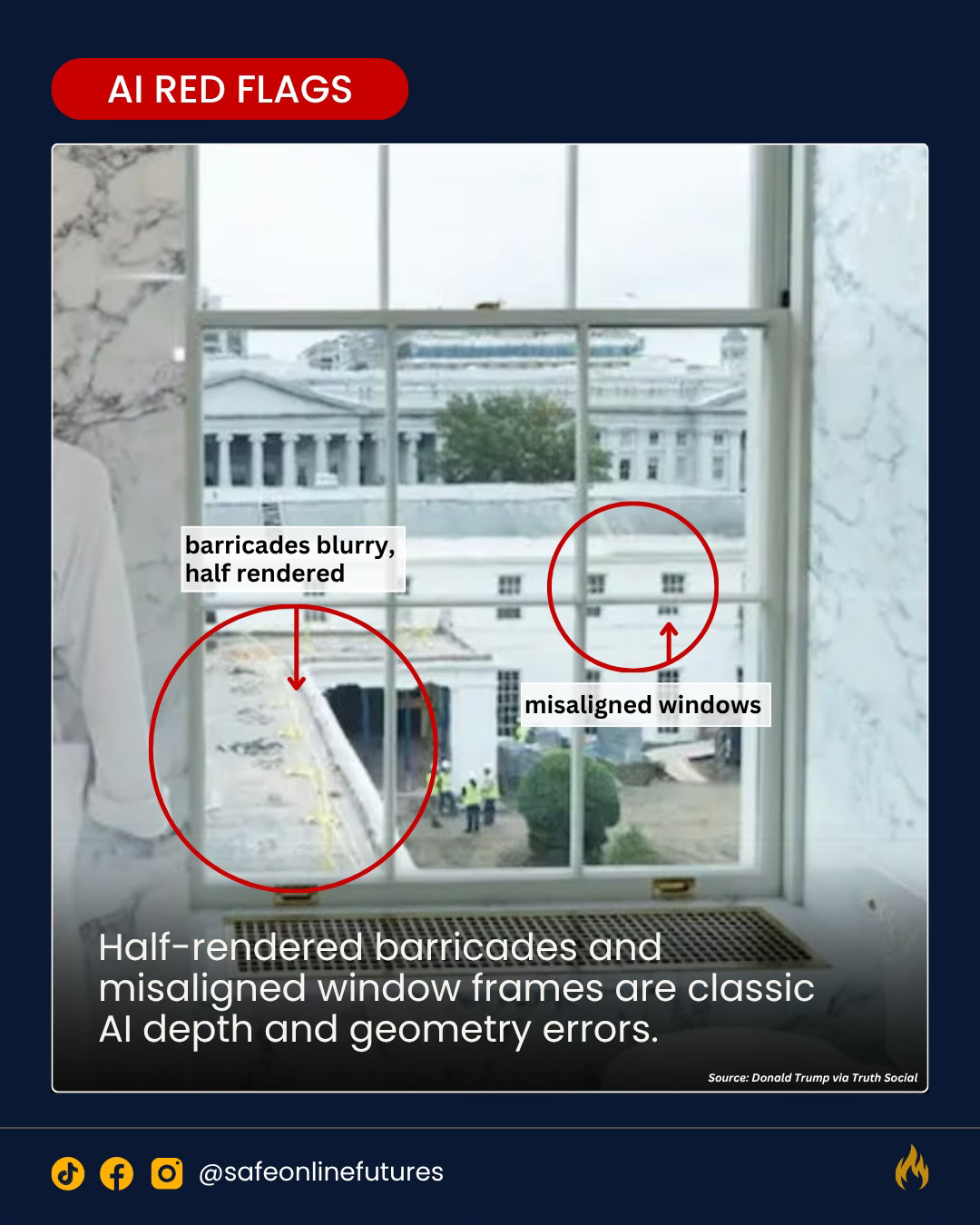
Yellow barricades supposedly marking East Wing demolition dissolve into smeared, half-rendered shapes. The windows themselves don’t align with the building’s architecture, as if the algorithm couldn’t quite figure out how glass and stone should meet.
These aren’t Photoshop errors. They’re the fingerprints of generative AI, the telltale signs left when algorithms stitch real and synthetic elements together. The image doesn’t need to be perfect. It just needs to be compelling enough to spread.
They work not because they fool your eye, but because they capture your attention. That’s the real danger of AI imagery in political communication: it doesn’t have to be perfect. It just has to be compelling enough to spread.
How the Attention Pipeline Works
The bathroom photos didn’t go viral by accident. They were engineered to exploit what I call the attention pipeline, a closed loop that converts spectacle into political power:
Outrage triggers emotion. The images provoke immediate reaction, positive or negative.
Emotion drives engagement. People share, comment, mock, and analyze.
Engagement feeds algorithms. Platform systems detect high interaction rates.
Algorithms reward visibility. The content gets pushed to more feeds.
Visibility becomes influence. The narrative dominates public conversation.
Trump has always understood this instinctively. He doesn’t rely on traditional media framing. Instead, he uses algorithms as amplifiers and audiences as distribution networks. AI simply accelerates the entire process, allowing a single post to reshape national conversation within hours.
The New Propaganda Model
This is how information warfare works in 2025. The goal isn’t to convince people of a specific lie. It’s to saturate the information space until truth becomes secondary to emotion.
AI tools make this frictionless. A few prompts can generate luxury, authority, or outrage on demand. By mixing real photography with AI-generated elements, a communications team doesn’t need to fabricate entire realities. They simply need to flood the public sphere with enough synthetic content to shift collective perception.
The result: people stop asking “Is this real?” and start asking “What does this mean?” By that point, the manipulation has already succeeded.
Every Share Feeds the System
Here’s what makes the attention pipeline so effective: even mockery becomes amplification.
Every repost, every meme, every late-night joke about the bathroom kept the cycle alive. The algorithm doesn’t distinguish between genuine engagement and critical commentary. It only measures whether you’re watching.
That’s how engagement becomes weaponized. It transforms outrage into data, data into visibility, and visibility into control. The marble bathroom was never about showcasing presidential taste. It was about training the public to consume and spread AI-generated content without questioning its authenticity.
What Got Buried
While the country debated marble patterns, millions of Americans were living the actual consequences of the shutdown:
Furloughed federal workers without paychecks. Contract workers suddenly jobless. Low-income families cut off from WIC and SNAP benefits.
These stories were covered. But the bathroom photos seized something more powerful than headlines: they captured collective attention that might otherwise have focused on the shutdown’s human toll.
That’s the core function of the attention pipeline: redirecting focus through engineered distraction.
Beyond Trump
This isn’t ultimately about one politician. It’s about a system that rewards manipulation at an industrial scale, where AI tools and social algorithms have fused into a single apparatus for narrative control.
AI generates the spectacle. Algorithms amplify the outrage. Audiences spread it, often believing they’re resisting it.
We’ve moved past “fake news” into something more sophisticated: synthetic narrative control. The images look real enough. The emotions feel genuine. The engagement metrics are undeniable. But the entire chain of reaction has been engineered.
Reality as a Rendering Process
The marble bathroom wasn’t a distraction from the shutdown. It was part of the shutdown strategy itself. A synthetic image deployed to mask a real crisis. A viral story engineered to bury the truth.
Reality used to be filmed. Now it’s rendered.
Every scroll, every pause, every click feeds the same pipeline, converting human attention into political currency. The more we treat these manufactured moments as entertainment, the easier it becomes for power to rewrite reality one AI-generated image at a time.
The question isn’t whether this will continue. It’s whether we’ll learn to recognize the architecture of manipulation before it becomes invisible.
This is Part 3 of our series on The Manufactured Reality. (Read Part 1 and Part 2 here.) Next: Part 4 — The Perception Coup: How Manufactured Reality Replaces Democracy
Read, share, and subscribe to Safe Online Futures, where reality still matters.