The Claim Doesn't Have to Be True. It Has to Be Profitable.
Nick Shirley's San Diego voter fraud video and the incentive structure behind it.
Right-wing influencer Nick Shirley is claiming more than 30 people illegally registered to vote at a UPS store in San Diego, California. The claim is false. AFP fact-checkers, using what the debunk itself described as “a few minutes of research,” established what the San Diego County registrar of voters and California secretary of state’s office confirmed within days: there are no voters registered to the UPS Store at 4142 Adams Avenue. The people registered at that address live in Kensington Commons, a 34-unit apartment complex housed in the same multi-use building, directly above the storefront. A residential balcony is visible in the video itself.
This isn’t Shirley’s first baseless viral claim. In December 2025, he posted a video accusing Somali-owned daycare facilities in Minnesota of defrauding federal childcare programs. That claim was also debunked, but not before it reached tens of millions of views, was amplified by Elon Musk, JD Vance, and Kash Patel, and prompted the Trump administration to freeze Minnesota’s childcare funding and send hundreds of federal agents, including ICE, to Minneapolis for an immigration crackdown. The policy response came before the facts were settled, and that sequence has since repeated itself.
The San Diego video follows the same pattern. Understanding why requires looking past the claim itself and at the incentives underneath it.
This Isn’t About Voter Fraud. It’s About Incentives.
In January, I documented how Shirley built national political leverage out of a dubious video about Somali-owned daycare facilities in Minnesota. The mechanics were straightforward: fabricate urgency, let platforms amplify, wait for elite figures to engage, and watch institutional pressure follow. The claims didn’t need to be true. They needed to be emotionally activating and structurally resistant to fast debunking.
The San Diego episode runs the same playbook, compressed. The video dropped on February 21, five days before Trump’s 2026 State of the Union, which Shirley attended as a guest. Timing is part of the product. Republican Senator Mike Lee and Donald Trump Jr. amplified the clip before any verification had occurred. Trump Jr.’s framing — “imagine if the mainstream media spent even a few minutes looking into any of these things” — is worth pausing on. The irony is that a few minutes of looking is precisely what revealed there was nothing there. But the amplification had already happened.
This is the mechanism. The claim doesn’t survive scrutiny, but it doesn’t need to. It only needs to travel faster than the correction.
The Polymarket Detail
There’s one element in this story that deserves explicit attention because it makes the incentive structure unusually legible: in the video, Shirley is wearing a shirt advertising Polymarket, a cryptocurrency-based prediction market. Polymarket subsequently amplified his claims on Instagram.
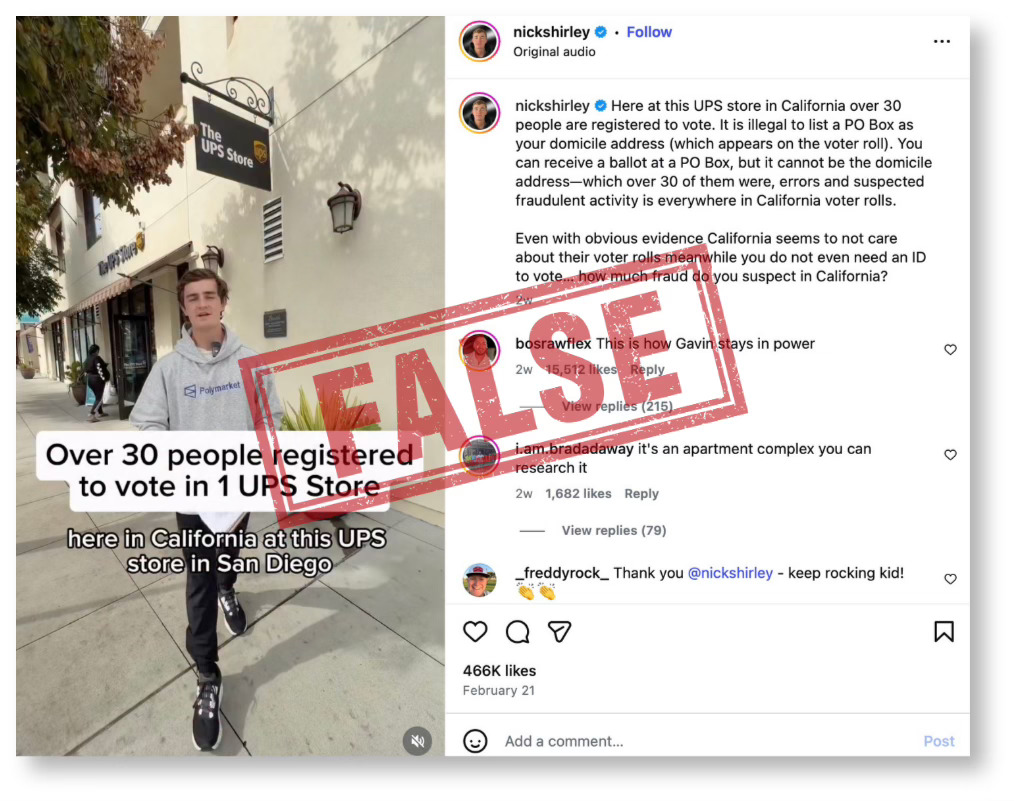
Polymarket allows users to bet on political and news outcomes. Viral claims about voter fraud, particularly when timed to a major political event, are exactly the kind of content that drives trading activity on platforms like this. Whether or not there’s a formal arrangement, the alignment of incentives is visible on screen, literally worn as clothing.
This is what the current system looks like when the machinery is running efficiently. The content creator gets reach and political access. The platform amplifying the content gets traffic and engagement. Elite political figures get a ready-made narrative. And the financial instrument underneath it all profits from the volatility the claim generates.
The voter fraud allegation is not the product. The attention is.
Why This Will Keep Happening
California election law is unambiguous: voters must register using a residential address. Private UPS mailboxes and PO boxes explicitly do not qualify. The secretary of state’s office confirmed that every voter registered at 4142 Adams Avenue used an apartment suite number, not the store’s suite. The registrar confirmed no voters are registered to the store itself.
This information was publicly available before Shirley posted the video. It was available while Senator Lee and Trump Jr. were sharing it. It was available when Polymarket was amplifying it.
The video was never structured to invite verification. It was structured to produce the impression of fraud — a man standing outside a store, papers in hand, speaking with conviction — and to circulate that impression at speed. The absence of evidence was always beside the point.
As I’ve documented in this series, the pattern is reproducible precisely because the incentives that drive it haven’t changed. Platforms reward velocity over accuracy. Elite amplification confers legitimacy before facts are settled. And access, including White House roundtables and State of the Union guest lists, follows attention, not verification.
Until those incentives shift, the UPS store in San Diego won’t be the last stop on this tour. Two things have to happen for that to change. Platforms need to be held accountable: not just for what gets posted, but for what their algorithms choose to amplify and at what speed. And the underlying reward structure has to change: systems currently optimized for emotional reaction need to stop treating outrage and accuracy as equivalent inputs.
Neither of those things happens through awareness alone. It happens through regulatory pressure, sustained public attention, and people who understand the mechanism clearly enough to demand something specific. Vague calls for accountability let platforms respond with PR. Naming the algorithm: the velocity reward, the engagement optimization, the architecture that makes a debunked claim travel ten times faster than its correction, makes the ask harder to dodge.
That’s what this series is for. If it’s useful to you, share it. And if you want to keep following this, subscribe below.
This is part of an ongoing series examining how attention becomes power in the modern information system. For the full analysis of the Minnesota daycare episode and the five-stage pipeline, see Part 3.