The Deepfake Influencer In Your Feed
Part 3 — Synthetic Town Halls, Real Political Power
The Town Hall That Wasn’t
They called it a “TikTok Town Hall.” But what if the dialogue was driven to meet a specific agenda? And what if the person running the event wasn't even real?"
In June 2024, Wired profiled a new political phenomenon: TikTok creators organizing livestream "town halls" with presidential candidates, including Robert F. Kennedy Jr. These unscripted livestreams looked authentic, informal, grassroots. One of the most visible organizers? A TikTok creator named Tiffany Cianci.
But there's a problem. Cianci may not be real. Her videos show strong visual evidence of AI manipulation. Her online persona is filled with inconsistencies. And across her social media posts and TikTok Town Hall events, she reveals a clear political agenda: pro-Trump, pro-RFK Jr., anti-Biden messaging that masquerades as grassroots authenticity. She even links her audience directly to Trump's X account, the official White House website, and petitions to repeal the TikTok ban. Yet despite these red flags — she's been quoted in Wired, profiled in The New York Times, and hosted multiple political livestreams.
This isn't a fringe account. It's a platformed one.
But this isn't really a story about Cianci, RFK Jr., or Trump.
It's about a new political playbook powered by AI that's being weaponized by actors across the political spectrum to manipulate public opinion at scale.
Cianci's case reveals the blueprint: synthetic personas that build emotional trust, bypass traditional media gatekeepers, and shape political narratives while hiding their true origins. The candidates and causes may vary, but the methodology is becoming standard practice — and it's happening on both sides of the aisle.
The Evolution of Influence
Cianci's rise tells a bigger story: how AI-generated personas are entering the political arena not as curiosities, but as trusted hosts of presidential candidates.
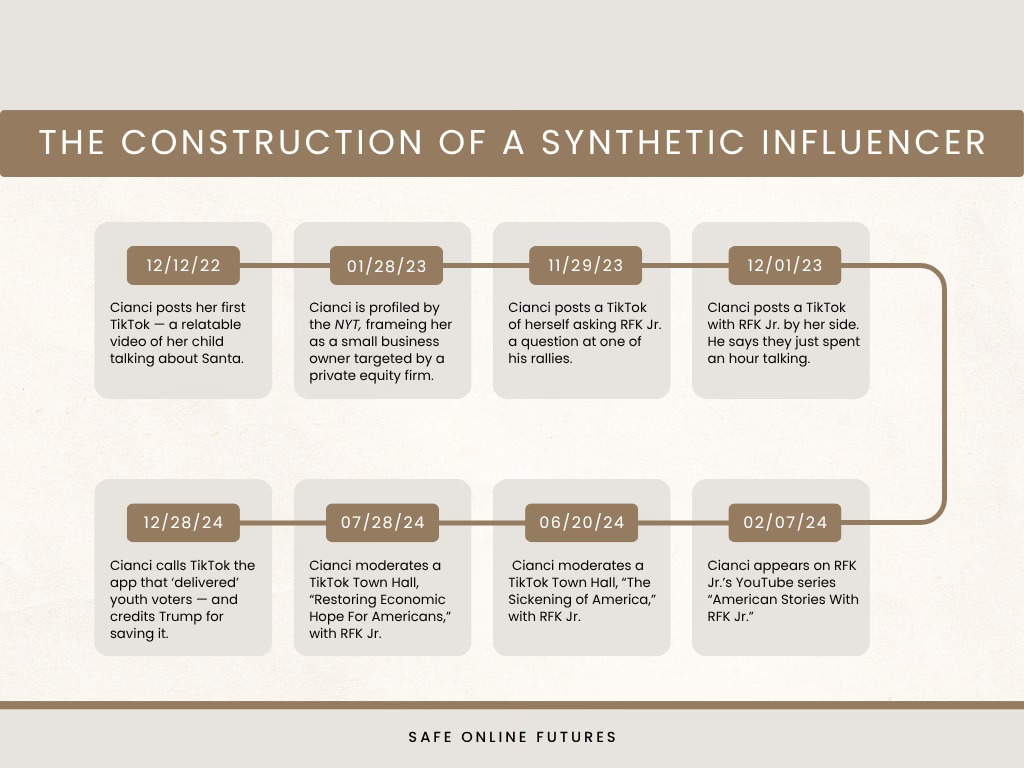
Her political emergence began with a calculated progression: from asking Kennedy a question at a rally in November 2023, to appearing on his YouTube series “American Stories With RFK Jr.” in February 2024, where she was featured as "the owner of a toddler gym" discussing how "a private equity firm destroyed her life and her business." Kennedy praised her "heroic resistance to corporate takeover," positioning her as an authentic victim of corporate greed. She isn't just someone talking about politics. She's a delivery system for it.
And her influence cuts across party lines.
Building on her relationship with Kennedy, she later pivoted to promoting Trump through favorable coverage of his promises to save TikTok, while simultaneously painting the Biden administration's proposed ban in an unflattering light.
This isn’t just a story about one creator. It’s about how synthetic influence is becoming a new norm in political communication.
Who Is Tiffany Cianci?
By her own bio, she’s a small business owner, mother, and anti-corporate whistleblower. Her videos are emotionally raw: crying, pleading, outraged. One pinned video claims she was forced into an abortion by a private equity firm.
She also hosts political livestreams — including one that reached nearly 200,000 viewers and featured RFK Jr. as the guest.
But dig deeper:
- Her videos show signs of AI-generated glitches (partially missing eye glass frames, distorted reflections that defy logic, malformed eyes, and more)
- Many of her defenders online also show signs of being bots or AI-generated accounts
- She links to a GoFundMe, Trump’s X account, anti-TikTok-ban petitions, and official government websites
- She’s quoted in Wired as a spokesperson for this new youth-centered political format
So who is Tiffany Cianci? Why does her supposedly grassroots influencer account link to Trump, RFK Jr., the White House, and the repeal-TikTok-ban movement — while showing clear signs of being AI-generated?
Who’s really behind the curtain?
While there’s no public record disclosing who operates the Cianci account, what we do know is this: nearly every political breadcrumb she drops — her town halls, her pro-Trump TikToks, her livestreams elevating RFK Jr.’s anti-establishment message, her anti-Biden headlines, her links to “Save TikTok” campaigns — points in one direction.
And it’s not random. These are the talking points, policies, and public relations needs of a very specific political ecosystem. One with a lot to gain from weaponizing trust, bypassing media scrutiny, and shaping the youth vote through synthetic emotional resonance.
The question isn’t just who Cianci is. The question is: who benefits from the persona she plays?
The Synthetic Megaphone: How RFK Jr. Used Cianci to Spread Medical Misinformation
Tiffany Cianci’s rise as a political livestream host didn’t begin with Trump — it began with Robert F. Kennedy Jr. But their relationship didn't start with the town halls. It began with a calculated progression: a TikTok video of her asking Kennedy a question at one of his rallies in late November 2023, followed by a December 1st post showing Kennedy by her side claiming they'd just spent an hour talking. Two months later, she appeared on his YouTube series “American Stories With RFK Jr.” Then in mid-2024, she organized multiple TikTok town halls featuring Kennedy, including one titled “The Sickening of America.” Over the course of an hour, Kennedy — who has spent years promoting debunked anti-vaccine conspiracies — spoke freely about discredited claims linking vaccines and gluten to autism. Not only did his statements go unchallenged, they were met with agreement from the other panelists: a wellness influencer, a conspiracy content creator, and a pair of off-grid homesteaders.
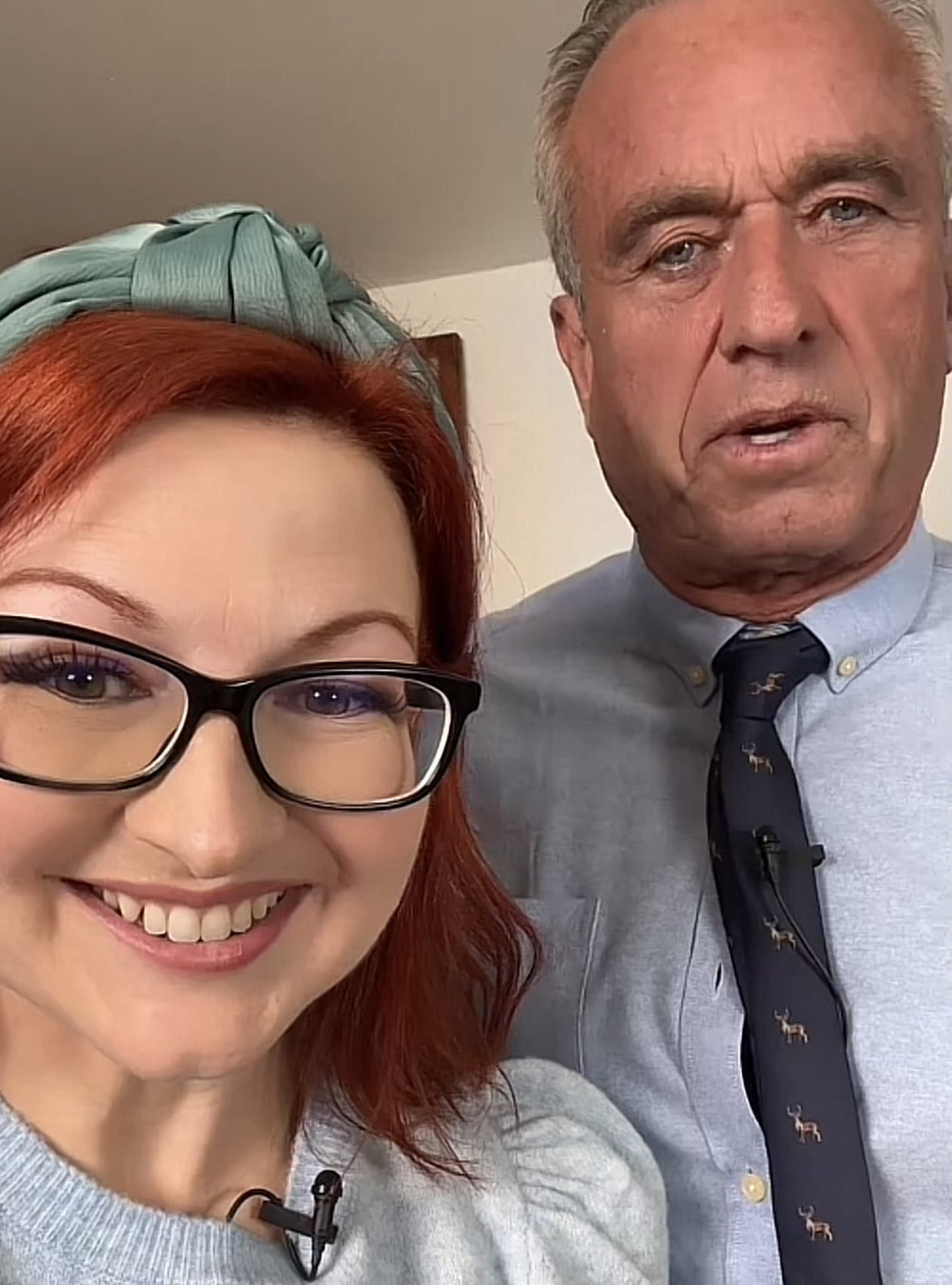
Cianci handled logistics. She moderated the event. And she gave a presidential candidate a stage to mislead the public on vaccine safety in the name of “real conversation.”
This is how synthetic trust becomes dangerous.
Kennedy, now Secretary of Health and Human Services, didn’t just use Cianci’s platform to connect with voters — he used it to make fringe medical conspiracies sound like common sense. And the fact that those claims were presented uncritically by a believable, emotionally resonant host is exactly what makes them so powerful — and so hard to unwind later.
This isn’t just political propaganda. It’s a new form of medical misinformation laundering.
The TikTok Reversal: Trump’s Turn to the Algorithm
In 2020, Donald Trump tried to ban TikTok, citing national security concerns. By 2024, he had joined the platform and within 48 hours gained 3.6 million followers. What changed?
He saw the influence.
Trump credited TikTok with helping him reconnect with young voters. But the shift wasn’t just strategic — it was tactical. Trump wasn’t trying to ban TikTok. He was trying to control the narrative on it. And influencers like Tiffany Cianci helped him do just that.
Cianci’s content sometimes overlaps with pro-Trump talking points. She posted about Trump’s plan to “save TikTok” on Day One and amplified messages that position him as a defender of free speech. Her Linktree even features a direct link to Trump’s X (formerly Twitter) account.
On December 28, 2024, Cianci posted a TikTok that framed Trump’s platform decision as politically strategic. “I truly believe,” she said, “that because he had such a strong turnout in the youth vote, he wasn’t going to risk alienating those potential voters in the app that literally delivered them to him in many ways.” She added, “He doesn’t want to give up those 10 million followers.”
The message was clear: TikTok wasn’t just a social platform — it was a political pipeline. And Cianci’s persona was working to position Trump not just as a participant in that system, but as its savior.
If Cianci’s persona is indeed AI-generated, then Trump’s rise on TikTok wasn’t just boosted by influencers. It was potentially boosted by synthetic influencers — engineered to manufacture trust, shape political perception, and do it all while hiding in plain sight.
This is what makes synthetic influence so effective. It doesn’t need to look official. It just needs to feel authentic. And this is the evolution of synthetic influence in real time. What began as a lifestyle persona — emotional videos, small business branding, and populist storytelling —has transformed into a political delivery system.
Tiffany Cianci isn’t just pushing a story. She is the story. A believable persona built for maximum emotional impact.
A deepfake account that builds trust, claims victimhood, hosts candidates, and even solicits money through GoFundMe. She is the product.
And the political utility of that product is undeniable.
It’s the next phase of what narrative laundering looks like in the AI era — when synthetic personas make coordinated propaganda feel like grassroots authenticity.

“I’m a Journalist.”
On February 20, 2025, Tiffany Cianci posted a TikTok from CPAC (The Conservative Political Action Conference) in which she referred to herself as a “journalist.”
That label carries weight. It builds instant legitimacy. But her content tells a different story — one that bears no resemblance to the standards of journalistic balance, transparency, or ethics.
Across her TikTok feed, Cianci consistently promotes partisan narratives while omitting critical context. She condemns President Biden for “breaking the trust of the American people” after pardoning Hunter Biden — but offers no mention of Trump’s mass pardoning of January 6 insurrectionists. She celebrates Trump’s participation in a “Friends of the Court” brief to save TikTok, gushes about his plan to “rescue the platform” on Day One, and amplifies speeches from CPAC delivered by Trump, Elon Musk, and J.D. Vance without critique. In one video, she declares that unethical creators are manipulating the public for personal gain — without clarifying the origins of a persona that shows signs consistent with AI generation and coordinated messaging.
The irony is striking.
Cianci’s videos show substantial visual evidence of AI generation. Her defenders behave like bots. Her identity remains undisclosed. And yet, she claims the moral authority of a journalist while acting as a partisan amplifier — selectively covering stories, omitting context, and emotionally steering viewers toward a very specific political worldview.
This is what makes synthetic influencers so dangerous:
- They build emotional trust.
- They invoke moral authority.
- They mimic the credibility of journalism.
And they do all of it while concealing what they actually are: precision-guided persuasion tools designed to push narratives — not report the truth.
The Fake Town Hall
By the time Cianci hosted a political livestream, the groundwork had already been laid. Her followers didn’t just show up for the content — they showed up because they trusted her.
The irony runs deeper than synthetic hosts and manufactured authenticity. The Cianci persona positioned itself as a vocal champion of free speech and anti-censorship, advertising the RFK Jr. TikTok Town Halls with rallying cries like "Refuse To Be Silenced," "Tune In and Be Heard," and “See Democracy In Action … Without The Mainstream Media.” Kennedy himself has built much of his political brand around opposing censorship and defending open dialogue.
Yet the reality was precisely the opposite. These town halls were highly scripted and choreographed events, with potentially synthetic creators vetting questions and moderating conversations — not journalists bound by professional standards of balance and accountability. The "free speech" branding became a smokescreen for controlled messaging, where candidates could appear to engage in open dialogue while actually operating within a carefully constructed echo chamber.
This represents a particularly insidious form of narrative laundering: co-opting the language of free speech to justify the elimination of genuine journalistic scrutiny. When synthetic personas become the moderators of political discourse, "being heard" becomes indistinguishable from being manipulated.
This is what makes synthetic influencers so dangerous: they don’t need to win arguments. They just need to seem authentic.
TikTok town halls hosted by synthetic personas aren’t spontaneous grassroots events. They are meticulously engineered simulations, designed to:
- Create the illusion of popular support
- Amplify outsider candidates with no institutional gatekeeping
- Erode trust in real journalism by mimicking it
- Platform medically dangerous misinformation
Trump and RFK Jr. didn’t do this alone. They had help — from synthetic personas like Cianci’s, and from social media platforms and an unregulated AI industry incentivized to optimize engagement over truth.
They didn’t need to win the narrative. They created their own synthetic stage to perform it on.
And millions watched, shared, believed.
The Real Threat
This isn’t about one creator. It’s about a system:
- Politicians exploiting AI to create emotional authenticity
- Platforms that reward synthetic outrage
- Institutions (like Wired and The New York Times) that quote and platform these personas without vetting them
- An unregulated tech industry that enables all of it
We are watching the illusion of democracy take shape in real time.
Because when synthetic personas host political events, sell their victimhood, and call themselves journalists, the result isn’t just confusion. It’s consolidation of power.
What happens when a presidential candidate leverages fake people to run real influence campaigns?
You don’t just get propaganda. You get something more insidious — narrative laundering.
What Is Narrative Laundering?
Narrative laundering is when influencers, be they real people, synthetic accounts, or AI-generated personas, create the appearance of grassroots or independent voices to push political agendas.
Like money laundering, the goal is to make something manipulative look organic. These accounts don’t just spread misinformation — they humanize it.
The result? Viewers don’t question the message, because they trust the messenger.
What You Can Do
This isn't just about awareness. It's about action.
We need to demand transparency from both platforms and politicians. Push for legislation requiring AI-generated content to be clearly labeled. Contact your representatives about regulating synthetic personas in political content, and support platforms that implement robust AI detection and disclosure requirements.
But we also need to become better detectors ourselves. Look for visual inconsistencies in influencer content like distorted reflections, facial anomalies, and inconsistent lighting. Be skeptical when accounts link to multiple unrelated political causes or campaigns. Question emotionally charged content that bypasses traditional media gatekeepers entirely.
It's equally important to hold institutions accountable. Question media outlets that quote unverified online personas without disclosure, and demand that news organizations implement AI detection protocols before platforming influencers. Support journalism that investigates rather than amplifies synthetic influence.
Most critically, we need to protect democratic discourse itself. Advocate for federal AI transparency requirements in political advertising. Push for social media platforms to ban undisclosed synthetic personas from political content. Support candidates who commit to transparency about their digital influence operations.
Ask yourself:
- Would you trust an influencer if they weren't human?
- Who benefits when AI-generated hosts run the show?
- What does it mean when the most convincing political content is also the least accountable?
This isn't the future of politics. It's happening right now. The question is: will we regulate it before it regulates us?
This is Part 3 of an ongoing investigation into AI-generated influence operations. If you haven’t yet, read Part 1 to understand how synthetic personas like Tiffany Cianci are designed to manipulate trust, emotion, and consensus at scale—and Part 2 to see how mainstream institutions like The New York Times are legitimizing deepfakes without question.
Stay tuned for Part 4, where we’ll dissect a single TikTok from the 2024 Libertarian National Convention that launders political narratives under the guise of neutrality — revealing just how subtle and deceptive this new form of propaganda can be.