The Facebook Privacy Post Is Fake. Your Data Concerns Are Not.
Why this hoax works, and what actually gives you control
If you’ve been on Facebook recently, you’ve probably seen it. A post claiming that a legal spokesperson appeared on 60 Minutes and advised every Facebook user to copy and paste a notice declaring that Meta cannot use their personal data, photos, or AI activity. Your aunt shared it. Your old coworker shared it. Maybe someone you really respect shared it.
It doesn’t work. It never did.
What the Post Claims
The Facebook message currently circulating reads something like this:
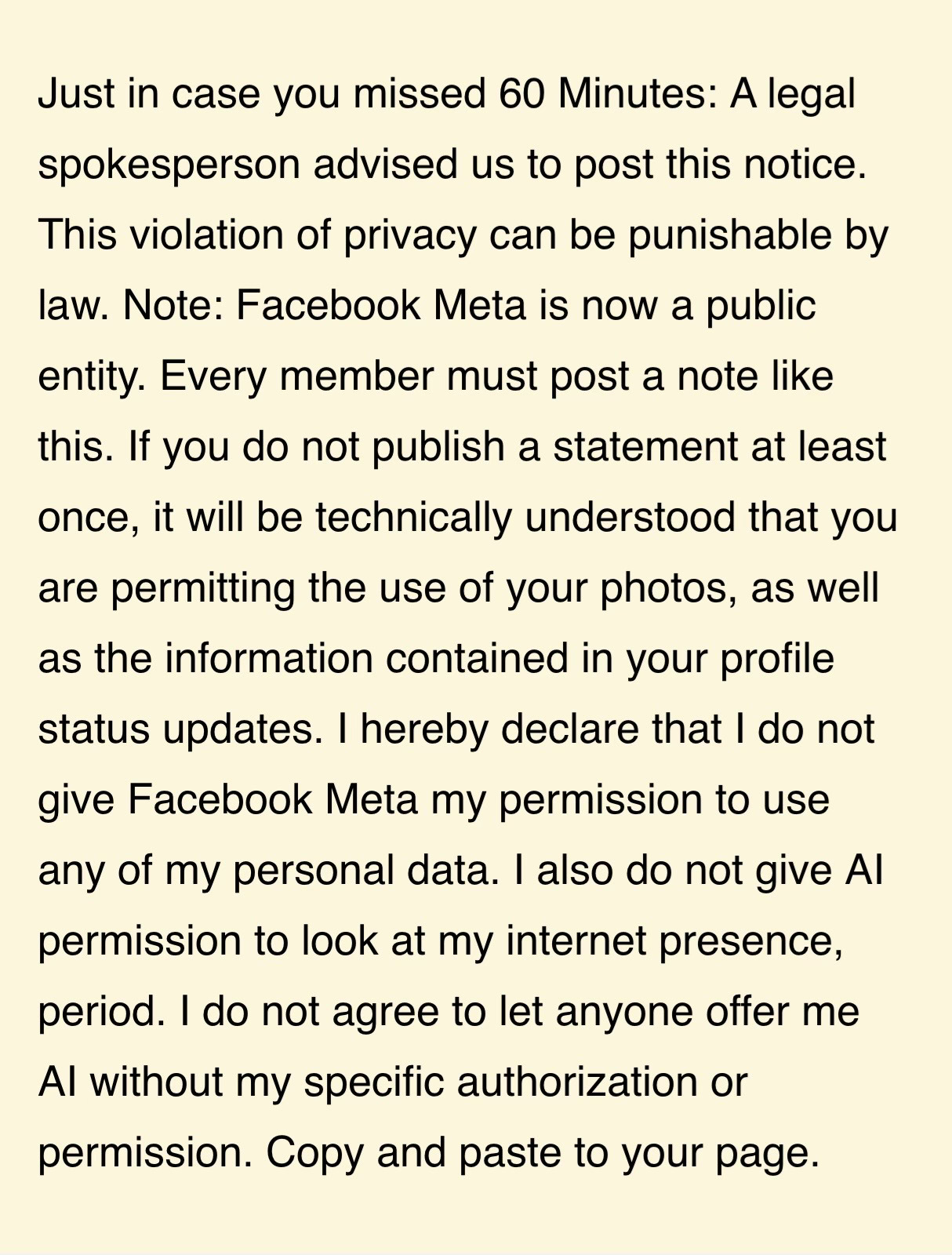
The premise is that sharing this message officially puts Meta on notice. Skip it, and you've technically given Facebook permission to do whatever it wants with your information. The language sounds official, the source sounds credible, and when people you trust are sharing it, it's easy to think you should too.
Why It’s False
Three things are wrong here, and they’re all pretty straightforward.
60 Minutes never said this. CBS News has not issued any guidance advising viewers to post privacy notices on Facebook. There’s no segment, no clip, no transcript. The name is just borrowed to make the message feel legitimate.
A Facebook post is not a legal document. You can’t establish legal protections by posting text on a social media platform. That’s not how law works, and that’s not how contracts work.
This hoax is as old as the internet. Over the years, the fact-checking site Snopes has debunked more than a dozen variations of the same hoax, each with slightly different wording and a different fake authority figure attached. The core claim has never changed, and it has never been true.
The Part Nobody Mentions
Here’s what the post leaves out entirely: Meta already has your data. Not because of some new policy, but because of the terms of service you agreed to when you signed up.
That agreement — the one almost nobody reads — is the actual legal document. It gives Meta a broad license to use your content, power their ad targeting, and, more recently, train AI models. It was drafted by lawyers, and you accepted it the moment you created your account. So did most of the people now sharing that copy-paste warning.
No post overrides it. You can’t unilaterally change the terms of a contract you already signed by publishing a paragraph on your timeline. If Meta’s legal team had any reason to worry about that, they would have addressed it in the terms of service long ago.
Why This Keeps Working
This isn’t about people being gullible. People who share these posts aren’t foolish — they’re worried. And honestly, that worry makes sense.
Most people have a gut feeling that their data is being used in ways they didn’t fully agree to and don’t fully understand. That feeling is largely correct. The problem is that this hoax offers a solution perfectly sized to match the anxiety: simple, shareable, feels like doing something. It just doesn’t actually do anything.
That’s the gap where misinformation lives. Not in confusion, but in the very human desire to feel like you have some control.
What You Can Actually Do
If you want more meaningful control over how Meta uses your data, there are real settings inside Facebook worth knowing about — though Meta makes them hard to find, which tells you something.
- Off-Facebook Activity (under Settings & Privacy) lets you see and limit what Meta collects about you from apps and websites you visit outside of Facebook.
- Ad Preferences gives you some control over how your data is used for targeting.
- Generative AI data settings let you opt out of your content being used to train Meta AI, depending on your region.
None of this is a complete fix. Meta’s data operation is massive, and these settings have limits. But they are real, they do something, and that’s more than any copy-paste post will ever give you.
Most people never hear about stories like this. Safe Online Futures makes sure you do. Subscribe on Substack.