The Four-Fingered Protester
When government agencies use AI-altered images to justify crackdowns, it’s not propaganda evolving — it’s reality collapsing.
On October 6, the Department of Homeland Security posted protest photos to Instagram. The caption: “FAFO. We will NOT allow violent activist to lay hands on our law enforcement.”
Each image showed protesters being rounded up by ICE agents — chaos, resistance, control. At the bottom: a recruitment link. JOIN.ICE.GOV.
Standard law-and-order propaganda, except for one problem.
Two photos feature the same protester. Same outfit, same restraints. In the first image, his left hand has four fingers. In the next, he has five. Not to mention that the right hand position flips — the palm faces the camera, but fingernails are visible, which is anatomically impossible.
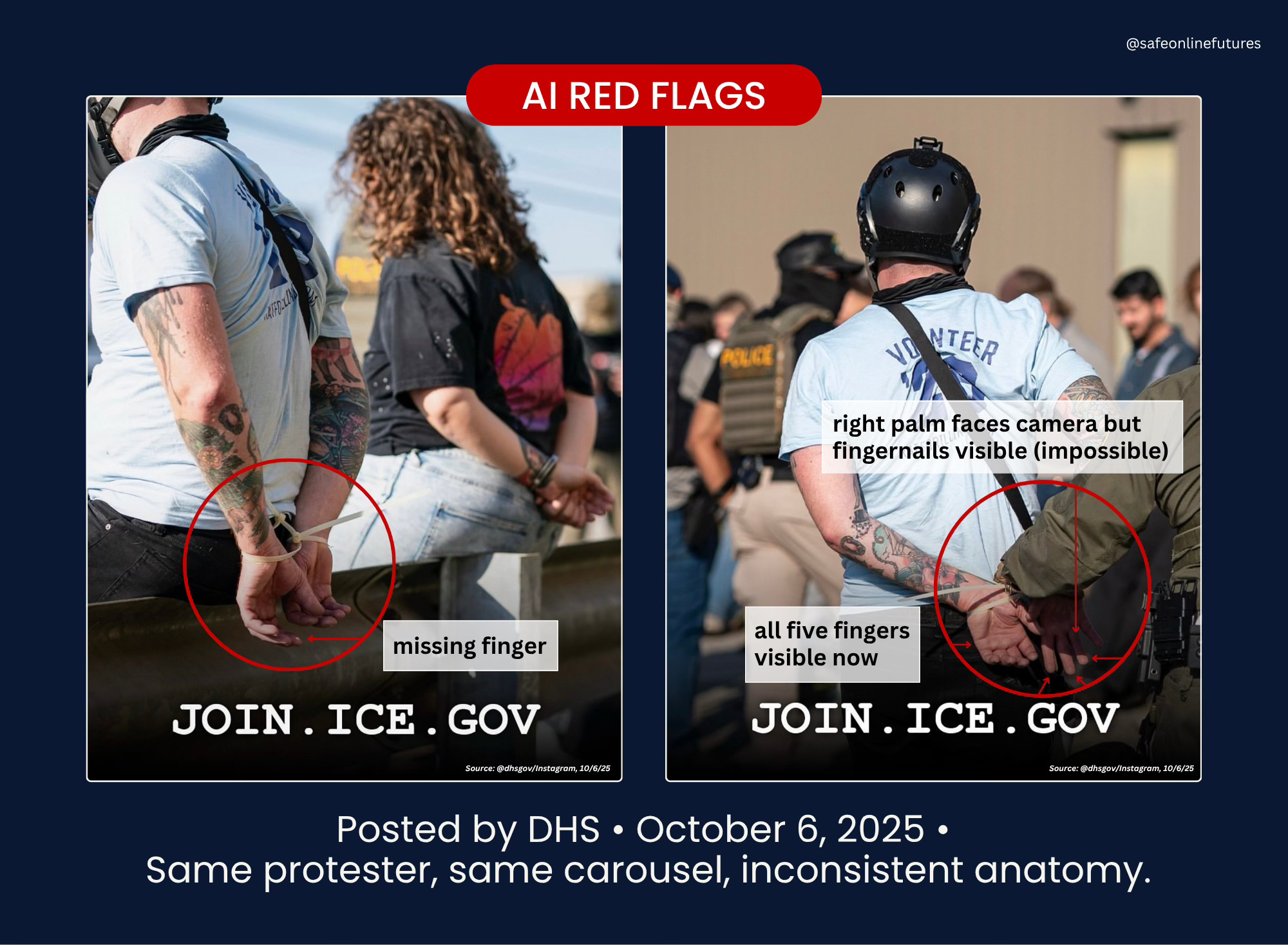
Same scene. Same carousel. Different anatomy.
These aren’t camera glitches. They’re signature AI artifacts — the kind that appear when synthetic imagery gets generated or composited. DHS didn’t post documentation of an arrest. They posted a digitally altered composite, presented as authentic evidence of violent unrest. The recruitment call to action turned the manipulation into a marketing tool.
That’s the tell. But it’s not the whole story.
Control what people see on their screens, and you don’t need to control reality. You only need to control perception. That’s the new propaganda pipeline: synthetic chaos gets amplified strategically, then validated judicially. The illusion becomes policy. Every fake photo trains us to stop questioning what’s real. Every unchallenged fake makes the next crackdown easier to justify.
Here’s how the machinery works.
If this were an isolated incident, it would be troubling enough. But that four-fingered protester doesn’t stay contained to official government channels.
He shows up in a Portland clip from conservative influencer Benny Johnson, who claimed it showed “dozens of Democrat domestic terrorists.” Similar scenes appeared in content from Katie Daviscourt and Nick Sortor — two other Trump-aligned accounts whose videos showed identical visual inconsistencies. Warped hands. Blurred signage. Impossible shadows.
As I documented in The Portland Playbook, these influencers operate as a coordinated network, amplifying identical imagery — often filmed at the same ICE facility — to construct the illusion of a city under siege. That’s not coincidence. It’s infrastructure.
And once you see the infrastructure, the feedback loop becomes obvious.
Influencers generate synthetic chaos. The chaos justifies federal intervention. The intervention “proves” the chaos was real. Now that loop operates in the open. The Trump administration, its DHS propaganda wing, and Trump-friendly influencers all draw from the same synthetic source material — digital forgeries designed to make Democratic-run cities look like war zones.
And it’s working.
Two weeks after the DHS post, a federal appeals court lifted the block on Trump’s Oregon troop deployment. The ruling specifically cited “violent protests” and “attacks” on federal agents outside the Portland ICE facility — the same narrative built on manipulated images and influencer videos.
The judges — both Trump appointees — acknowledged that the President “may exaggerge the extent of the problem on social media.” But they cited that manufactured chaos as providing a “colorable basis” to justify deployment anyway.
Synthetic images now inform federal decisions. The pipeline is clear: AI-fabricated imagery gets amplified by influencers, echoed by government, legitimized by courts.
This didn’t happen by accident. An October 10 New York Times investigation made the coordination explicit: Trump’s administration and a network of right-wing influencers have been staging content around ICE facilities in Portland — framing isolated street scenes as “siege zones,” filming with cooperative DHS officials, pushing footage across the pro-Trump media ecosystem.
Kristi Noem, Trump’s Homeland Security Secretary, reportedly traveled to Portland with influencers in tow to choreograph this narrative of “lawless Democrats.” The videos they posted used the same settings, same characters, same protest backdrops. In at least one case, the same four-fingered man.
What starts as a staged photo op shapes headlines, then judicial rulings.
Treating this as one flawed photo would miss the point entirely. This is a multi-platform psychological operation that merges synthetic imagery, influencer amplification, and algorithmic reach to create an emotional reality that outpaces truth.
Every part of the machine benefits. The administration gets visual justification for crackdowns. Influencers get viral outrage content. Algorithms get the engagement loops they’re built to reward. The public gets conditioned to associate dissent with disorder.
When government agencies distribute AI-altered imagery to promote enforcement agendas, the line between public information and psychological manipulation doesn’t just blur. It disappears.
We’re past the point where we can treat manipulated images as isolated incidents or technical errors. This is infrastructure. This is process.
And here’s what makes it dangerous: there are no regulations governing synthetic content in political messaging. No requirements for disclosure. No penalties for government agencies that distribute altered imagery. Platforms have no incentive to label AI-generated propaganda — it drives engagement, which drives revenue.
The courts won’t save us. They’re already citing synthetic chaos as legal justification.
The platforms won’t save us. They’re built to reward this content.
The government won’t save us. They’re distributing it.
Traditional media won’t save us. They’re distributing it too.
The only leverage we have is understanding. Know the playbook. Recognize the ecosystem fueling it. Identify the patterns — the warped hands, the recycled scenes, the coordinated amplification.
Then get loud.
Every time you spot a suspect image, say so. Every time you see the same “protest scene” recycled across influencer accounts, call it out. Every time a government agency posts recruitment material over manipulated photos, demand accountability.
The machinery runs on our passive consumption. It breaks when we stop scrolling and start questioning.
The playbook is already running. But it only works if we let it.
This essay is part of an ongoing investigation into how politicians, influencers, algorithms, and AI tools are reshaping political communication in America.
Related Reading:
The Portland Playbook
When Influencers Become the Press
Manufacturing Evidence