The Information Vacuum
What happened on social media after the White House Correspondents’ Dinner shooting wasn't chaos. It was the business model.
Almost as soon as gunshots were reported at the Washington Hilton on the night of the White House Correspondents’ Dinner — an event President Trump attended for the first time — social media detonated. Before police had confirmed a motive or anyone knew whether the suspect had acted alone, influencers, pundits, and anonymous accounts across X, Bluesky, and Instagram had already made up their minds.
No questions. No concerns. Just a verdict.
Within minutes of the shooting, accounts across the political spectrum began flooding every platform with conspiracy theories. On Bluesky, which leans heavily left, users posted “STAGED” over and over, echoing the response to the assassination attempts on Trump in 2024. On X, users claimed the shooting was orchestrated to boost support for Trump’s plan to build a new White House ballroom. According to data from TweetBinder, the word “staged” surged past 300,000 posts on X within 18 hours. NewsGuard, which tracked the claims in real time, found that posts advancing the staged-shooting narrative generated 80 million views on X alone in less than two days. The algorithm doesn’t distinguish between posts that spread a theory and posts that refute one. It rewards all of them.
The most valuable moment in a breaking news cycle — for influencers, algorithm-chasing accounts, and anyone whose business model depends on engagement — is the first thirty minutes. Facts are scarce. Emotions are running at full volume. The public is reaching for their phones, searching for something that explains what they’re looking at. That window is an opportunity, one the most sophisticated operators in the attention economy have built their entire business models around.
This is not a new phenomenon. The same pattern played out after the assassination attempt on Trump in Butler, PA in 2024. After the capture of Venezuelan President Nicolás Maduro. After every major breaking news moment of the past several years. The information vacuum fills instantly — not with facts, but with the content the platform infrastructure is built to reward: hot takes, inflammatory framing, and conspiracy theories optimized for emotional reaction.
University of Michigan professor Cliff Lampe put it plainly: “People are reshaping reality based on what they want to be true or not. They’re not looking for good information, they’re looking for confirmatory information.”
That’s only part of the picture. What isn’t discussed enough is that platforms aren’t neutral bystanders watching this happen. They built the infrastructure that makes it profitable.
Influencers have every incentive to post speculation and rumor even when they don’t believe it, because on revenue-sharing platforms like X, views translate directly into payouts. Conspiracy content, inflammatory framing, a question posed to your audience designed to generate maximum engagement — all of it feeds the algorithm, and the algorithm feeds them back.
The most cynical version of this play was documented in real time the night of the shooting. Mario Nawfal — an online influencer with over 3 million followers on X who has previously promoted Russian talking points — posted a collection of unfounded theories about the attack, then added at the end of the same post that he didn’t believe any of them. The post received more than 500,000 views (as of April 28, 2026).
Then there’s the ballroom. In the immediate aftermath of the shooting, right-wing influencers across multiple platforms posted the same message — build the ballroom, build the ballroom, build the ballroom — before any facts had been confirmed, with no variation in framing and no pause for the gravity of what had just occurred. No expressions of relief that guests were unharmed. No acknowledgment of what had happened. Just the talking point, deployed in near-perfect lockstep across a large number of verified accounts.
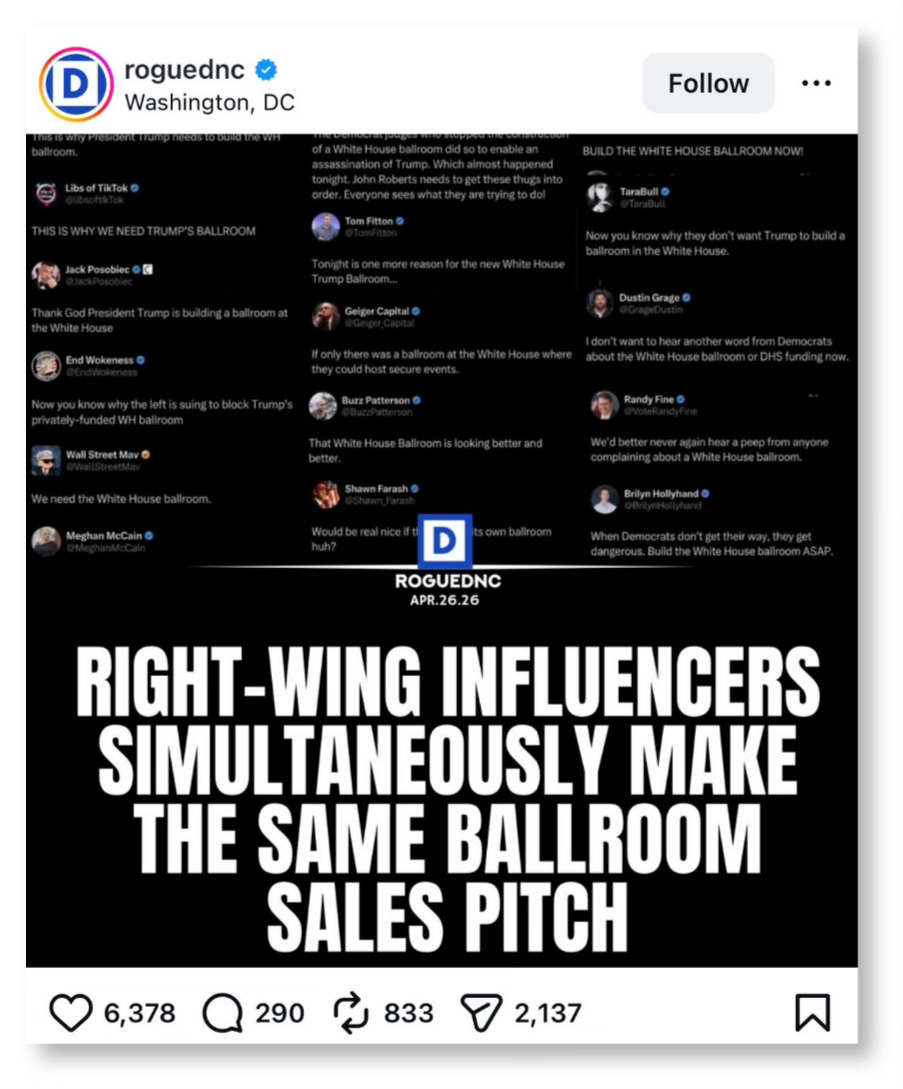
We have no idea which of those accounts is operated by a real person, which is a bot, and which is an AI-generated persona. Because nothing is required to be labeled. That regulatory vacuum is the environment that makes this kind of operation possible at scale — without accountability, and without any mechanism for the public to assess what they’re actually looking at.
Among the most widely shared posts that night were claims that the shooter had been killed on scene. He wasn’t. He was arrested. Those posts received millions of views. The corrections received a fraction. Some authors posted retractions. The retractions didn’t travel.
As University of Connecticut professor Amanda Crawford told the New York Times: “Getting out the truth and establishing facts and reliable information takes time. But our audiences really don’t have that kind of patience.”
Right-wing conspiracy theorist Alex Jones went from publicly questioning whether the shooting was staged to publicly saying it wasn’t — in the space of a couple of hours. Almost no one who saw the first post saw the second. Former Congresswoman Marjorie Taylor Greene posted “many questions about Cole Allen” and let her audience draw its own conclusions. At least one mainstream outlet described Press Secretary Karoline Leavitt’s pre-dinner comment that “There will be some shots fired tonight in the room” — a figure of speech about the jokes Trump was scheduled to deliver — as “eerie” and “bizarre,” effectively laundering a conspiracy framing into credible-seeming coverage without technically endorsing it.
This is how misinformation spreads. Not just through the obvious bad actors, but through people who should know better, acting on deadline, chasing engagement, and adding fuel without fully recognizing they’re doing it.
And when the air is this thick with noise, it becomes very hard to see what’s actually worth looking at, including certain details about this incident that deserve more scrutiny than they’re currently getting.
Making the claim that the WHCD shooting was staged without evidence would be irresponsible. That evidence does not exist. But there are questions worth asking that have nothing to do with staging.
Three assassination attempts on the president in under two years. My husband worked directly for two Chairmen of the Joint Chiefs — General Mark Milley and General Charles Q. Brown Jr. Based on what he experienced with those security operations, the planning was exhaustive, the advance work comprehensive, and the protocols non-negotiable. The narrative of a Secret Service detail porous enough to have failed three times strains credibility for anyone with direct knowledge of how these operations actually work.
A president who has boycotted the WHCD for years, and has spent years delegitimizing the very press corps that attends it, suddenly shows up this year. An incident occurs. He pivots almost immediately, not to expressing relief that no one was hurt, but to making the case for a ballroom he has been trying to build for months, a project currently facing legal challenges. Scores of right-wing influencers push the identical ballroom message before the facts are in. RT, Russian state media, amplifies claims on X tying the shooter to Israeli causes without a shred of proof.
And by the following morning, no one is talking about gas prices climbing into summer driving season, the kind of kitchen table issue that flips Congress. No one is talking about the collapse of the US-Iran peace talks in Islamabad, a significant foreign policy failure for someone who ran as the world’s greatest dealmaker.
None of that is proof of staging. All of it is worth asking about.
I watched the C-SPAN footage from inside the ballroom, the moment the gunfire is audible and attendees begin to look around. I watched the video Trump posted to Truth Social purportedly showing the gunman moving past the security detail. In both, I saw things I couldn’t explain. I’m not going to tell you what caused what I observed. What I will tell you is this: we live in an information environment where AI-generated video is real, regularly used by political actors, and carries no label required by law. The public has no reliable mechanism for verifying the authenticity of footage distributed through official channels, whether that’s a nonprofit public broadcaster or the president’s own social media account. That concern is the direct and documented consequence of the regulatory vacuum this piece is about.
The information operation surrounding this event has made it nearly impossible to ask hard questions clearly — about any of it. That is not an accident. It is a modern propaganda tactic called the Firehose of Falsehood. Flood the zone with so much contradictory content — conspiracy theories, hot takes, “STAGED” and “BUILD THE BALLROOM” posts running simultaneously across every platform — that the public becomes too exhausted and too confused to locate the truth. Legitimate scrutiny drowns in illegitimate speculation. People who are trying to think clearly eventually stop trying.
A population that has given up on finding the truth — that has become so overwhelmed by the volume and the noise that it simply disengages — is a population that is profoundly easier to manipulate. That exhausted, disengaged population is the intended outcome of the Firehose of Falsehood.
Whether or not the chaos surrounding the WHCD shooting was deliberately engineered, it produced exactly that result. And this administration understands how algorithms work well enough to know precisely what it produces.
None of this changes on its own.
The mechanics are straightforward, even if the industry wants you to believe otherwise. Influencers and politicians flood your feed with conspiracy theories and inflammatory hot takes because the algorithm pays them to. On platforms like X, views convert directly to revenue. Engagement — outrage, confusion, fear — drives views. The people who are best at generating outrage, confusion, and fear get paid the most and reach the most people. They are not, first and foremost, true believers. They are operators. They have reverse-engineered the system because the system made it worth their while. Change what the algorithm rewards, and their behavior changes immediately — not because they developed a conscience, but because the financial incentive shifted. Platforms have the ability to make conspiracy content and coordinated inauthentic behavior less profitable. They have simply chosen not to, because outrage and fear are extraordinarily good for business.
Three things have to happen, and none of them are optional if you want this information environment to improve rather than metastasize.
Algorithms must be regulated. Platforms have spent twenty years demonstrating they will not meaningfully reform their own incentive structures without being forced to. The engagement-maximization model that rewards outrage and conspiracy content over accurate information is a policy choice. Changing it requires lawmakers who understand what they’re regulating and have the will to regulate it.
AI-generated content and AI-operated accounts must be labeled, by law. When coordinated inauthentic behavior is indistinguishable from organic human opinion, when we genuinely cannot tell whether a wave of “build the ballroom” posts represents real people, bots, or AI-generated personas, we have lost the basic ability to evaluate what we’re looking at. Mandatory disclosure is a choice the industry has lobbied aggressively to avoid making.
Citizens have to vote like this is a ballot issue — because it is. There are candidates at every level of government who understand that algorithmic accountability is a public safety issue, a democratic integrity issue, and a national security issue. There are candidates who don’t, or who are actively funded by a tech industry that wants nothing to change. The difference matters. Showing up matters. Staying engaged in the political process that determines who writes these rules matters — especially when the information environment has been engineered to make you feel so overwhelmed and so cynical that you stop participating. That feeling is not an accident. It is the intended outcome of the system we are all living inside.
The Firehose of Falsehood that swallowed the news cycle after the WHCD shooting will keep running. The information vacuum will keep filling with conspiracy content, coordinated talking points, and AI-generated or AI-assisted media that carries no label and no accountability. The bots, the AI personas, and the revenue-hungry influencers will keep doing exactly what the platform infrastructure pays them to do.
Until the infrastructure is forced to change. That requires regulators. Regulators require legislators. Legislators require voters who understand what’s at stake and show up anyway — even exhausted, even cynical, even when the system has been designed to make participation feel pointless.
That is what it takes. There is no other lever.
Understanding the system is the first step to changing it. Share this piece.