The Lie Traveled In a Real Photo
How a miscaptioned image of Kid Rock got 7 million views, and why you'll see it again.
Seven million views for a lie that took seconds to write.
The words were “JUST IN: Kid Rock addresses The Pentagon on the Strait of Hormuz.” The image underneath them was real. Kid Rock had been at the Pentagon, photographed at the lectern in the press briefing room as part his “Freedom 250” promotional tour tied to America’s 250th anniversary. Defense Secretary Pete Hegseth posted the slideshow himself.
About an hour later, Spencer Hakimian, an influencer on X, lifted one of the photos and gave it a new caption. He did not say Kid Rock was on tour. He said Kid Rock was briefing the Pentagon on a live geopolitical flashpoint. None of it was true. None of it had to be.
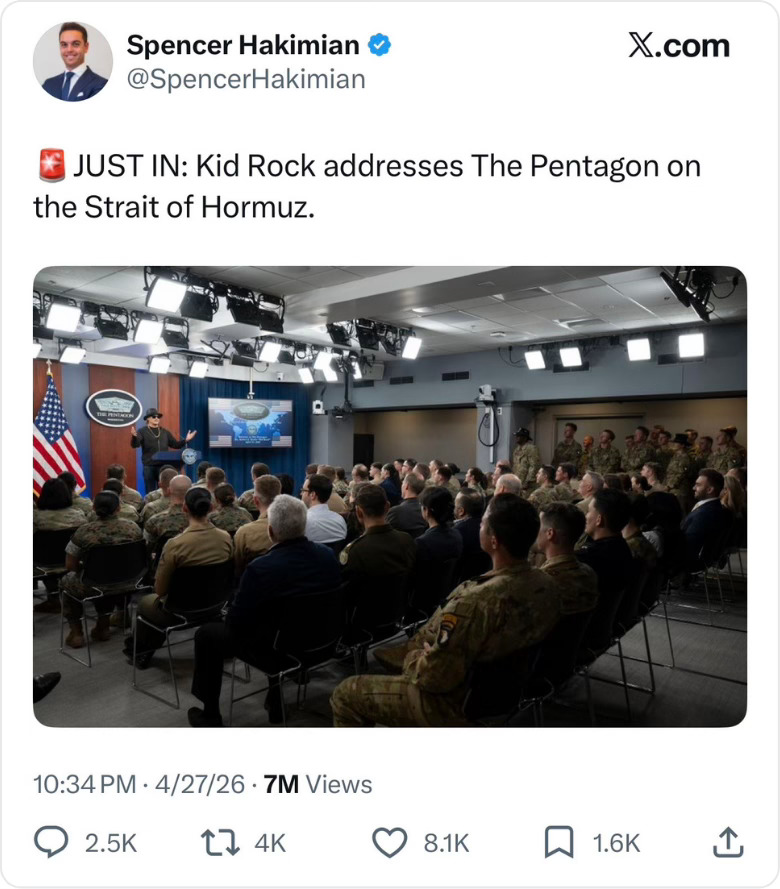
Snopes traced the rumor, contacted a Pentagon spokesperson, and confirmed what was actually happening that day: a celebrity photo op for an anniversary tour. By then the image was already moving across Bluesky, Facebook, Reddit, and Threads, sometimes with the Hormuz framing intact, sometimes cropped into something even simpler. The correction reached a fraction of the audience the original did, days later, after the impression has set.
The mechanics are worth slowing down on, because they are the details you should expect to see again and again between now and the midterms.
The real photo is the entire trick. A fabricated image triggers people’s instinct to verify. A real image short-circuits that instinct. Anyone who reverse-image-searched the picture would find it on the Defense Secretary’s verified account, which functions as confirmation that something true is happening. The caption never gets the same scrutiny as the pixels do. Sophisticated operators in the attention economy understand this, which is why the most efficient misinformation in 2026 is rarely a deepfake. It is a genuine artifact in a fabricated frame.
The choice of subject was not accidental. The Strait of Hormuz is in the news because the U.S., Israel, and Iran have been negotiating around the shipping route in recent ceasefire talks. Hakimian selected an anxiety that was already simmering and attached a caption. Successful viral content does not happen on its own. It is engineered by operators who study what their audiences are afraid of, what they are angry about, what they are primed to believe, and who package the lie accordingly. Kid Rock briefing the Pentagon on a geopolitical flashpoint is absurd, and that absurdity is the point. It maps onto an existing narrative about competence in government, which is what makes it shareable.
The why is the part of this story that matters most.
Nothing Hakimian did was illegal or violated X’s rules. He did not impersonate anyone, fabricate an image, or hack into a federal account. He posted a real photograph with a false caption written to read as straight news. No comedy hashtags, no winking caveat, nothing in the post indicating it was anything other than a wire-service bulletin. Hakimian later added hashtags like #funny, #meme, and #comedy to follow-up posts, repositioning the original as satire after it had already traveled. The 7 million views happened in the credulous-sharing phase. The comedy tags arrived later, available as a retreat hatch if anyone got serious about asking.
This is now a recognizable pattern. Post it straight, harvest the reach, label it as a joke once challenged. And it is a pattern because the platform pays for it. X’s revenue-sharing program translates views directly into payouts for accounts above a certain threshold. Influencers have every incentive to post inflammatory content even when they do not believe it, because views become money and engineered misinformation outperforms accurate reporting on every metric the algorithm rewards. Conspiracy content, inflammatory framing, a question or statement posed to an audience designed to generate maximum engagement — all of it feeds the algorithm, and the algorithm feeds them back. A miscaptioned real photograph attached to a current geopolitical anxiety is not a mistake or a prank. It is a rational business decision inside a system that was built to reward exactly this behavior.
And the asymmetry keeps the loop running. Snopes had to write hundreds of words and contact a federal spokesperson to debunk one-sentence caption. The original takes seconds to compose and seconds to share. The fact-check arrives smaller and slower than the post it is correcting. You do not need synthetic media to manufacture a synthetic moment. You need a real photo, a current news hook, a confident framing, and an account with reach. Kid Rock walking around the Pentagon for an anniversary photo op is a real, mildly weird story. Hakimian’s caption turned it into a viral one, and the caption is what 7 million people carried away.
So what do you do with this.
In the short term, the only defense is the one you build for yourself. When a post hits your feed and your gut says share it, pause for a second longer than feels natural. Ask whether the words above the image were ever attached to it before someone typed them in. Reverse-image-search the picture and see where else it appears and what captions came with it. Look at the account posting it and ask whether they are in the business of being right or in the business of being shared. These habits will not make you immune but they put you one step ahead of a system that is counting on you not to notice.
In the longer term, none of this changes through individual vigilance. The behavior keeps happening because it pays. It will keep happening, and it will get faster, cheaper, and more convincing, until platforms are required to change the incentives that produce this behavior. That requirement will not come from the platforms themselves. It will come from lawmakers willing to regulate algorithmic incentives, restructure revenue-sharing programs that reward engineered outrage, and hold platforms accountable when lies reach millions with no correction.
That is a voting question. The next year will offer a steady stream of moments like this one, and each is a small reminder that the people who designed this system are not going to redesign it on their own. The midterms are the leverage point. The candidates worth supporting are the ones who can describe what is happening on these platforms in something close to the level of detail you have just read, and who are willing to act on it.
Until then, the loop runs. Hakimian gets paid. The next caption is already being written.
If this piece helped you see the pattern, share it with someone who needs to see it too. The best defense against engineered misinformation is real people passing along real analysis. To stay ahead of how platforms and influencers are reshaping what you see, subscribe below.