The Manipulation Infrastructure
Part 1: The Machine That Learns What You’ll Believe
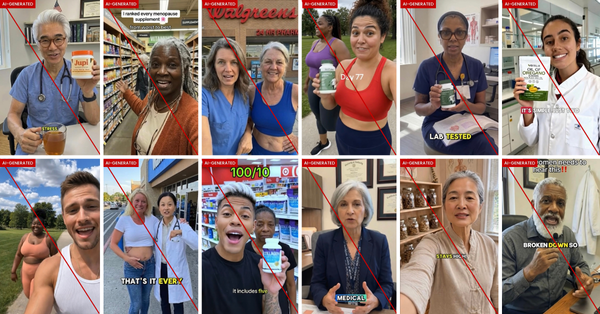
You’ve probably seen a fake image online this week.
Maybe you recognized it. Maybe you didn’t. Maybe you shared it before someone pointed out the extra finger, the melted text in the background, the way the light fell wrong.
Here’s what you almost certainly didn’t think about: what your response taught the system.
Not a person. Not a government. Not some shadowy cabal. The system — the infrastructure of platforms, algorithms, and data collection that sits between you and everything you see online. It watched what you did. It recorded how long you looked, whether you shared, whether you paused, whether you checked, whether you argued, whether you moved on. It recorded the same thing for every other person who saw that image.
And now it knows something about all of you that it didn’t know before.
Three moments. One lesson.
In recent months, three pieces of manipulated or potentially manipulated content caught public attention. Each one tells us something different about the world we’re living in.
The first was a kiss cam clip from a Coldplay concert in July 2025. It appeared to show a tech CEO embracing a woman who was not his wife. The clip went massively viral — outrage, schadenfreude, the usual cycle. But if you looked closely, the footage showed telltale signs consistent with current AI video generation limitations: overly saturated skin tones, audience members with fused fingers, unnatural-looking eyes, warped elbows, and distorted fingers. [I broke down these artifacts in detail here]
The clip was never confirmed to be AI-generated. But those artifacts are well-documented signatures of what today’s AI video tools struggle to render convincingly. Mainstream media didn’t raise these red flags. They reported the story at face value. The skepticism phase didn’t lag behind the virality — it never arrived at all.
The second was a set of images suggesting Taylor Swift and Travis Kelce had gotten engaged in August 2025. These images were posted to Swift’s official Instagram account — the one with 280 million followers (more people than the population of every country on Earth except China, India, the United States, and Indonesia). If you stopped scrolling and looked carefully, the photos showed signs consistent with images that have been AI-generated or AI-altered. [detailed analysis here] But virtually no one stopped scrolling and looked carefully. The story was reported, shared, celebrated, and absorbed as fact.
Again: no confirmation these were AI-generated or AI-altered. And again: no mainstream scrutiny of the visual evidence. The images were accepted. The engagement data was generated. The cycle moved on.
The third was different. In January 2026, a digitally altered image of ICE protester Nekima Levy Armstrong was circulated by the White House. Tears had been added to her face and her skin tone darkened. The original photograph, posted by U.S. Secretary of Homeland Security Kristi Noem, showed her calm and composed; the White House version depicted her as emotionally distressed. This image involved a government entity deliberately reframing a citizen’s image to change its meaning. Unlike the celebrity examples, this one actually generated some pushback — people noticed, questions were raised. And then, within 48 hours, it effectively disappeared from public discourse. No retraction. No investigation. No policy discussion about when and whether the government should be circulating manipulated images of its own citizens.
Let’s pause for a moment. I want to be precise about what I’m saying and what I’m not.
I’m not saying these three moments were connected. I’m not saying someone sat in a room and planned them as a sequence. I have no evidence of that, and claiming otherwise would be dishonest.
What I am saying is that it doesn’t matter.
Why intent is the wrong question
When people encounter the idea that manipulated content might serve a strategic purpose, the first instinct is to ask: Who’s behind it? Was it intentional?
These are natural questions. They’re also a dead end. Here’s why.
Imagine a city that installs surveillance cameras on every street corner. The cameras are there for traffic management — that’s the stated purpose, and let’s take it at face value. No one installed them to track individual citizens’ movements.
But the footage exists. It records where people walk, when, how often, in what patterns. Anyone with access to that footage now has a detailed map of the population’s movement habits. A city planner might use it to optimize bus routes. A burglar might use it to figure out when your street is empty. A political operative might use it to understand which neighborhoods mobilize when there’s a protest.
The cameras weren’t installed with any of those purposes in mind. But the infrastructure makes all of those uses possible — and the data gets more useful every single day the cameras keep running.
Social media platforms are those cameras. And every piece of content you interact with — real or fake, meaningful or trivial — is generating footage.
What the “footage” actually looks like
Here’s what makes the kiss cam clip so instructive — not as a scandal, but as a case study in what the infrastructure captures.
When that clip went viral, here’s a partial list of what the platforms’ own systems automatically recorded:
Speed of spread. How quickly did the clip move from initial posting to mass visibility? Which networks carried it fastest? Which types of accounts amplified it?
Emotional segmentation. Who reacted with outrage? Who reacted with glee? Who defended the CEO? Who attacked him? (Did someone comment “disgusting” or “poor guy” or “clearly fake”? Each response tells the algorithm something different about that user — their moral triggers, their emotional defaults, their critical thinking habits. Every comment is a data point.) These aren’t guesses — platforms track reaction types, comment sentiment, and sharing patterns in granular detail. This is documented in Meta's privacy policy, which every user agreed to but almost no one has read.
Critical thinking failure rate. This is the metric that should disturb you most. The clip contained multiple visible artifacts consistent with AI generation. The information needed to question it was in the clip itself. And functionally no one questioned it — not the public, not journalists, not the platforms. This tells the system something extraordinarily valuable: the current threshold for uncritical acceptance of AI-generated video is remarkably high. You can have fused fingers, warped elbows, and distorted skin tones, and the vast majority of viewers will not notice or will not care.
Demographic engagement patterns. Which age groups, geographies, and interest clusters engaged most? Which shared fastest? Which were most emotionally activated? This is segmented, targetable data — the same kind advertisers pay billions for.
Attention decay. How quickly did people lose interest? Did the story sustain? Did it evolve? When the next cycle hit, how cleanly did it disappear?
The Swift/Kelce engagement images generated the same data set — with one addition. These images were distributed through an official account to an audience larger than most nations. The infrastructure didn’t just measure how people responded to potentially manipulated content. It measured how people responded to potentially manipulated content that carried the implicit endorsement of a trusted source. That’s a different data point entirely, and a more valuable one.
None of this required anyone to plant these images on purpose. They went viral. The system recorded the results. The data now exists.
Now do the same math with the White House image
Everything I just described applies equally to the altered image of Nekima Levy Armstrong. The platforms recorded the same behavioral data — speed of spread, emotional response, demographic patterns, attention decay.
But add a layer.
This time, the content was connected to government power. To law enforcement. To how the public perceives protest and state response to protest. The emotional valence isn’t celebrity gossip — it’s civic. The people who engaged weren’t processing entertainment; they were forming opinions about policy, about rights, about what their government is doing. And the alteration wasn’t ambiguous — it was designed to transform a calm protester into a distressed one, to change the emotional meaning of the image entirely.
And the data generated by their responses is just as available, just as granular, and just as useful to anyone interested in understanding how to move public opinion on those subjects.
Now add another layer: it was the only one of the three that generated any skepticism at all — and it still vanished in roughly 48 hours.
Think about that gradient for a moment.
Celebrity content with visible AI artifacts: zero mainstream scrutiny. Complete acceptance. Infinite skepticism lag — because skepticism never arrived.
Government content with deliberate alteration: some pushback, briefly. Then gone. No accountability. No policy response.
The system now has data points on both ends of that spectrum. It knows that entertainment-framed manipulation passes without any friction whatsoever. It knows that politically-framed manipulation generates some resistance but that the resistance is short-lived and carries no institutional consequences.
That is a vulnerability map. Not because someone designed it as one. Because the infrastructure produced it automatically, as a byproduct of doing what it always does.
The ecosystem is learning
Here’s where the three examples start to matter together — not as evidence of coordination, but as evidence of what the ecosystem now knows.
Celebrity manipulation is low-stakes. Nobody’s rights are affected by whether people believe a tech CEO cheated or Taylor Swift got engaged. But the behavioral data generated is structurally identical to what’s generated by political manipulation. The same metrics. The same vulnerability maps. The same measurements of how fast skepticism spreads — or whether it spreads at all.
Think of it this way: if you wanted to understand how a population responds to manipulated content before you deploy it on something that matters, you couldn’t design a better dry run than celebrity gossip. Not because anyone necessarily did design it for that purpose — but because the infrastructure doesn’t distinguish between entertainment and civics. It processes both the same way. It extracts the same data. It optimizes the same pathways.
The celebrity examples show the ecosystem what works at low stakes. The political example shows what works at high stakes. And the data from both flows into the same reservoir, available to the same actors: platform operators, advertisers, political campaigns, foreign intelligence services, and anyone else with the resources to access or purchase behavioral analytics.
The system doesn’t need a conspiracy. It just needs to keep running.
Why this should matter to you personally
Here’s the part that’s easy to miss if you’re thinking about this abstractly.
You’re in the data.
Not hypothetically. Not in some vague “big data” sense. Your specific responses to content — what you paused on, what you shared, what made you angry, what made you hopeful, what you didn’t bother to check — have been recorded and categorized. They’ve been fed into models that predict what you’ll believe next, what emotional trigger will move you, and how long you’ll pay attention before you move on.
This isn’t surveillance in the way most people imagine it — someone reading your messages. It’s something more structural and in some ways more invasive. It’s a system that knows your patterns of belief. Not what you think, but how you come to think it. What sequence of emotional cues gets you to share without checking. What framing makes you trust a source. What topics make you stop thinking critically.
And that profile gets more accurate every single day you use these platforms. Every piece of manipulated content you encounter — whether you fall for it or catch it — refines the model.
What’s coming in this series
This is Part 1. Here’s what we’ll cover next:
Part 2 breaks down the specific behavioral metrics being harvested — not in technical jargon, but in concrete terms you can see in your own behavior.
Part 3 examines why the infrastructure itself is the evidence — why waiting for proof of a “conspiracy” means missing the mechanism that’s already operating in plain sight.
Part 4 addresses what this means for democracy, agency, and what (if anything) can be done about it.
One last thing. If you’re reading this and thinking “but I’m careful — I don’t fall for fake images,” I’d ask you to consider: the system doesn’t just learn from the people it fools. It learns just as much from the people who resist. Your skepticism is data too. It maps the boundaries of what works and what doesn’t, which populations are harder to reach and which angles might work better next time.
There is no opting out of this. There is only understanding it.
For clear, evidence-based analysis of how AI and media are reshaping politics and reality, subscribe here.