The Missing Lapel: When AI Enters the Newsroom, Reality Stops Being Evidence
Part 4 of The Manufactured Reality: Inside the broadcast glitches that reveal how political footage is being silently rewritten
Control of perception is control of consent. We’ve reached the point where that’s no longer a metaphor. It’s the operating system of our information environment. And you don’t need classified briefings or conspiracy theories to see it. You only need to slow down footage that millions of people watched without ever questioning whether what they were seeing was real.
Because when AI operates inside the media pipelines that inform the public, the collapse of trust doesn’t begin with a catastrophic event. It begins with something small. A visual detail that should be impossible.
The Anomaly Everyone Missed
On November 30, during a press gaggle aboard Air Force One, Donald Trump lashed out at two female reporters who pressed him on the details of a recent MRI. He told one she’d be “incapable” of passing a cognitive test. He ended the exchange with “You too,” said with the kind of dismissive irritation that drives instant engagement.
Millions watched the clip. Millions had opinions about it. And almost no one noticed the part that wasn’t real.
The footage came directly from the White House YouTube channel. This is not a re-upload, not a news network’s edit, not footage filtered through social media compression. This is the official government record of the event.
Freeze that official footage and Trump’s suit lapels are completely missing. Not shadowed. Not compressed. Not distorted. Missing.
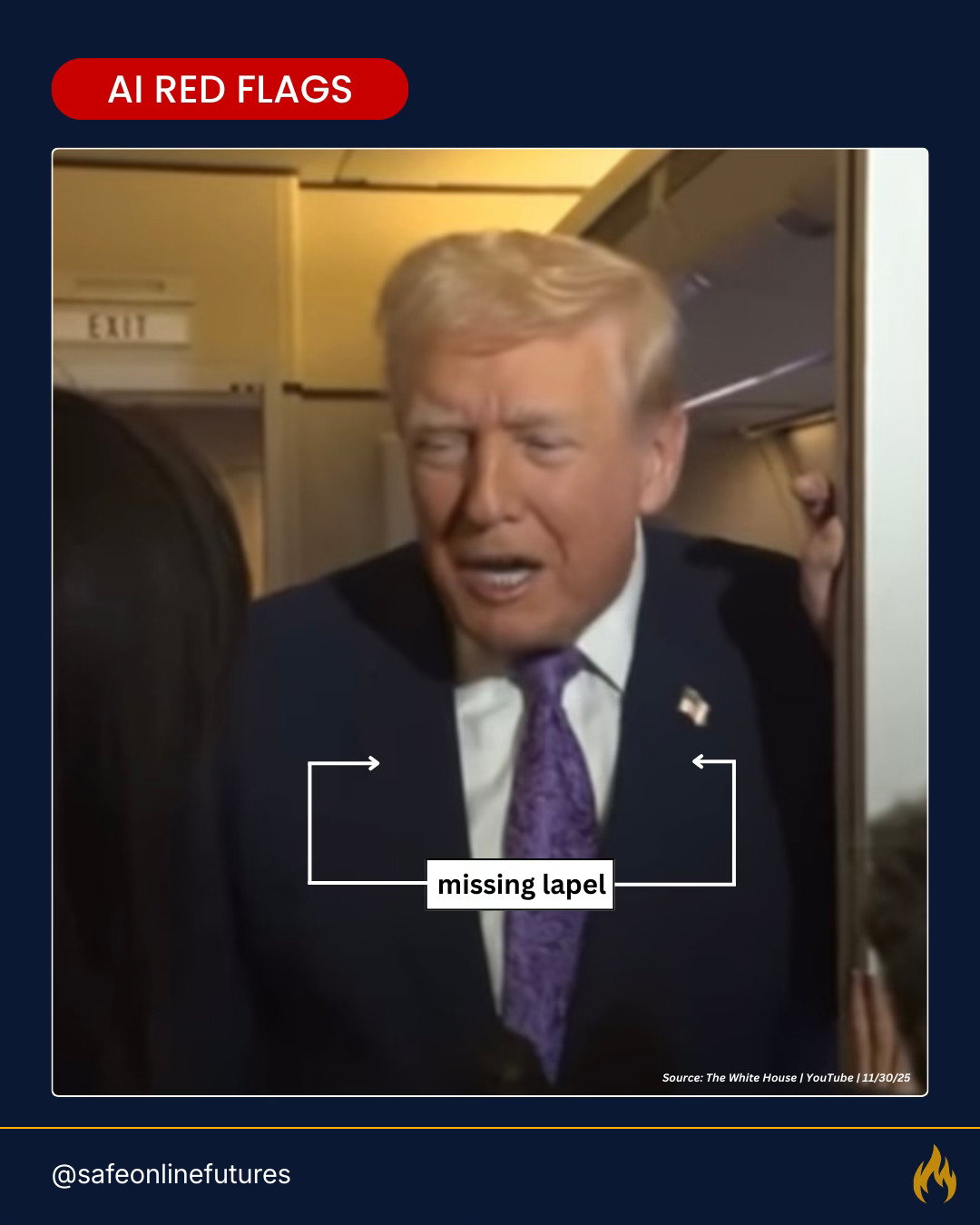
A physical impossibility inside what is supposed to be unaltered government documentation.
This isn’t a lens issue. It isn’t a broadcast hiccup. It’s the signature of an AI system smoothing, interpolating, or reconstructing part of the frame and failing.
The event may have happened. But the version the public saw was not purely recorded.
The Pattern Behind the Glitch
In another widely circulated clip from PBS News, Trump snapped at a journalist who attempted to fact-check him: “Are you a stupid person?” At the exact moment he delivers the line, his face distorts in a way that doesn’t match compression or motion artifacts. [I’ve annotated the frame-by-frame breakdown here.] The pattern across clips is consistent.
AI is now operating inside the broadcast pipeline. Not as a standalone deepfake. Not as an app. But as an embedded part of the modern video processing stack itself.
Tools like Topaz Labs Video AI handle automated upscaling, lighting correction, motion smoothing, frame interpolation, edge reconstruction, and adaptive denoising. Broadcasters use them because they’re faster and cheaper than human oversight, and because they require no transparency about when or how AI has altered what viewers see. When those systems malfunction, they produce synthetic errors, not analog ones. Like disappearing lapels.
And the most telling part isn’t the glitch. It’s how quickly it passed through the public consciousness without a single institutional question.
Why Outrage Is the Perfect Cover
There’s a structural reason these anomalies go unnoticed.
The more emotionally explosive the content, the less attention viewers give to the integrity of the footage itself. Outrage narrows vision. It turns the viewer into a reactor, not an observer.
While everyone was venting about Trump’s treatment of female reporters, no one was looking at the image delivering the outrage.
Spectacle on the surface. Synthetic manipulation underneath. And a public trained to focus only on the spectacle.
Manufactured reality doesn’t need secrecy. It only needs distraction.
The Infrastructure Already Exists
Across Parts 1, 2 and 3 of this series, I laid out the architecture. Trump-aligned billionaires now control or influence major broadcast networks, newspapers, and social platforms. Editorial guardrails have been weakened or removed. AI tools have become standard inside newsrooms, streaming systems, and live broadcast environments because they’re cheaper, faster, and require no transparency.
This is not propaganda in the classical sense. It’s perception engineering, executed through ownership, technology, and algorithmic amplification.
The missing lapel is not the scandal. The uncritical acceptance of the missing lapel is the scandal. It reveals a populace whose perceptual defenses have already been softened by years of algorithmic conditioning.
A Familiar Playbook, New Technology
We’ve seen versions of this before. In Stalin’s Soviet Union, photo editors airbrushed purged officials from images to rewrite history after the fact. The technology was crude, the revisions obvious to trained eyes, but the goal was never perfection. It was to establish that reality itself was negotiable, controlled by those in power.
The difference now is speed and scale. Soviet photo manipulation required darkrooms and manual labor. Today’s AI systems operate in real time, embedded in broadcast pipelines, altering footage as it streams to millions. The revised image becomes the official record before anyone thinks to question it.
When reality is editable at the point of distribution, there is no original to return to. There is only the version those who control the infrastructure choose to show you.
When Democratic Consent Becomes Theater
Democracy depends on people making informed choices. But when the information reaching the public is shaped, filtered, or partially generated by AI, people may still feel like they’re participating even while their decisions are being guided by manufactured inputs.
Citizens go through the motions of choosing, but the reality they’re choosing from has already been engineered.
A system like that doesn’t need to suppress votes or silence dissent. It only needs to feed the public images and narratives that feel authentic enough.
Once perception is programmable, accountability becomes optional.
Democracy can survive disagreement. It cannot survive fabricated reality.
This Is the Perception Coup
The Perception Coup is not a takeover of institutions. It’s the takeover of reality itself. It replaces a shared civic lens with individualized, synthetic, emotionally engineered experiences that feel like information but function like persuasion.
When citizens can no longer verify the authenticity of the footage shaping their political judgments, democratic participation becomes a ritual act, not an informed one.
The vote still happens. The outrage still happens. The discourse still happens. But the input layer, the images, clips, and narratives people rely on, has already been optimized and engineered before it reaches them.
Once that shift completes, reality becomes a partisan commodity.
What You Can Do
The Perception Coup isn’t futuristic. It’s here, visible in tiny artifacts hiding inside political footage, anomalies no one questions because the emotional content is loud enough to carry the narrative alone.
Start by changing how you watch. When political footage provokes a strong emotional reaction, watch it twice. Once for the content that made you angry or afraid. Then again, on mute if necessary, looking only at the image itself. Does the lighting make sense? Do edges hold together when the camera moves? Does anything appear or disappear that shouldn’t?
Train yourself to see the seams. Look for the small impossibilities that reveal AI interpolation. A lapel that vanishes. A face that warps at the wrong moment. Motion that’s too smooth or edges that reconstruct strangely.
And when you find them, document them. Screenshot them. Share them. Because the only defense against manufactured reality is a public that has learned to recognize when they’re being shown something that isn’t entirely real.
We are entering a world where images are increasingly synthetic, footage is partially generated, the public cannot distinguish documentation from fabrication, and those who own the pipelines own the story.
This isn’t the evolution of propaganda. It’s the replacement of reality.
And if we lose the ability to recognize what is real in the first place, we lose the foundation that democratic consent depends on.
This is the Manufactured Reality. And unless we learn to see the architecture behind our own perceptions, we will mistake manufactured input for informed judgment and call it democracy.
This is Part 4 of our series on The Manufactured Reality. (Read Part 1, Part 2, and Part 3)
Read, share, and subscribe to Safe Online Futures, where reality still matters.