The Outrage Playbook
Charlie Kirk’s death marks a new phase in Trump’s strategy to radicalize and control
Charlie Kirk's death unleashed something ugly — not the tragedy itself, but how quickly it was weaponized into a rallying cry for authoritarian power. Trump and his allies didn't wait for facts, didn't pause for mourning, didn't call for justice. Before investigators could even piece together what happened, they were already demonizing half the country with language designed to cut deep.
This wasn't grief. It was calculation.
The Outrage Machine
Trump understands social media better than most tech executives. Outrage performs. Anger spreads faster than wildfire. Algorithms reward the content that keeps us glued to our screens, and nothing hooks us quite like red-hot political rage.
The pattern never changes: Kirk gets murdered, and within minutes, Democrats become "the party of violence." The rhetoric gets cranked to maximum volume — not to inform anyone, but to set them on fire. Millions of impressions later, nobody's talking about the actual crime. Everyone's fighting a war that exists primarily in their feeds.
This isn’t just about assigning blame — it’s about creating the illusion that all Democrats are evil. Repetition and incendiary rhetoric do the work. When people are bombarded with those messages day after day, it starts to feel like common sense. That’s the illusion of consensus: most people may want peace, but you’d never know it if you open your feed.
But this isn't just about engagement metrics. When you can enrage enough people online, some of them will carry that fury into the real world. Digital rage becomes street-level chaos.
We've seen this film before. January 6th wasn't born in a vacuum — it was incubated in algorithm-driven echo chambers where bots, influencers, and politicians all pushed the same lie about a stolen election. What we’re seeing around Kirk’s death is that same incubation process — rage curated, amplified, and redirected. The platforms' outrage-amplifying mechanics nudged thousands of people toward the Capitol steps, many of whom might never have acted without that constant digital prodding.
Trump's team is running the same playbook now. They know exactly how to game the system: exploit algorithms that reward outrage, reinforce beliefs in sealed echo chambers, deploy bots and influencers (real or synthetic) to manufacture fake consensus, and let politicians pour gasoline on the flames.
Most people have no clue how sophisticated this machinery has become. Every scroll, like, and comment feeds a system that's studying their behavior and fine-tuning the next manipulation. They don't see how algorithms, synthetic media, confirmation bias, and political rhetoric work together to turn ordinary citizens into unwitting soldiers for someone else's agenda.
And when the inevitable chaos erupts? Trump and his allies can point to the very unrest they manufactured and declare: "See? This is why we need more crackdowns. More control. Fewer rights for them."
Manufacturing the Visual Evidence
Words alone can't carry this strategy. They need pictures.
Just like the Ukrainian refugee stabbing, the "Big Balls" carjacking, and the LA ICE protests, many photos and videos circulating about Kirk's death show telltale AI red flags. Whether intentional or negligent, even the FBI is distributing images that show signs of AI, wrapping synthetic content in the credibility of federal law enforcement.
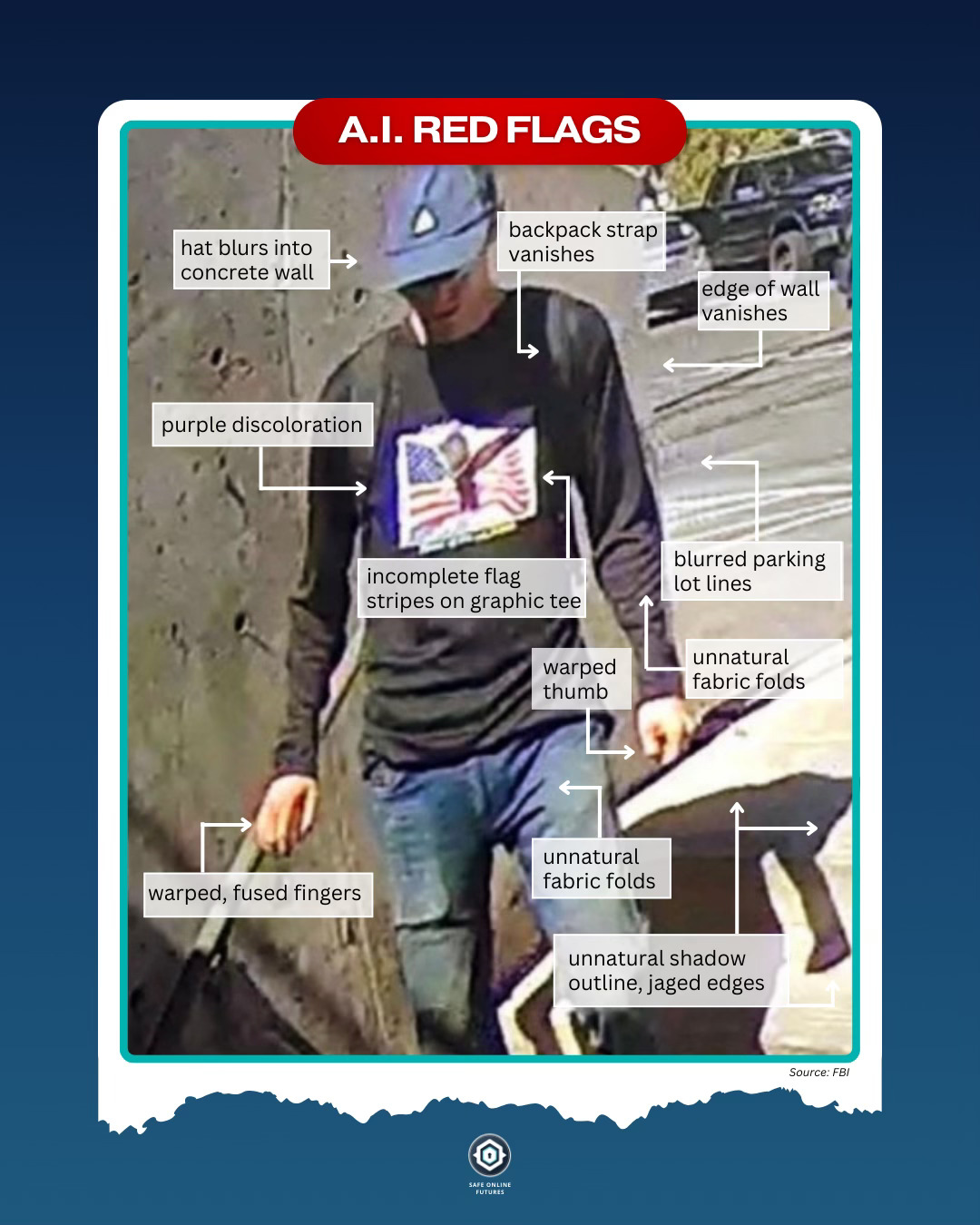
This matters because incendiary quotes get attention, but shocking images supercharge the algorithm. A distorted photo or glitchy video doesn't just illustrate the story — it becomes the story. Synthetic visuals transform outrage into "evidence," making the narrative harder to question and easier to spread.
If you make it trend, you make it true. — Renée DiResta
The Violence Feedback Loop
This isn't a bug in their system. It's the entire point.
The strategy works in stages: stoke anger, reinforce it with manufactured imagery, push it through social media pipelines, wait for real-world flashpoints, then use those flashpoints to justify authoritarian measures.
The Charlie Kirk circus isn't really about Kirk. It's about engineering a cycle of violence and crackdown that consolidates power.
Every click trains the machine. Platforms and political operators track which messages hook us, which visuals move us, which words make us rage. That behavioral data becomes the blueprint for the next propaganda wave. The language gets sharper, the visuals more convincing, the emotional manipulation harder to resist.
This isn't just propaganda — it's adaptive propaganda. The system learns what provokes us, then fine-tunes the message to provoke us harder next time.
The Real Target
The goal isn't winning partisan points. It's control.
Provoke enough people into action — protests, clashes, violence — and the right gets all the justification it needs to crush freedoms under the banner of "restoring order."
Meanwhile, the manufactured outrage cycle distracts from the issues that actually matter: housing costs, healthcare, wages. Trump promised to bring down prices. They haven't budged. But as long as people stay locked in algorithm-fed fury over Charlie Kirk, nobody's demanding answers about why rent keeps climbing or groceries keep getting more expensive.
Breaking the Cycle
This goes beyond politics as usual. It's social engineering—a feedback loop where rhetoric, synthetic visuals, and algorithms combine to provoke unrest, then use that unrest to justify authoritarianism.
Here's the trap: they want the opposition to take the bait. To lash out. To provide the unrest they need to prove their point.
Which means the most subversive thing we can do right now is refuse to play our assigned role in their theater.
The Way Forward
Silence won't save us. But neither will rage on their terms.
We need to get louder about exposing the manipulation, not just angrier at the bait. We have to shatter the illusion by naming it, by refusing to let AI-generated images, weaponized rhetoric, and algorithmic manipulation pass unchallenged.
Because if deception builds momentum, deception wins. But if truth and resistance build momentum, truth wins.
Silence is compliance. Loudness is leverage. If we want democracy to survive this cycle, we can’t just scroll past — we have to break the machine.
Exposing how media manipulation, AI, algorithms, and the attention economy are rewriting reality. Subscribe for free to receive insights into the forces reshaping truth in the digital age.