The Portland Playbook
How influencers weaponize AI — turning calm streets into chaos for clicks
Scroll through social media last week and you’d think Portland was burning. Videos showed clashes outside the ICE building — chaos, shouting, police lines, smoke. Conservative influencers declared Antifa was back, Portland had gone “lawless,” and federal troops needed to step in.
Meanwhile, in actual Portland: clear skies, brunch crowds, thousands of runners filling downtown for the city marathon. Local officials described the protests as small and mostly peaceful.
So how did the internet see a city in flames?
Because people with massive platforms — and explicit political agendas — wanted you to.
The Formula
What’s happening in Portland isn’t organic outrage. It’s a system.
Two conservative media figures sit at the center: Nick Sortor and Katie Daviscourt. Both have built their followings on political commentary dressed up as street-level journalism — citizen reporting that functions as partisan propaganda. Both were in Portland last week. Both posted footage showing clear signs of AI manipulation.
And both pushed the same line: Portland is chaos. Democrats can’t govern. Only Trump can fix it.
Same old “lawless Democratic cities” story. Just delivered with better tools.
The Players and What They Did
Nick Sortor has over a million followers on X and appears regularly on Fox News as the truth-teller documenting urban collapse. On October 2nd, police arrested him outside Portland’s ICE facility during a protest they described as mostly calm until a minor altercation erupted. He was charged with disorderly conduct and released.
Hours later, Sortor reframed his arrest online: proof that Portland Police are “controlled by violent Antifa thugs.” That narrative spread instantly across conservative media. Fox amplified it. Trump’s channels amplified it.
Local leaders saw it differently. Oregon Governor Tina Kotek accused Trump allies of sending influencers specifically to provoke confrontation and film the results. “They’re clearly trying to antagonize the crowds,” she said. Portland’s mayor agreed: “It’s an aggressive approach trying to inflame a situation that has otherwise been peaceful.”
Here’s what matters: The footage both Sortor and Daviscourt shared with their audiences — the videos they used to claim Portland is lawless — is riddled with AI red flags.
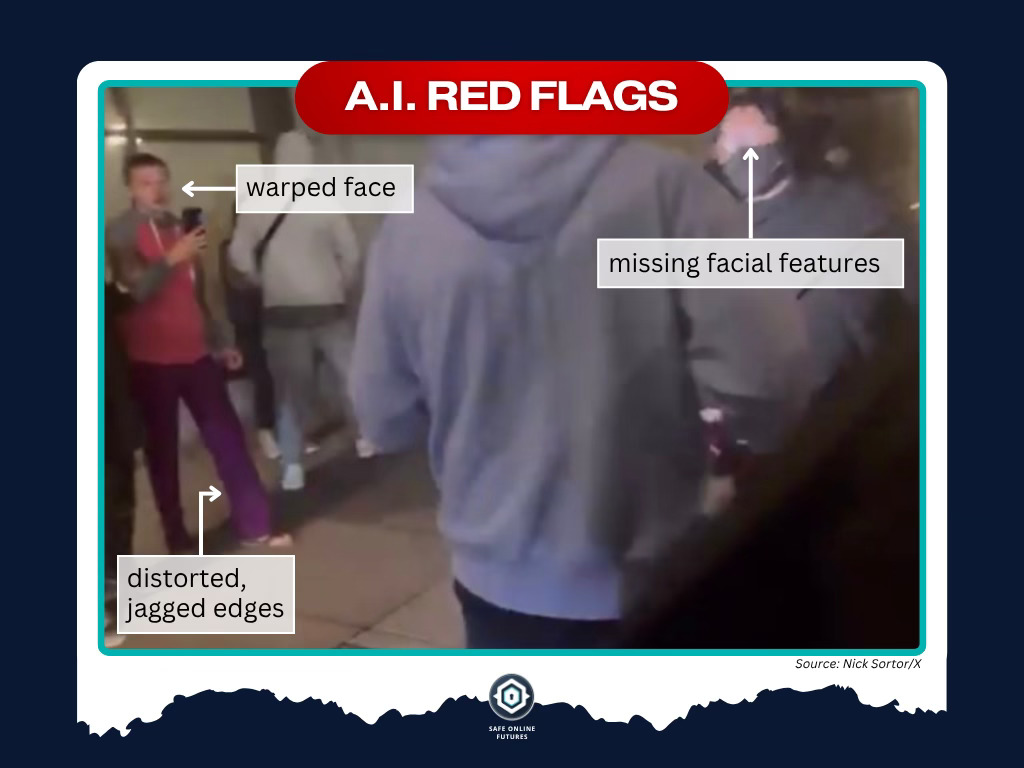
Even Sortor’s video of his own arrest shows glitchy, unstable video, blurred lettering on background objects, and shadows that don’t match the scene. These aren’t compression artifacts. They’re signatures of AI manipulation.
Katie Daviscourt, correspondent for The Post Millennial—a far-right outlet that treats the line between opinion and reporting as a suggestion—posted similar footage. With over 250,000 followers on X, she claimed she was assaulted by “Antifa” protesters wielding flagpoles. She appeared on Fox News the next day, then on conspiracy theorist Jack Posobiec’s podcast, describing Portland as “complete lawlessness.”
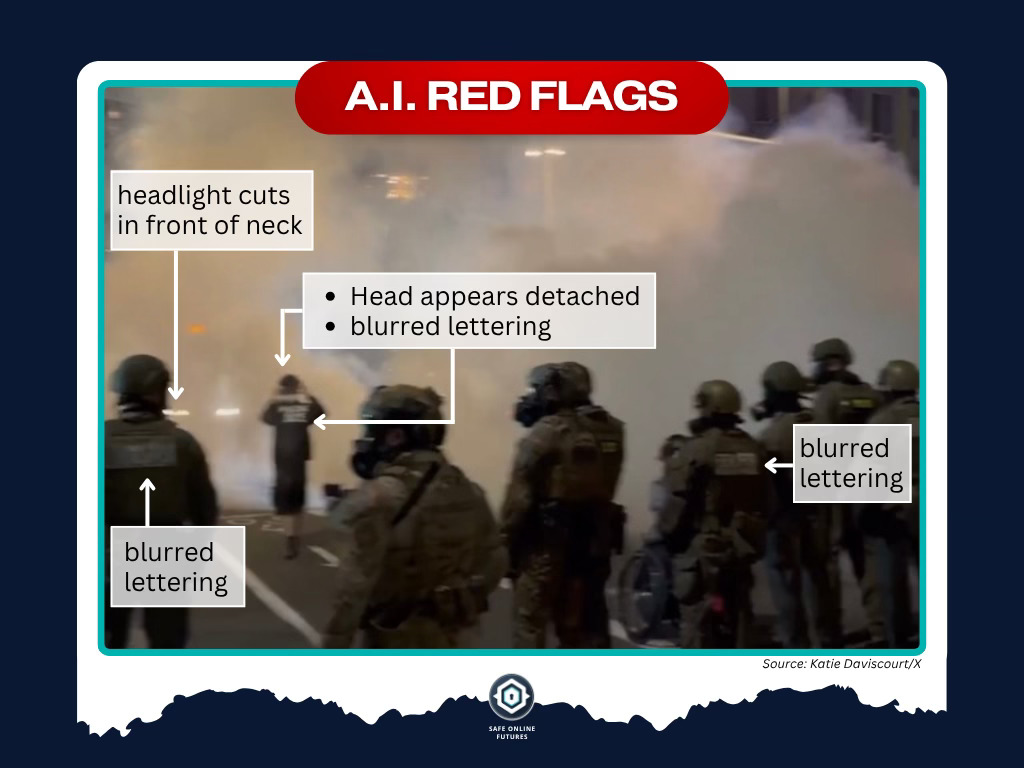
Her footage shows obvious AI red flags: a head detached from a body, blurred lettering on clothing, and lighting that defies physics. Local reporters and residents say the protests were calm.
The question becomes unavoidable: Are they manufacturing AI footage to advance their “Portland is lawless” narrative? Creating the illusion of chaos — using synthetic media — despite officials confirming the protests have been mostly peaceful?
When you use synthetic imagery to document supposedly real events, you’re not doing journalism. You’re producing propaganda.
From Fake Footage to Federal Crackdown
Here’s where manufactured content becomes real-world policy.
Sortor’s arrest — documented in video showing clear AI manipulation — is now being used to justify Trump administration intervention in Portland.
According to Sortor, he received a personal phone call from Attorney General Pam Bondi informing him that the DOJ is launching a full investigation into the Portland Police Bureau over his arrest.
Then DHS announced it’s surging CBP and ICE agents to Portland — directly in response to the incident.
Read that again: A potentially AI-fabricated arrest video has triggered a federal investigation of local police and a Department of Homeland Security deployment.
This is the feedback loop. Influencers create synthetic chaos. The chaos justifies federal intervention. The intervention becomes proof that the crisis was real all along.
The Outrage Assembly Line
We’ve seen this pattern on repeat since 2020: Antagonize a protest. Film selective moments — or generate them with AI. Upload to platforms that reward emotional content. Drive engagement and profit. Shape political perception.
As one Portland demonstrator put it: “There are more people filming each other than there are rabble-rousers.”
The tactic works because social platforms prioritize emotion over accuracy. Outrage spreads fastest. Algorithms don’t distinguish real from fake — only engagement from silence. Once that content hits the mainstream, reality and fabrication become indistinguishable.
AI Makes Chaos on Demand
Influencers used to need an actual confrontation to create viral content. Now they can generate one.
AI video tools can fabricate protests that never happened, or modify real footage to make minor scuffles look like riots. In a social feed, synthetic clips blend seamlessly with authentic ones.
The result: hybrid propaganda. Part real, part synthetic, entirely manipulative.
Each fake clip reinforces Trump’s narrative that Democratic cities are collapsing. Each viral post conditions the public to accept that authoritarian “law and order” interventions are necessary.
This isn’t about optics. It’s about power.
Manufactured Chaos as Governing Strategy
Trump and his allies have spent years framing Democratic cities as failed states. It’s the narrative that justified sending federal troops into Portland in 2020. The difference now: AI makes the fiction photorealistic.
Control what people see on their screens and you don’t need to control reality — only perception.
When the public gets flooded with synthetic imagery until truth feels unknowable, most people stop trying to sort it out. That’s when power consolidates — quietly, efficiently, algorithmically.
The Portland protests are a small stage for a larger experiment: testing how far influencers and AI tools can reshape collective belief.
What We’re Risking
This isn’t about one protest. It’s about training the public to accept illusion as evidence.
When AI-generated chaos defines our understanding of civic life, we lose control over what’s true.
When influencers and political operatives can fabricate disorder to justify crackdowns, democracy itself becomes the thing being manipulated.
Before You Share the Next Viral Clip
Next time you see footage of a city “on fire,” stop.
Ask who filmed it.
Ask who benefits from you believing it.
Ask whether the outrage you’re feeling was engineered — and why.
The danger isn’t just that AI can fabricate chaos.
It’s that we’re being trained not to question whether the chaos is real.
This essay is part of an ongoing investigation into how influencers, algorithms, and AI tools are reshaping political communication in America.