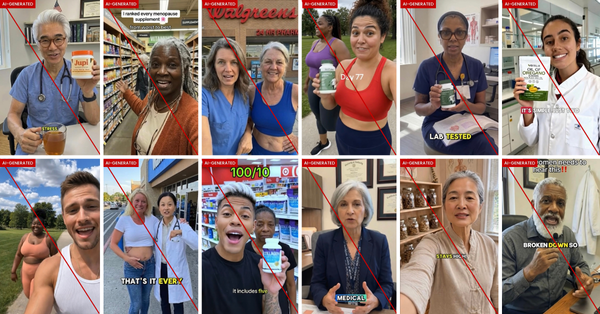
The Swift-Kelce Experiment
You weren't just sold an engagement. You were the test subject.
Taylor Swift and Travis Kelce's engagement announcement wasn't news — it was a product launch. The same goes for every manufactured celebrity "scandal" dominating your feed right now. These aren't journalistic events. They're branding campaigns designed to extract your attention and convert it into profit.
I wrote about Coldplay using this exact playbook just a few weeks ago with their CEO "cheating scandal" — but the Swift-Kelce engagement represents a clear escalation. Where Coldplay appeared to test whether manufactured outrage could go viral, Swift-Kelce appears to test whether manufactured joy works even with synthetic content showing visible artifacts. The tactics are getting bolder, and the synthetic content is getting sloppier, suggesting someone is learning just how much you'll accept.
When the New York Times breathlessly covers Swift's engagement photos, they're not informing you. They're amplifying a marketing operation that enriches everyone involved — celebrities, platforms, brands, and publishers — while you get fed advertising disguised as journalism.
You're being played. And it's about to get much worse.
The Glitches Were the Point
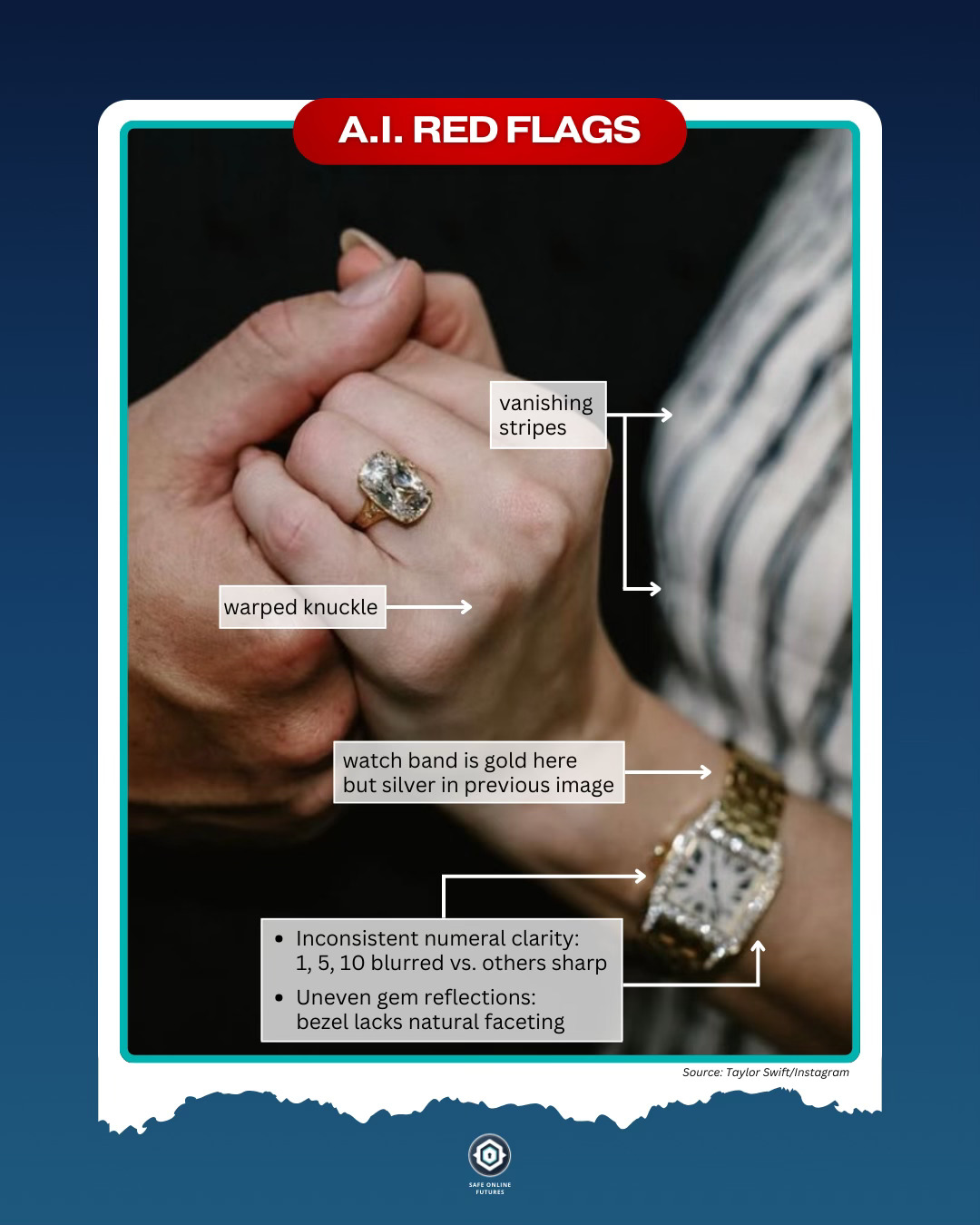
Here's what should alarm you: those engagement photos were highly suspicious. Jewelry warped mid-image. A watch band changed colors between frames. Dial numbers blurred into digital mush. The textures looked like melted plastic.
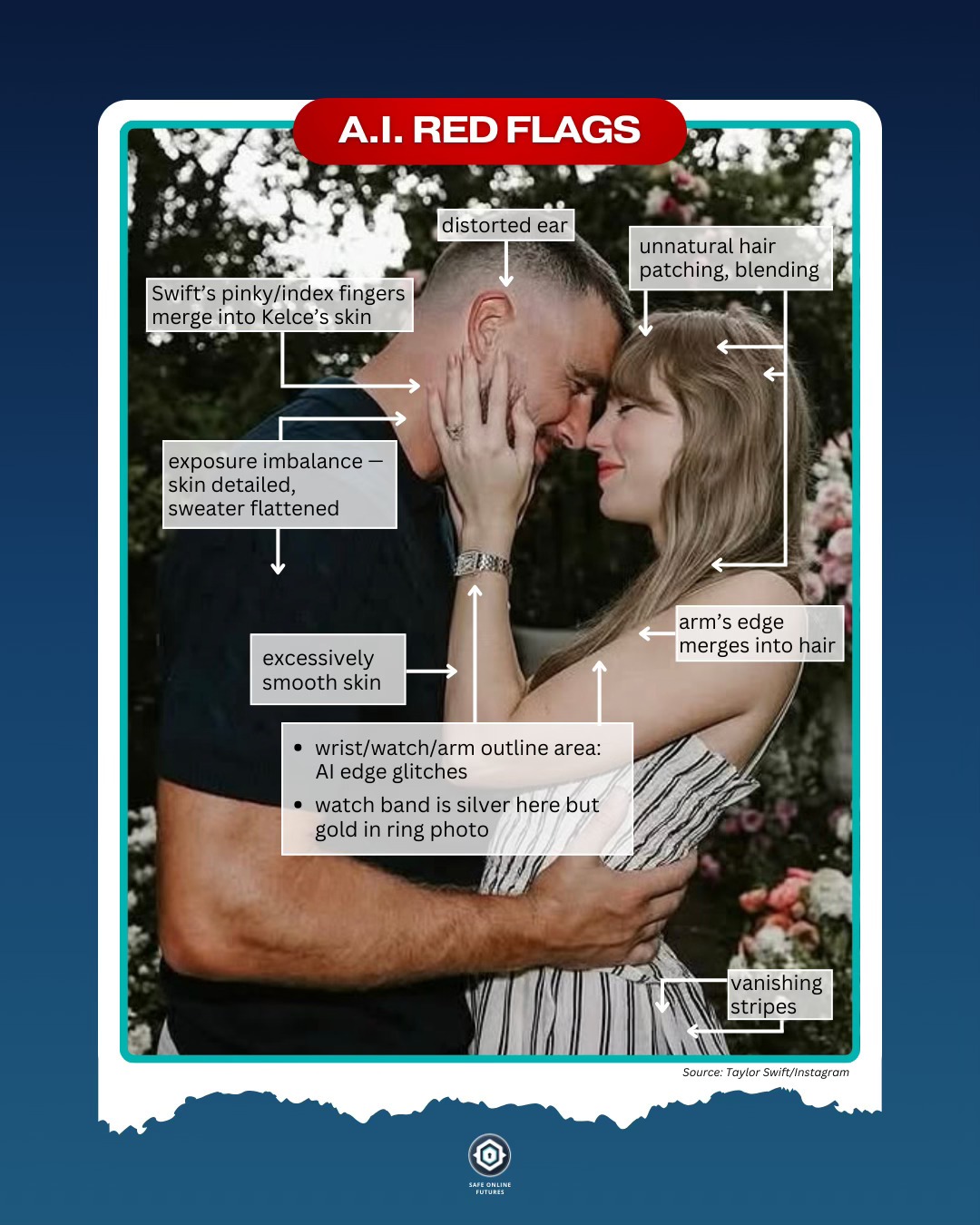
For those closely following AI detection, these weren't subtle AI artifacts — they were glaring, unmistakable flaws. Any competent photo editor would have caught them. Any skeptical journalist should have questioned them.
But nobody did. Why?
The photos sailed through the world's most powerful media ecosystem without a single raised eyebrow. Major outlets republished them. Millions shared them. Brands celebrated them.
That wasn't random sloppiness. It looks like a deliberate test. Two celebrities with high-powered PR teams tasked with tightly curating their public images don't make mistakes like this. The logical question becomes: Was this a deliberate test to gauge how much synthetic garbage the public will swallow if it's wrapped in celebrity packaging and pushed through algorithms?
The answer: All of it.
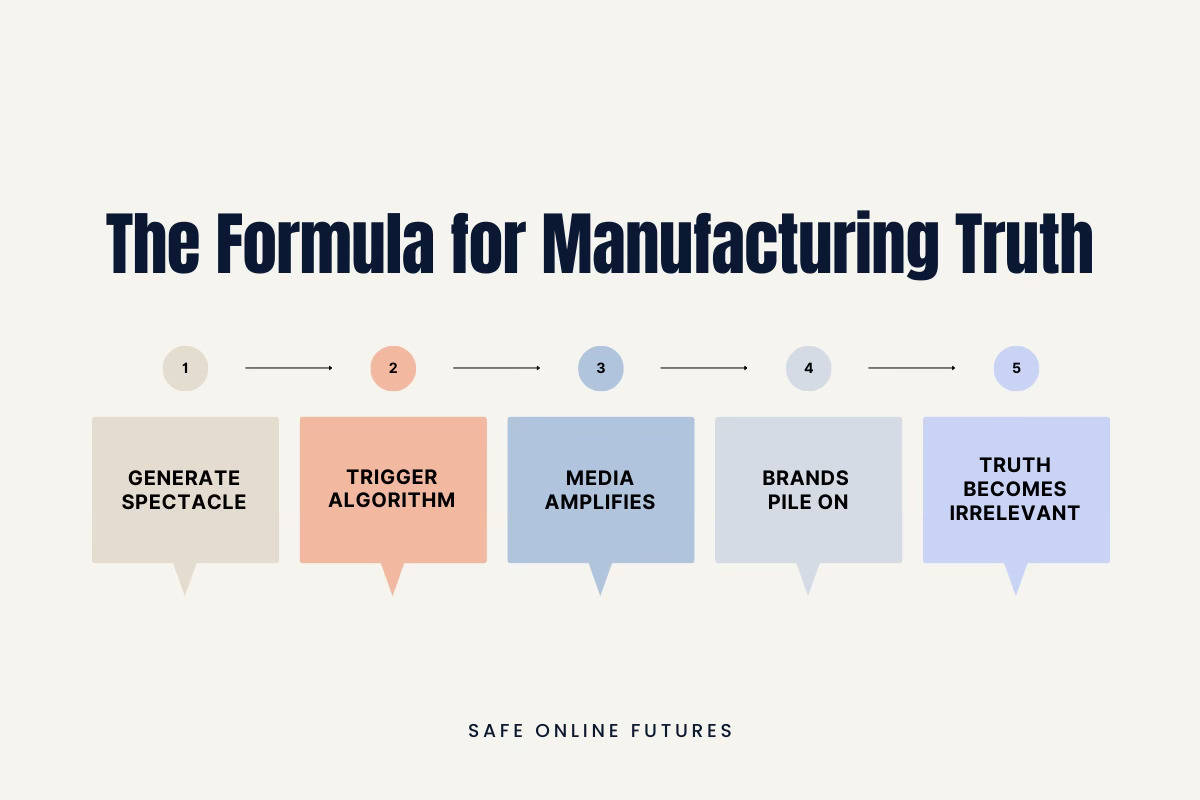
The Formula for Manufacturing Truth
Watch how it works:
- Generate the spectacle (real or synthetic — doesn't matter)
- Trigger the algorithm (engagement metrics explode)
- Media amplifies (headlines chase the numbers, not the truth)
- Brands pile on (every corporation wants their slice)
- Truth becomes irrelevant (virality equals validity)
This is what researcher Renee DiResta calls "if you make it trend, you make it true." Once something goes viral, questioning its authenticity becomes beside the point. The conversation moves from "Is this real?" to "How can we profit from it?"
You've Been Here Before
This isn't new. Powerful institutions have always run experiments on unwitting populations:
- Tuskegee (1932-1972): Black men were told they were receiving free healthcare but were deliberately left untreated for syphilis so researchers could study disease progression
- MKUltra (1953-1973): The CIA secretly dosed Americans with LSD in hospitals and universities to test psychological manipulation techniques
- Facebook emotional study (2012): The platform manipulated 700,000 users' newsfeeds without warning to test if emotions were contagious — hiding behind user agreements to data policies most people never read
The common thread: subjects were deceived about what was happening while researchers collected behavioral data. Today's version just has better reach. Instead of experimenting on individuals in secret, AI and social platforms let them test on millions simultaneously. Every viral moment is a data point. Every reaction is recorded. Every click trains the system to manipulate you more effectively next time.
You are the test subject. You never agreed to participate.
They didn’t just sell you a story. They studied your response to it.
Follow the Money Trail
Who profited from Swift and Kelce's "engagement"?
- Swift and Kelce monetized their relationship into a billion-dollar brand asset
- Meta harvested ad revenue from record-breaking traffic
- News outlets got free content that required zero investigation
- Brands rode the wave for cost-free global exposure
- AI/PR firms proved they could manipulate public perception at massive scale without resistance
Everyone won except you. You got lied to, studied, and sold to — all while being told it was entertainment.
This Is Bigger Than Celebrity Gossip
Here's why you should be furious: if the most scrutinized celebrity on Earth can post images with clear AI artifacts and receive unquestioned validation from major media outlets, what happens when the same tactics get deployed in politics? In war coverage? During natural disasters?
We're already seeing it. Deepfake political ads. AI-generated "evidence" of war crimes. Synthetic disaster footage designed to trigger donations or policy changes. The same playbook that sold you a fake celebrity romance appears to be getting used to sell you fake political candidates and manufactured crises.
And it's working because AI remains essentially unregulated. No disclosure requirements. No authenticity standards. No accountability when synthetic content shapes public opinion or policy decisions.
The Swift-Kelce photos weren't just entertainment. They appear to have been a preview of what happens when unregulated AI collides with the Attention Economy: reality itself becomes a marketing campaign, and the public becomes the test subject.
The Real Experiment
Strip away the celebrity glitter and here's what actually happened:
You were sold advertising disguised as news. You were used as a test subject in a mass psychology experiment. Your reactions were harvested as data to improve manipulation techniques. And you were primed to accept synthetic content as reality — making you easier to deceive when those same methods get used to sell you political candidates or justify military interventions.
The experiment succeeded. You accepted the fake images. Media outlets legitimized them. Brands profited. And the platforms collected data on exactly how to fool you more effectively next time.
Why You Should Be Angry
This isn't about whether Taylor Swift is engaged. This is about powerful interests discovering they can manufacture reality and sell it to you as entertainment while studying your responses for future manipulation campaigns.
You're being conditioned to accept lies wrapped in spectacle. Every fake viral moment trains you to stop questioning what's real. Every synthetic celebrity story normalizes the idea that authenticity doesn't matter as long as something is entertaining enough.
They're not just stealing your attention — they're rewiring your relationship with truth itself. And they're doing it to make you easier to control when they need to sell you something that actually matters: a political candidate, a war, a policy that benefits them at your expense.
The same system that convinced you to care about a fake celebrity engagement is being designed to convince you to vote, spend, or stay silent exactly when they need you to.
That should make you furious. Because the next time they deploy these tactics, the stakes won't be celebrity gossip. They'll be your democracy, your economy, and your future.
And by then, they'll know exactly how to fool you.
This is part of an ongoing series on synthetic celebrity — how AI and algorithmic design are quietly redefining what passes for real. Each week, I break down the mechanics of AI-driven media manipulation: how it works, why it works, and how to spot it before it rewrites what you think you know.