The Synthetic Body Behind the Schumer Rebrand
AI-enhanced celebrity imagery is reshaping what consumers think GLP-1s can deliver — and no one is disclosing it.
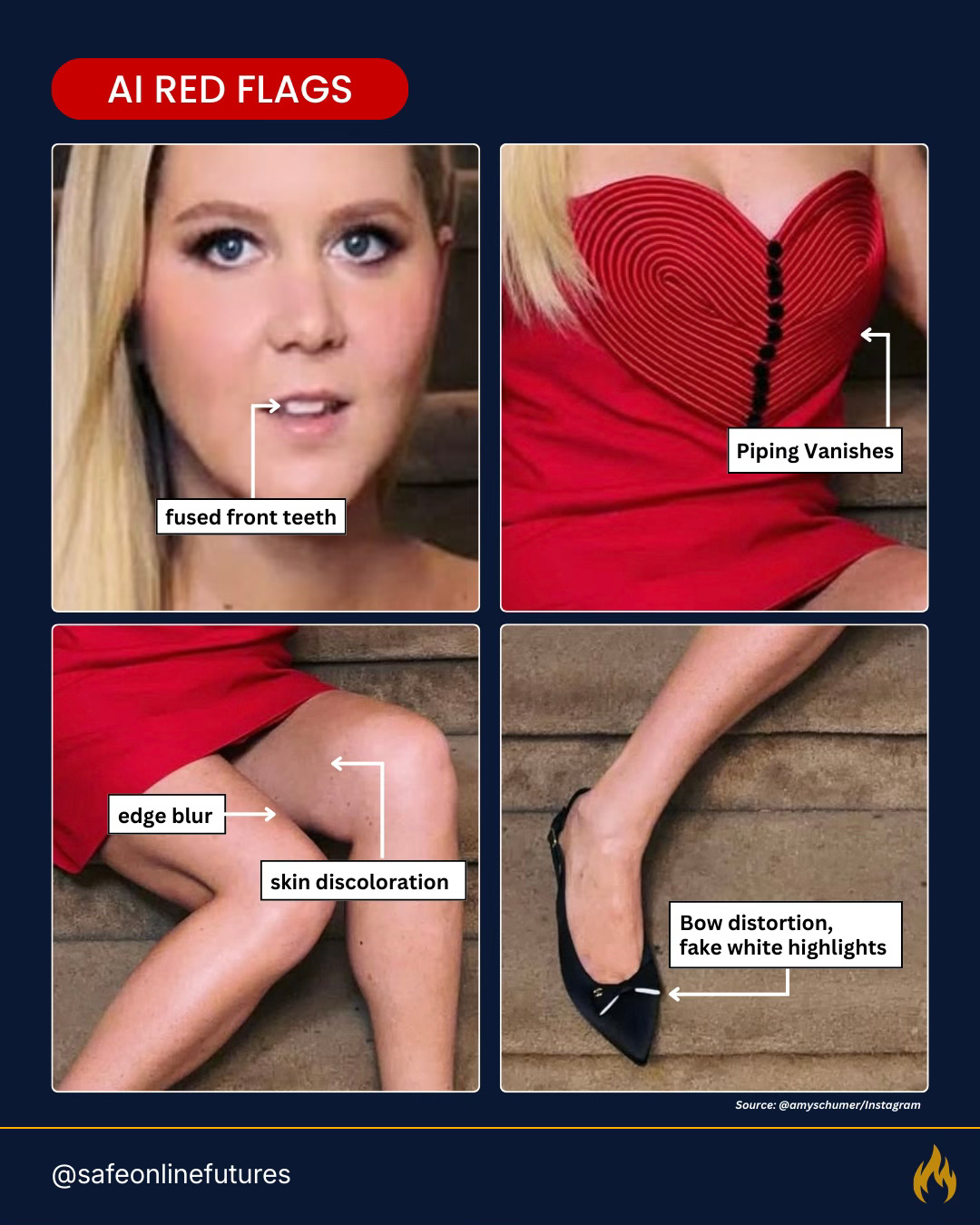
Amy Schumer wiped her entire Instagram feed this fall and reintroduced herself with a set of glossy, dramatically slimmed-down images. At first glance, it looks like a standard celebrity reset. But look at the photos closely. They’re not simply edited. They show the unmistakable fingerprints of AI manipulation: blurred garment edges, warped textures, unnatural skin rendering, geometric distortions. These aren’t filters. They’re synthetic reconstructions.
And that changes everything.
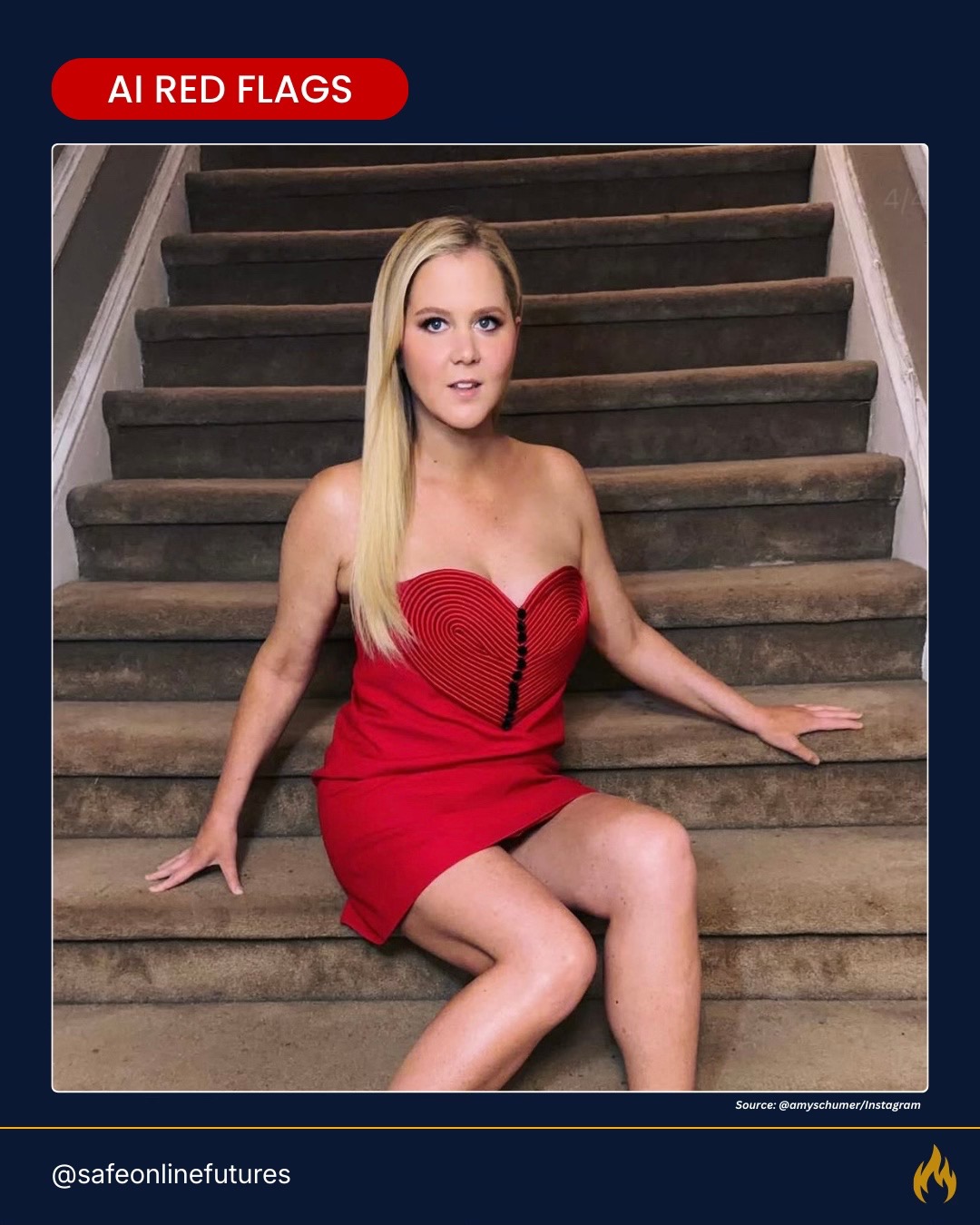
Here’s what trained eyes see when they look at this image.
Schumer has talked publicly about GLP-1 medications before. Back in March 2025, she shared a video praising Mounjaro and speaking candidly about her experience with Midi Health, the perimenopause telehealth company she’d invested in the previous September. She disclosed her investment directly. She explained her journey: the failed attempt with Wegovy years earlier, the perimenopause diagnosis, hormone therapy, and the eventual success she found with Mounjaro.
All of that transparency makes the Instagram reset even more consequential — because this time, the narrative isn’t just about her health. It’s about the imagery.
She clearly lost weight. The medications clearly worked for her. None of that is in question. What is in question is the version of herself she is now presenting to 12 million followers: a curated, AI-perfected body offered as visual proof of her transformation at the exact moment she has a financial stake in the company providing access to those medications.
That’s the ethical fault line.
When a celebrity known for authenticity swaps real photos for synthetically engineered ones, without acknowledging the technology, the images stop functioning as personal expression. They become marketing assets. They imply outcomes that human biology doesn’t produce and GLP-1s don’t guarantee. And most people scrolling past have no idea they’re looking at AI.
This is the shift I want to examine. Not whether Schumer lost weight (she did). Not whether GLP-1s are effective (they are). Not whether her health improvements are legitimate (I have no reason to doubt them). The question is whether the version of her body she is now using to anchor her narrative is real enough to justify the influence she holds over her audience.
In the age of AI, the line between inspiration and manipulation isn’t blurring anymore. It’s being erased.
The Synthetic Celebrity Pipeline
Schumer isn’t the first public figure to reset her image through AI, but she’s one of the clearest examples of something I’ve been tracking: Synthetic Body Marketing. This is the use of AI-altered or AI-generated celebrity images to imply the effectiveness of a medical product, wellness regimen, or cosmetic intervention.
Here’s how the pipeline works in Schumer’s case.
First, she undergoes a physical transformation. She loses weight through GLP-1s and medical treatment. She’s open about this journey, discussing it candidly in videos and posts.
Second, she becomes financially invested. In September 2024, she invests in Midi Health alongside other prominent women leaders, positioning herself not as a traditional brand ambassador but as a user-turned-stakeholder in the perimenopause telehealth company.
Third, she continues sharing her health narrative. In March 2025, she posts a detailed video about her experience with Mounjaro, hormone therapy, and Midi Health, explicitly disclosing her investment.
Fourth comes the platform reset. Months after these disclosures, she wipes her Instagram, creating a clean break from historical photos and the “before” image the public remembers.
Fifth comes the synthetic rollout. She uploads highly manipulated photos that present a sleek, stabilized version of her body, face, skin, and clothing.
Sixth, she anchors the new narrative, posting captions about health improvements, inner strength, self-love, and curating what you want the world to see.
The result? A curated, synthetic version of her body becomes the visual proof that her health regimen works.
This is not disclosed. This is not regulated. And this is not harmless.
Why Celebrity Influence Now Outweighs Expertise
The most significant risk here isn’t the AI manipulation itself. It’s who is doing it and why.
Amy Schumer has spent over a decade cultivating a reputation as unfiltered, relatable, body-honest, emotionally candid, and proudly messy in the most human sense. That identity gives her enormous parasocial trust. She isn’t a health expert. She isn’t a clinician. She isn’t a researcher. Yet her 12 million followers treat her disclosures about weight, health, and menopause as authentic, firsthand guidance because they believe she would never manipulate them.
This is why celebrity influence has quietly overtaken expertise in the GLP-1 market. Consumers aren’t listening to endocrinologists. They’re listening to women they like.
Now add AI into that dynamic.
When a celebrity curates a synthetic version of her post-GLP-1 body but presents it as natural, she is no longer sharing her journey. She is selling an invisible product: the illusion that medical interventions produce flawless, symmetrical, perfectly contoured results with no side effects and no realism.
Her followers don’t know the images are manipulated. They trust her. They believe they’re seeing “the real Amy.” They assume the transformation is achievable. They assume the visuals reflect human biology.
This is how AI-assisted influence becomes consumer manipulation.
What AI Erases: The Real Side Effects of GLP-1s
One of the hardest realities to confront in the GLP-1 boom is this: celebrities on these medications are now using AI to erase the side effects that real people experience.
Loose skin? Gone. Texture changes? Gone. Facial volume loss? Creatively “fixed.” Hormonal swelling? Smoothed. Skin elasticity issues? Corrected by the model.
AI doesn’t enhance reality. It overwrites it.
So while Schumer offers transparency about the drug, she withholds transparency about the medium. That’s not accidental. It’s strategic. She’s letting people believe the AI version of her represents what GLP-1s can deliver. And in the same breath, she is marketing a telehealth provider in which she now has a financial stake.
You cannot separate those two facts. The imagery is part of the sales pipeline.
The Quiet Part Said Out Loud
A line from one of Schumer’s recent photo captions is particularly revealing: “Instagram is not your identity, it’s a curation of what you want the world to see.”
That is not how a comedian talks about photos. That is how a brand strategist talks about assets.
She is telling you plainly: you will see what she wants you to see. She has curated away the parts she does not want you to see. The images are not meant to be a record of reality. They are meant to serve a narrative.
This is exactly how synthetic identity pipelines are justified inside celebrity PR circles. You’re not deceiving, you’re “curating.” You’re not lying, you’re “managing your image.” You’re not manipulating, you’re “editing for aesthetic cohesion.”
But when the curation is paired with undisclosed AI and monetized through a financial stake in a health-tech company, it crosses into ethically indefensible territory.
Why This Is Different From Regular Photo Editing
Before someone says “celebrities have always edited photos,” let me be clear about why this is different.
Traditional photo editing enhances what’s already there. You adjust lighting, smooth skin texture, maybe slim a waistline or whiten teeth. The underlying structure remains human. The biology is still visible. You can tell you’re looking at a photograph of a real person who exists in three-dimensional space.
AI body reconstruction is something else entirely. It doesn’t enhance. It replaces. It can generate entirely new facial features, reshape bone structure, redistribute body mass, create impossible symmetry, and render skin in ways that don’t reflect actual human tissue. The images aren’t photographs anymore. They’re synthetic interpretations of a person, optimized for visual perfection.
When you filter a photo, you’re saying “here’s me, but better lit.”
When you use AI to reconstruct your body, you’re saying “here’s a version of me that doesn’t exist.”
That distinction matters exponentially when the synthetic body is being used to sell a medical product.
Why This Moment Matters
Here’s what followers take away from Schumer’s new feed: “This is what GLP-1s will make you look like.”
But the truth is: “This is what GLP-1s plus AI will make you look like.” And the AI is doing most of the heavy lifting.
When a celebrity sells a medical outcome using synthetic images, they’re no longer just misrepresenting their body. They’re modifying consumer expectations. They’re weaponizing parasocial trust. They’re altering the mental model of what success looks like. They’re pushing people toward pharmaceuticals using an artificially engineered body as proof.
I don’t care how authentic your brand is. That is deception.
We are entering a phase of the Attention Economy where celebrity bodies are no longer bodies at all. They are composites. They are AI interpretations. They are brand assets optimized to influence behavior. And when those assets become intertwined with health products, telehealth prescriptions, and GLP-1 pipeline marketing, consumers stop making decisions based on medical reality and start making them based on synthetic fantasy.
Schumer has a financial stake in a startup that reached a $150 million revenue run rate as of October 2025. That company has attracted investment from top executives at OpenAI, Atlassian, Databricks, Cloudflare, Google, Apple, Amazon, Meta, Life360, Calm, Universal Music Group, and Warner Media. The same industry building the AI tools that can generate synthetic bodies is investing in the telehealth companies selling GLP-1 medications. Midi Health provides access to the very medications that supposedly produced the body Schumer is now displaying through AI-perfected imagery. The visual proof and the profit motive are inseparable.
This is why the Schumer case matters. It reveals exactly how AI can be used to manipulate consumers, not through obvious deepfakes, but through curated, normalized “beauty” that looks just real enough to pass. AI didn’t make her lose weight. AI made her loss look perfect.
That distinction is the entire story.
If this investigation helped clarify what’s actually happening inside celebrity-driven GLP-1 marketing, share it. The only defense against synthetic narratives is literacy. And if you want more reporting on AI manipulation, synthetic celebrity, and the new attention economy, subscribe to Safe Online Futures. The stakes are getting higher — and the blind spots are getting wider.