This Is Not About the Jesus Image
The attention infrastructure behind two days of unavoidable content.
At 2:49am on April 13, 2026 while most of America slept, President Donald Trump posted an AI-generated image of himself to Truth Social. He was dressed in white and red robes. Golden light radiated from his hand as he touched the forehead of a sick man with the American flag, eagles and military planes flying behind him.
By the time people woke up, it was everywhere.
But this isn’t a story about the image. It’s a story about the infrastructure that guaranteed you’d see it — and kept you looking at it instead of everything else that was happening.
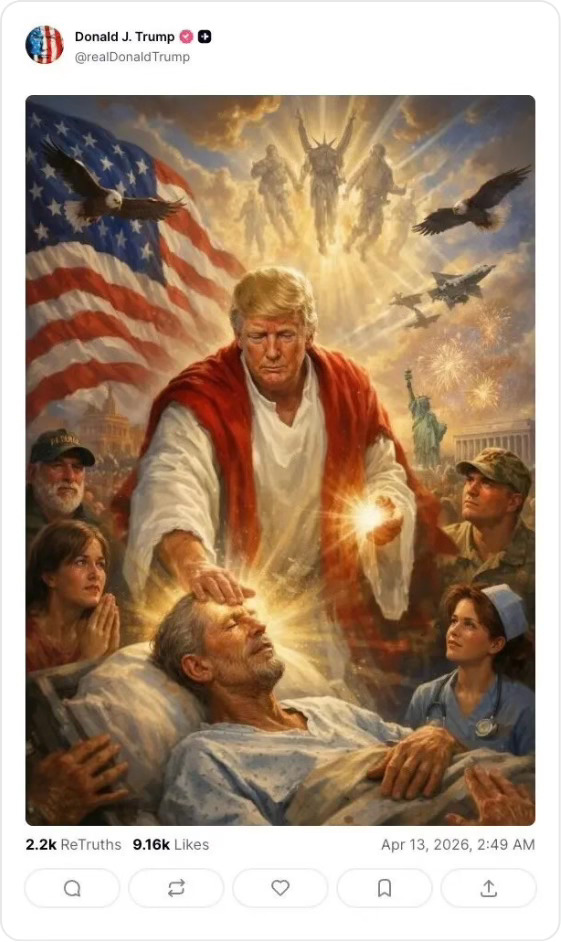
Here is how it played out, stage by stage.
STAGE 1: ACCESS
Reach precedes credibility. Visibility is the entry point.
The image didn’t arrive in a vacuum. Hours earlier, Trump had posted a lengthy attack on Pope Leo XIV on the same platform — the first American-born pope, and a vocal critic of the U.S. war in Iran. “WEAK on Crime, and terrible for Foreign Policy,” Trump wrote of the leader of the Catholic Church. That post came the same night a 60 Minutes report aired that had clearly gotten under his skin.
The Pope attack was the first provocation. The image, posted a few hours later in the middle of the night, was the escalation. Together they represent something worth understanding about how the pipeline operates: a compound sequence in which the second ignition point fires before the first has completed its cycle, absorbing it, amplifying it, and producing a news event larger than either post would have generated alone.
Truth Social is not a large platform by any conventional measure. Its audience is a fraction of what Trump commands on X, and small compared to Facebook or TikTok. What it has instead is a different kind of power: near-total media surveillance. Every major newsroom monitors it. Every post gets screenshotted, carried, and redistributed to audiences exponentially larger than those engaging on Truth Social. The platform’s reach isn’t its own. It’s borrowed from the mainstream media infrastructure that has proven, repeatedly, that it cannot look away.
Layered on top of that access dynamic is something new. The AI-generated image that consumed two days of public attention cost nothing to produce. Anyone with a phone and an image generation tool can now create sacred imagery featuring a sitting president in minutes. The entry cost for maximum provocative impact has effectively reached zero.
STAGE 2: AMPLIFICATION
Algorithms reward emotional arousal. Anger travels faster than context.
The image was algorithmically close to perfect. Visual content moves faster than text across every platform. It was visceral. It involved a famous person doing something that felt morally unambiguous. Every share in disgust, every reaction post, every screenshot — all of it registered as engagement, because the algorithm doesn’t distinguish between approval and horror. It measures interaction, and interaction is what it got.
What extended the story’s life beyond a typical outrage cycle was a second wave of amplification that the first wave alone couldn’t have generated. Conservative influencers, evangelical media figures, and religious voices began piling on — not in support of the image, but against it. Riley Gaines, a right-wing media influencer and Fox News contributor, wrote: “Why? Seriously, I cannot understand why he’d post this. Is he looking for a response? Does he actually think this?” She added that “a little humility would serve him well” and “God shall not be mocked.” Marjorie Taylor Greene called it “blasphemy” and said “I completely denounce this and I’m praying against it.”
Every one of those posts was its own engagement event. Every reply, every counter-reaction, every media outlet covering the conservative backlash extended the image’s reach further. The pipeline doesn’t distinguish between outrage from the left and outrage from the right. It only measures volume, and the second wave doubled it.
STAGE 3: INSTITUTIONAL RESPONSE
When institutions respond to scale, they amplify what they intend to scrutinize.
By Monday morning, every major newsroom was on the story. Cable panels. Chyrons. Reaction segments. All of them doing exactly what journalistic instinct said to do: hold power accountable by covering what power did. All of them, in doing so, ensuring that millions more people encountered the image.
The more revealing institutional responses came from within Trump’s own world. Vice President JD Vance, the highest-ranking Catholic in the federal government, was asked about the image on Fox News. He dismissed it as presidential humor and suggested the problem was the audience’s failure to understand it. The provocation became a personality trait. The sacrilege became a communication style.
What Gaines did next is revealing about how dissent actually functions inside the attention economy. After her criticism generated significant engagement — and after Trump publicly announced he was "not a big fan of Riley, actually" — Gaines celebrated the image's deletion, said it had "missed the mark," but confirmed she would continue supporting Trump and the America First agenda. The full sequence completed within a single news cycle. And that sequencing is the story: an influencer whose livelihood depends on audience engagement found a high-return moment to dissent, monetize the attention, and fall back in line before the cycle closed. What looked like a moral stand was actually engagement optimization.
Trump managed two audiences simultaneously. Deleting the post gave religious conservatives what they needed. The “I thought it was me as a doctor” explanation gave his base a deflection to deploy. The “fake news” pivot redirected blame outward. He apologized to no one.
STAGE 4: POLICY CONSEQUENCES
Real stories don’t disappear. They just have to fight harder for attention.
Nobody can say with precision what didn’t get covered while this dominated news feeds for 48 hours. But we can say what was running concurrently and what it was competing against.
The U.S. war in Iran — a conflict the pope himself called “absurd and inhuman violence,” the very week Trump attacked him for saying so — was in the news cycle that same weekend. Gas prices that remain high. Tariff chaos generating genuine economic uncertainty for working families. These are stories that require sustained, resource-intensive reporting to cover well. They don’t generate the kind of visceral spike that an AI image of the president as Jesus Christ generates.
Trump understands this calculus better than any political actor in recent history. A single Truth Social post costs nothing to produce and commands a news cycle. Holding sustained public attention on the costs of a war requires weeks of careful journalism. The system doesn’t treat those two things equally, and the people who exploit that asymmetry know exactly how the math works.
STAGE 5: FEEDBACK LOOP
The system teaches the people who use it.
This pattern has a precedent. In May 2025, days before the conclave that would elect Pope Leo XIV, Trump posted an AI-generated image of himself dressed as the leader of the Catholic Church. The backlash was swift. He didn’t apologize. The image remains on his official accounts. Nothing happened.
Ten months later, he posted an image of himself as a Jesus-like figure. Again, the backlash was instantaneous. This time, he deleted it, offered an explanation that almost no one believed, blamed the fake news media, and did not apologize. The post attacking Pope Leo — the provocation that preceded the image by a matter of hours — remains online.
Two cycles. Same structure. Zero political cost.
Each time the cycle completes, the confirmation runs in both directions. Political actors learn their behavior generates massive reach with no consequences. The platforms log the engagement numbers their content produces. The media ecosystem demonstrates again that it cannot look away. And so the system doesn’t self-correct. It compounds, with the next escalation already being calibrated against what this one produced.
THE SYSTEM ISN’T BROKEN. IT’S WORKING AS DESIGNED.
Once again, a political actor confirmed that provoking institutional outrage is the most efficient media strategy available — because the outrage itself is the distribution.
These tactics will keep working because the system is built precisely to reward this behavior. Every share, reaction, and outrage cycle tells the algorithm that this content works. And the algorithm will keep serving it, to everyone, at scale, until the incentives change.
Platforms have shown they can change those incentives when forced to. They have tweaked algorithms before — when regulators leaned in, and when public pressure became impossible to ignore. They did not do it voluntarily. They did not do it out of civic responsibility. They did it because they had to, which means the lever is political, and the hand on that lever is yours.
Asking yourself who benefits from your attention before you share something is necessary. But individual awareness alone won’t move the needle. Algorithmic regulation — Forcing tech companies to reward accuracy, reason, and civil discourse instead of outrage, sensationalism, and division — is a democracy issue, and there are candidates from both parties willing to say so. Finding them, supporting them, and voting for them is the most effective tool we have left.
This case study applies the Outrage Pipeline framework developed in this series. If you’re new here, start with Part 1: How Platforms Turn Attention Into Political Power.