What NASA Didn't Tell 107 Million People
An active spaceflight, an official government account, and documented AI artifacts with no disclosure.
On April 5, 2026 — Flight Day 5 of the active Artemis II mission — the official Nasa Artemis Instagram account posted a video of the space crew awarding Canadian Space Agency astronaut Jeremy Hansen his gold astronaut pin, the traditional NASA milestone marking a first spaceflight. It was simultaneously cross-posted to NASA’s primary Instagram account and the Canadian Space Agency’s official account, reaching a combined audience of over 107 million followers (as of April 6, 2026). It is a brief video, shot inside the Orion capsule, the kind of footage that seems unremarkable until you slow down and look at one specific face. Astronaut Kristina Koch’s mouth disappears mid-frame. Her glasses vanish off her face between cuts. Her facial features shift in a pattern that anyone who has spent time studying AI-generated video will recognize immediately. Not one of those posts included a disclosure of any kind.
Watch the original here. Watch my video breakdown here.
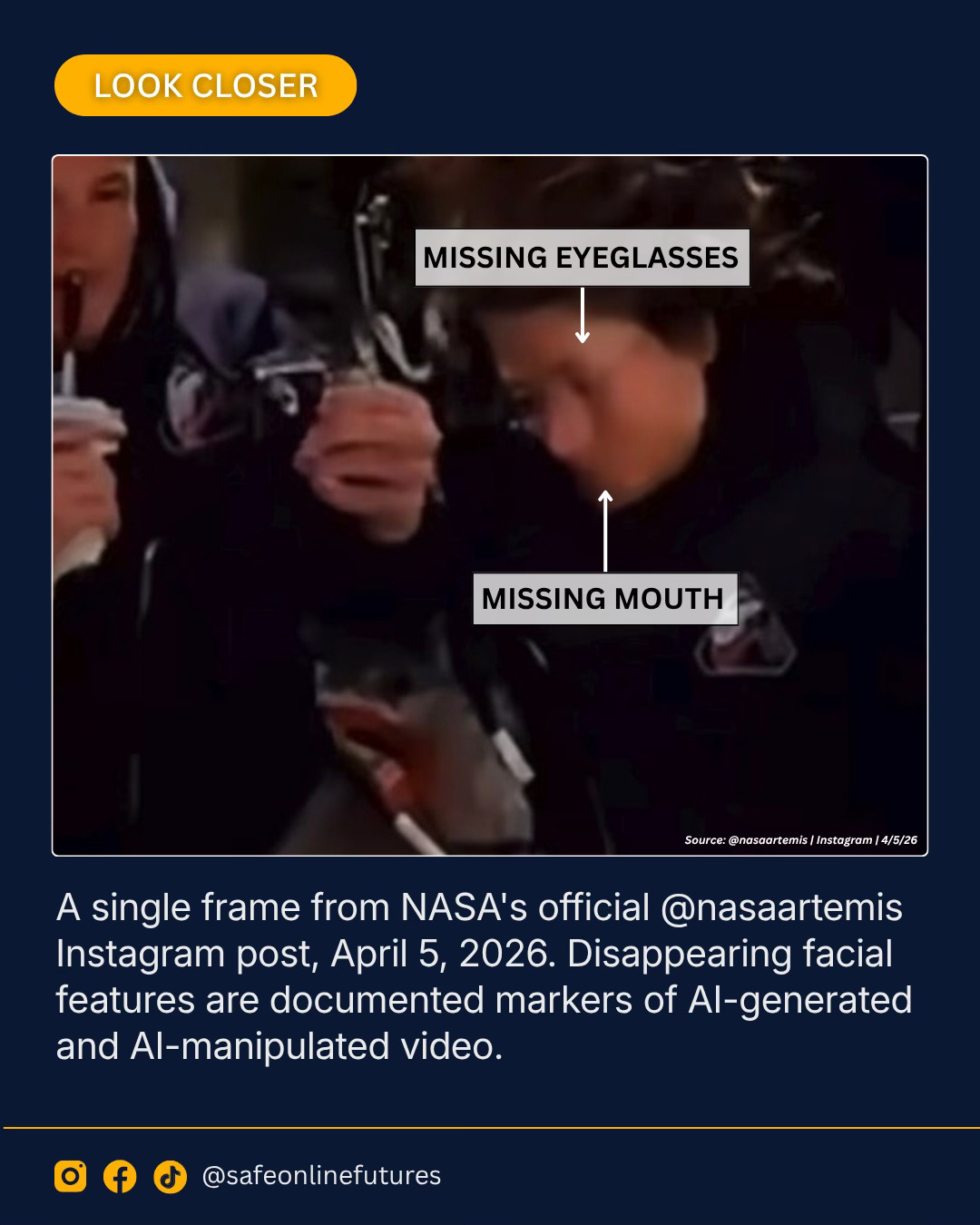
These are not minor compression glitches. Deep-space transmission can introduce compression artifacts, but compression doesn’t make mouths disappear or erase glasses from someone’s face. Those are distinct failure modes, and they belong to a different category of problem entirely.
This says nothing about the underlying facts of the flight. The Artemis II mission is real, the coverage has been extensive, and none of what follows challenges that. What is being examined is narrower and, in some ways, more troubling. A federal agency posted content to its official mission account, during an active historic spaceflight, that carries multiple documented markers of AI-generated or AI-manipulated video, and disclosed nothing. Not a label. Not a note in the caption. Nothing.
That absence matters enormously right now. AI-generated video has become sophisticated enough that most people cannot detect it by eye, and the tools that claim to do it automatically are notoriously unreliable. There is no law requiring any platform, media outlet, or government agency to disclose when AI has been used to generate or manipulate content. Congress has not moved a finger to enact legislation requiring disclosure. So when NASA posts a video with the hallmarks described above and says nothing, it isn’t technically breaking any rule. It is operating exactly within the vacuum that lawmakers built by doing nothing. That is the part that should make you uncomfortable.
When a private creator uses AI to enhance footage, you can decide how much that bothers you. When a federal agency does it, or appears to, on official mission content reaching over 107 million people, the calculation is different. NASA carries institutional trust built over decades. That trust is precisely what makes undisclosed AI use on its platforms so corrosive, because most of those 107 million people will never see an annotated breakdown of AI anomalies. They will see a warm moment from space, take it at face value, and move on. They were never given the information they would need to evaluate what they actually watched.
The label is not a technical challenge. It is a choice. And the power to change that belongs to all of us — in the demands we make, the representatives we hold accountable, and the elections we show up for. Demand the label. Every time. From everyone. Including NASA.
Update — April 16, 2026
Since this piece was published, the pattern has widened. A video distributed by the Associated Press and published on the New York Times website on April 12, 2026 shows astronaut Christina Koch’s mouth and nose disappearing and reappearing during a welcome ceremony in Houston — the same category of facial feature failure documented in the original NASA Instagram video. The AP has editorial standards. The Times has editorial standards. Neither disclosed anything. The full breakdown is in the video linked here.
If you believe government accounts should be required to disclose AI-generated and AI-manipulated content, say so. Contact your representatives. Get loud. Elections have consequences and November is closer than it looks.