When a Fake Photo Becomes Federal Policy
Trump’s D.C. “emergency” shows how AI-manipulated imagery fuels authoritarian power
Edward Coristine — known as "Big Balls"— lay bloodied on Washington D.C. pavement, his body crumpled against concrete. The Department of Government Efficiency (DOGE) staffer had been attacked while trying to stop an apparent carjacking, according to a police report. Within hours, the image blazed across Truth Social — proof, according to Trump, that the nation's capital had spiraled "out of control." Soon after, Elon Musk tweeted that a DOGE staffer had been "beaten to the point of concussion" by an alleged gang in DC.
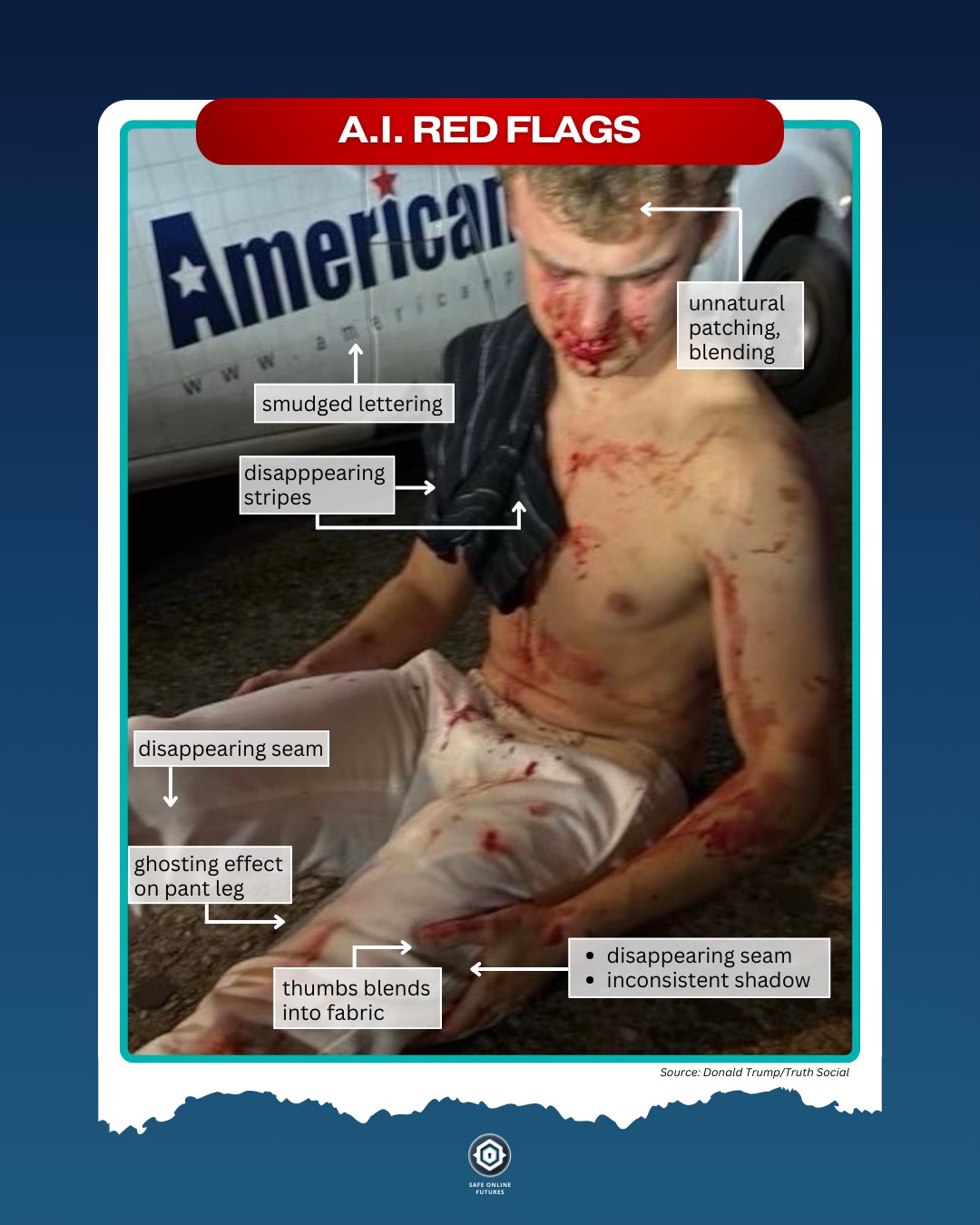
There's just one problem: look closer at that photo. The seams blur where they shouldn't. Fabric warps impossibly. A thumb melts into a pant leg like digital clay.
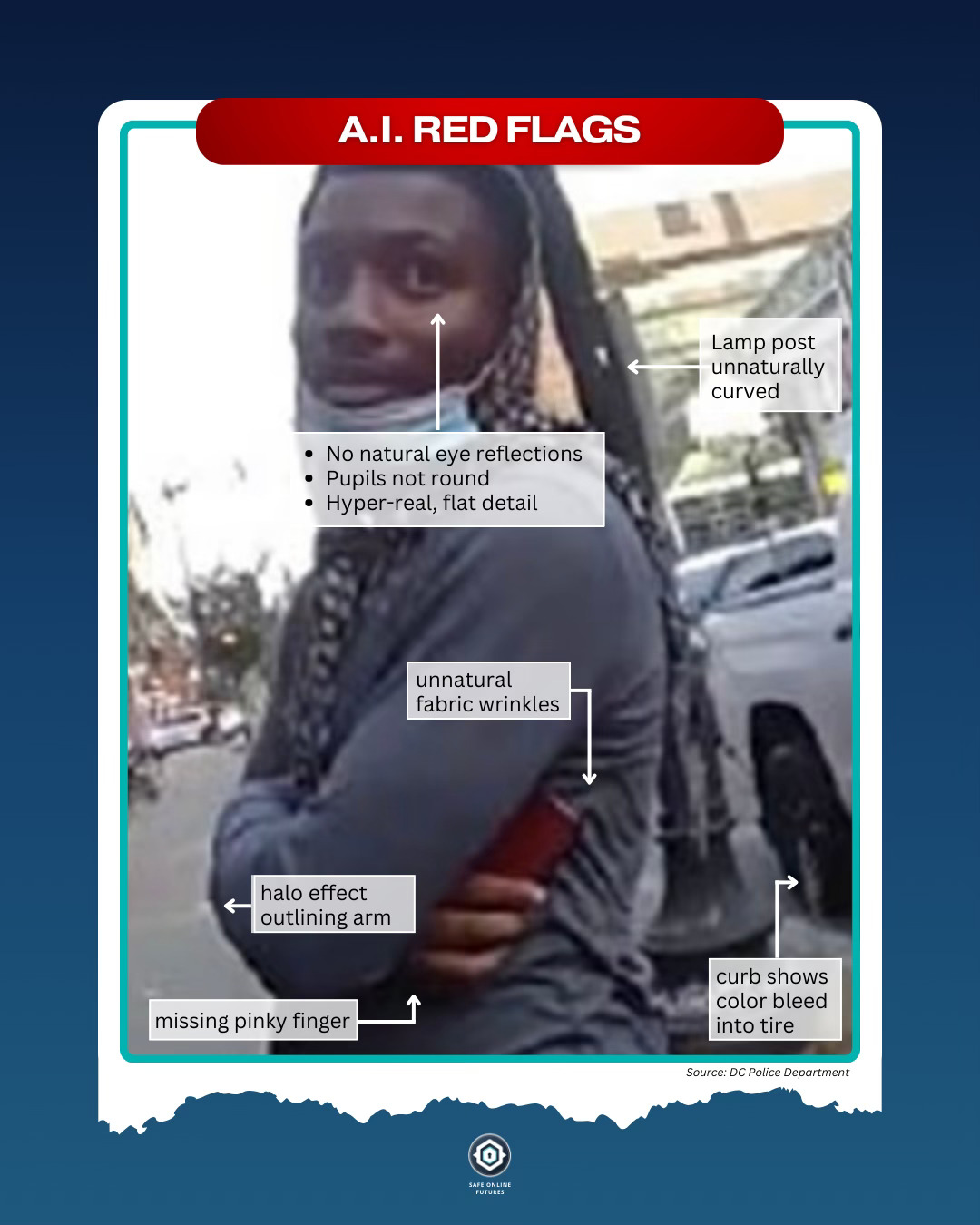
Meanwhile, suspect photos released by the D.C. police include hyper realistic eyes and clothing folds that defy physics.
But Trump wasn't banking on anyone looking closer. He was banking on the opposite.
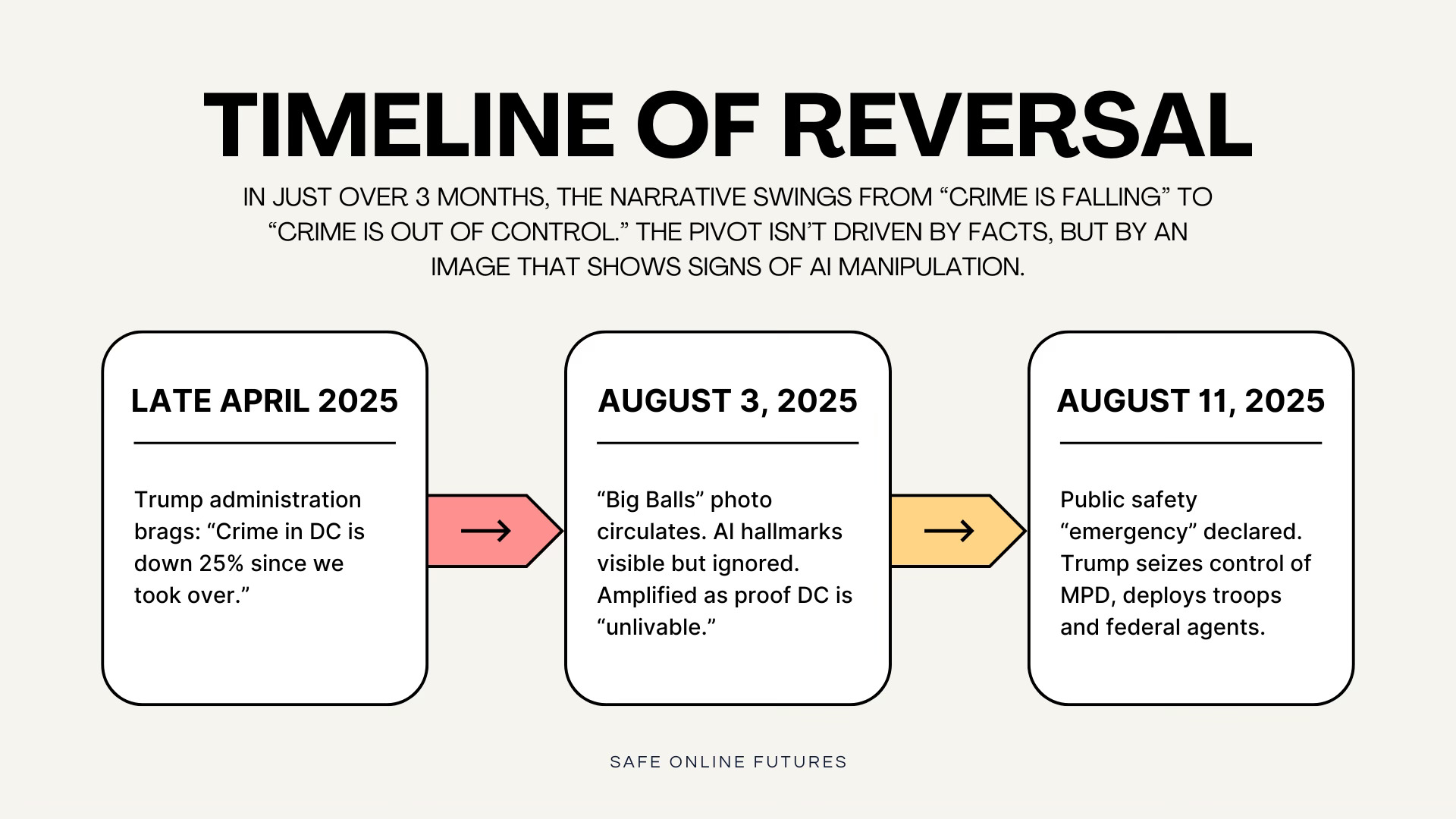
Within days of the photo's release, the president had declared a "public safety emergency" in D.C., seized control of the Metropolitan Police Department, and deployed 800 National Guard troops alongside 500 federal agents into the city. The manufactured image became the pretext for an unprecedented federal takeover — and by the time critics could parse warped pixels, the power grab was already complete.
This is Trump's political machinery at its most refined: declare a crisis, amplify a shocking image, justify extraordinary action, then let the outrage over the power grab itself bury the manufactured nature of the original crisis. It's a distraction loop that weaponizes both AI manipulation and media complicity to cement authoritarian control.
The Crisis That Never Was
Trump's "public safety emergency" declaration invoked D.C.'s Home Rule law to place Attorney General Pam Bondi in temporary command of the Metropolitan Police. His justification painted a city "overrun" by violent gangs, juvenile mobs, and "drugged-out maniacs."
The data told a different story entirely. D.C.'s own crime statistics showed most major categories down double digits over the past year. Just three months earlier, Trump's administration had celebrated a 25% drop in crime under his leadership. So how do you sell an emergency that doesn't exist?
You manufacture one — with imagery.
Anatomy of a Digital Power Grab
The "Big Balls" incident reveals Trump's strategy operating at peak efficiency:
Step 1: Declare the Crisis
Reality becomes irrelevant. The city transforms from statistically safer to narratively dangerous through sheer assertion.
Step 2: Deploy the Visual
Circulate an image that compresses the entire story into a single, visceral frame. When reality lacks sufficient drama, AI manipulation sharpens it to perfection.
Step 3: Trigger the Emotional Override
Fear steamrolls statistics. Anger obliterates nuance. Citizens feel unsafe regardless of what the numbers say.
Step 4: Execute Extraordinary Measures
Under cover of manufactured urgency, Trump accomplishes what almost no president has attempted: federalizing a city's police force and flooding it with federal troops.
Step 5: Launch the Distraction Loop
Public debate laser-focuses on the legality and authoritarian implications of the takeover. Meanwhile, the AI-manufactured foundation of the entire emergency dissolves into background noise.
Media as Unwitting Accomplice
The transformation of a dubious photo into a "crisis" required more than Trump's Truth Social megaphone — it needed mainstream media amplification. Major outlets plastered the "Big Balls" image across front pages and cable segments without a single disclosure about its AI manipulation hallmarks.
This failure operates on two destructive levels. First, lack of scrutiny breeds legitimacy. Once CNN, the Washington Post, and other outlets featured the photo, it stopped being "Trump's evidence" and became simply "evidence." Repetition conferred truth where verification had failed.
Second, the incentives align perversely. Outlets chasing engagement benefit from shocking, bloodied imagery just as much as Trump does. Whether through negligence or design, mainstream media became the accelerant for a manufactured crisis, normalizing the propaganda and ensuring its fabricated origins never faced serious scrutiny.
The New Mechanics of Power
The "Big Balls" case exposes how political control operates in the AI era:
- AI creates the trigger. The image wasn't documentation — it was narrative fuel, purpose-built to justify predetermined action.
- Manufactured outrage enables real power. Federalizing a city's police becomes thinkable because the photo made it feel necessary.
- The distraction loop seals the deal. Public debate locks onto Trump's legal authority and authoritarian overreach while the AI-manufactured justification escapes examination.
- Media complicity amplifies everything. By failing to vet and disclose manipulation, outlets transform propaganda into accepted fact, cementing the illusion of crisis.
Trump doesn't need the public to doubt these images. He counts on them believing. Once emotional reactions take hold, authoritarian moves proceed under the protective banner of "necessity."
The formula is devastatingly simple: AI serves as the delivery mechanism. Media provides amplification. Authoritarianism becomes the inevitable outcome.
Beyond the Pixels
The "Big Balls" photo isn't just a digital curiosity or even a singular propaganda success. It's a blueprint for how power gets seized in the AI age — not through persuading the public with facts, but by manufacturing the visuals that make extraordinary actions feel not just justified, but urgent.
Every warped seam and impossible fold in that image represents a small fracture in the relationship between truth and power. When AI can generate the crisis and media can amplify it without question, the gap between manufactured emergency and real authority collapses entirely.
We're not just watching Trump test the limits of presidential power. We're witnessing the beta version of governance by generated imagery — where the question isn't whether something happened, but whether it looks convincing enough to justify what comes next.
Stay ahead of the lies — subscribe for free to receive more analysis on AI deception and media manipulation.