When America's Most Trusted News Sources Fail Us
The Gaza photos that reveal a new era of AI deception in journalism
Imagine scrolling through social media or watching the evening news and seeing a devastating photo of a starving child.
You’re moved to tears. You share it. You donate money. You form opinions about war, policy, and human suffering based on what you’ve seen.
Now imagine discovering that the photo was artificially generated, manipulated by computer software, or critical context was omitted — and the news organization never told you.
This isn’t a hypothetical. It’s happening right now with some of America’s most trusted news sources.
We no longer have the luxury of blindly trusting what these institutions present as fact. The outlets we’ve relied on for decades are publishing AI-manipulated content without disclosure — potentially violating their own editorial standards — and expecting us to accept it as authentic documentation of reality.
The Story That Broke Everything
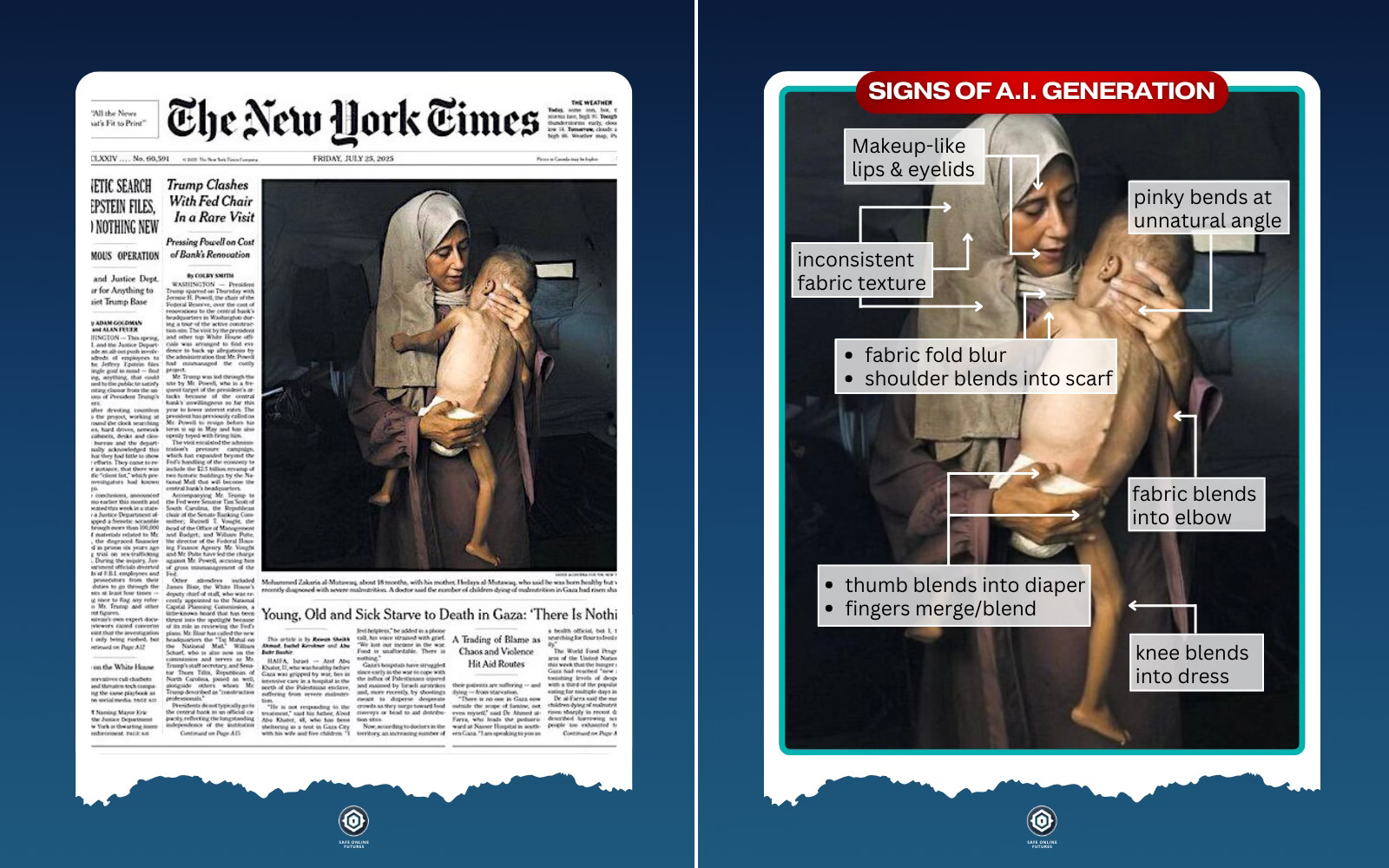
In July 2025, a heartbreaking image of 18-month-old Mohammed Zakaria al-Mutawaq went viral worldwide. The photo, showing an emaciated child in Gaza, appeared on the front page of The New York Times. Several other similar photos of the baby appeared in articles from mainstream media outlets, including NPR. These photos became, as one outlet described it, "the face of the humanitarian crisis" in Gaza.
But there was a problem — actually, several problems.
First, The New York Times initially failed to provide crucial context: the child had pre-existing health conditions including cerebral palsy and genetic complications that contributed to his appearance. Critics argued this omission was misleading, making the child appear to be a victim of starvation when his condition was more complex. When called out, the Times issued a correction acknowledging they should have included this medical context from the beginning.
But there was a second, more serious problem that still hasn't been addressed: the photos themselves showed telltale signs of artificial intelligence generation or manipulation. Fingers that merge together or lack clear edges. Fabric textures that don't exist in reality. Overly polished facial features, including unnaturally uniform lip and eyelid shading, that don’t fit the context. The kind of glitches that AI image generators commonly produce.
Here's the kicker: neither The New York Times nor NPR disclosed to their readers that these images showed signs of AI manipulation. They presented them as authentic documentation of human suffering — potentially violating their own editorial standards about AI transparency.
But it gets even murkier.
On July 27, 2025, David Collier — an investigative journalist focused on extremism — published another image of Mohammed. In his write-up, Collier claimed that "wider and unpublished pictures" show Mohammed's older brother, Joud, looking healthy and well-fed, alongside their mother. He argued that this undermines the media narrative, because outlets allegedly cropped or blurred the brother out to heighten the emotional impact.
Here's the problem: Collier did not cite the source of this "wider" image. A reverse image search shows it first appearing on his own site, with no prior traceable origin. And when you zoom in, the photo itself contains anomalies consistent with AI generation or manipulation — irregular fabric patterns, depth of field inconsistencies, and inconsistent typography. In other words, the very image Collier uses to accuse the media of deception may itself be a manipulated image.
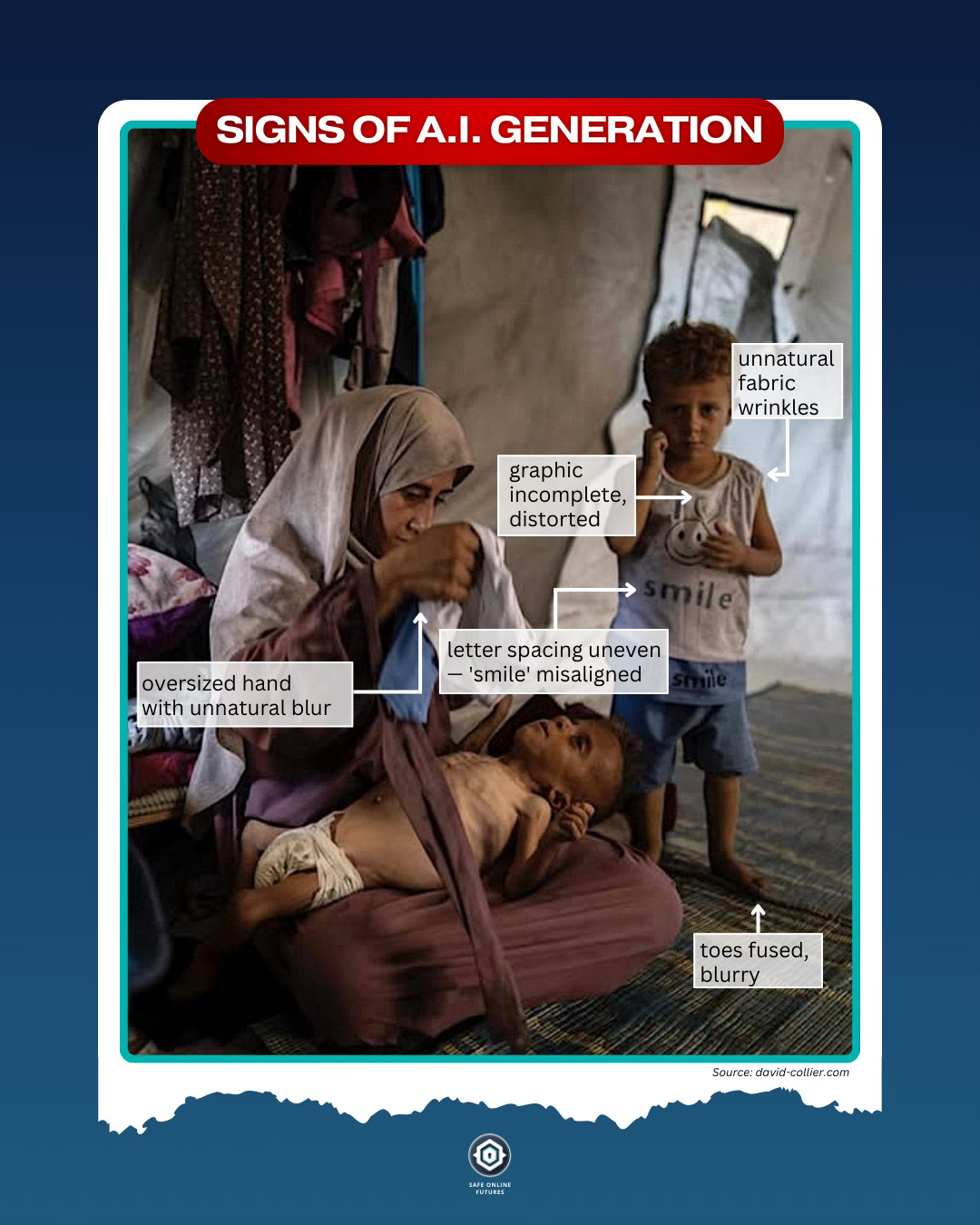
This creates a kind of disinformation inception: mainstream outlets run images with visible AI artifacts without disclosure, and their critics counter with "gotcha" images that also appear manipulated. The result is an information environment where every side is presenting suspect visuals — and the public is left unable to trust any of it.
When both the headlines and the rebuttals are built on manipulated images, truth becomes whatever someone can make you believe.
They Have Rules — But They're Breaking Them
This disinformation inception — where both mainstream outlets and their critics deploy suspect images — makes it all the more damaging when trusted institutions may not be following their own guidelines.
You might think, "Well, maybe these outlets just don't have guidelines about AI yet. They're figuring it out as they go."
They're not.
Both organizations have written policies about AI transparency:
The New York Times policy: "We should be transparent with readers about our work and the tools used to produce it. If we make substantial use of generative A.I., we should disclose our process through clear labeling and explanations."
NPR's policy: "As we do with the other aspects of our journalism, if GAI plays a significant role in the reporting of a story we should reveal that fact to our audience."
These aren't suggestions. They're explicit editorial standards that both outlets created for themselves. And they appear to have violated their own rules.
Having written policies but potentially not following them creates false security for readers who assume these institutions have safeguards when the evidence suggests they may not.
When Logic Goes Out the Window
NPR's coverage included something that should raise red flags for anyone thinking clearly. They published a photo showing obvious AI manipulation signs and claimed it came from the starving child's mother, Hidayat Al-Motawaq, who was living in a displacement tent in Gaza.
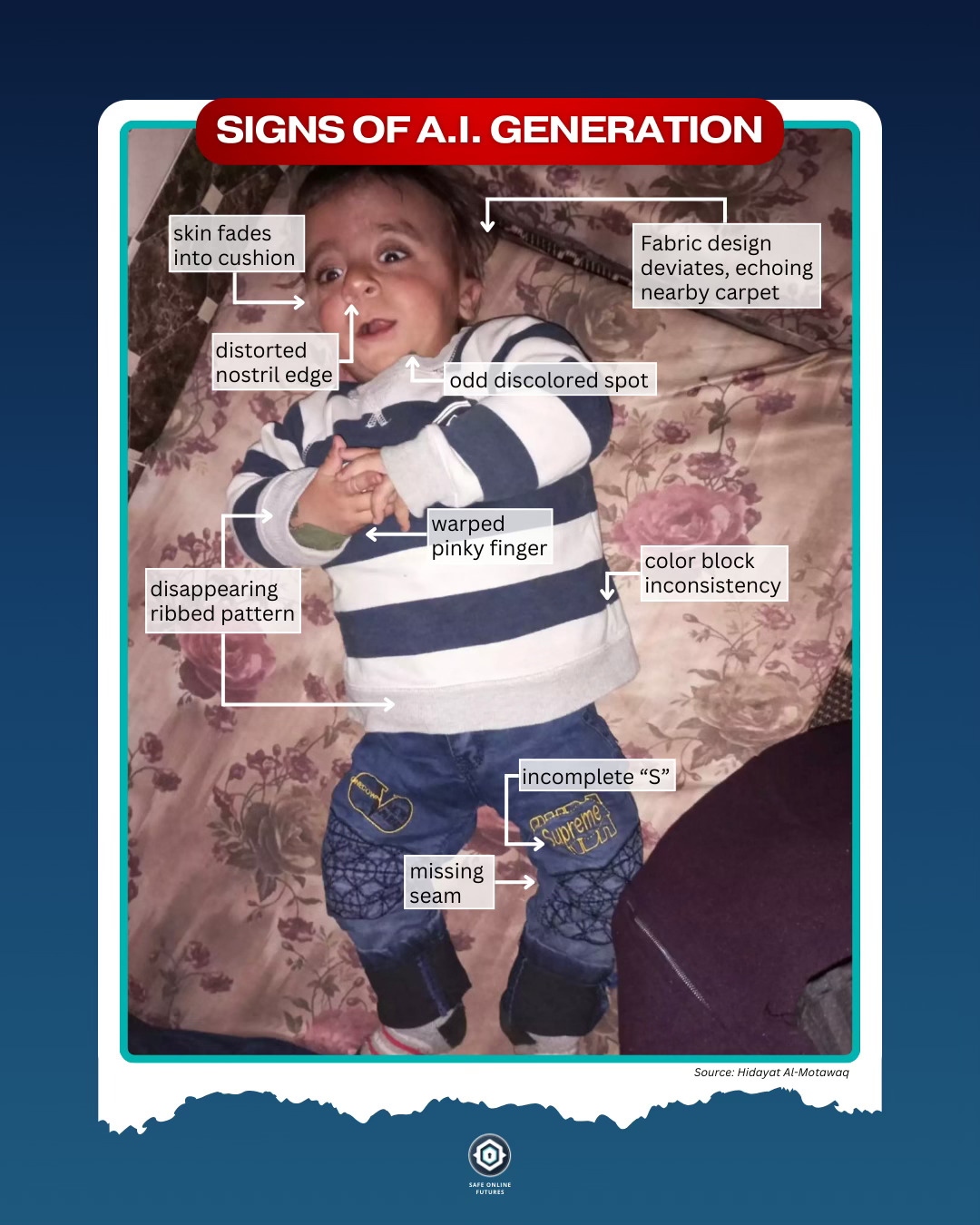
Let's think about this logically: this woman's child is starving. She can't access adequate food or medical care. She's living in a tent after being displaced by war. Yet we're supposed to believe she has high-speed internet, paid software, and the technical skills to generate or alter images with AI? The attribution doesn't just strain credibility — it breaks it.
Then there's the timeline problem. NPR dated the image to February 2025, showing the baby appearing comparatively healthy and nourished. Compare that to the July 2025 images that went viral, where the same child appears severely emaciated. Side-by-side, these create an emotionally explosive before-and-after narrative that powerfully reinforces claims that Israel is intentionally starving Gaza's population. Whether intentional or not, that visual progression is narrative gold in a propaganda war.
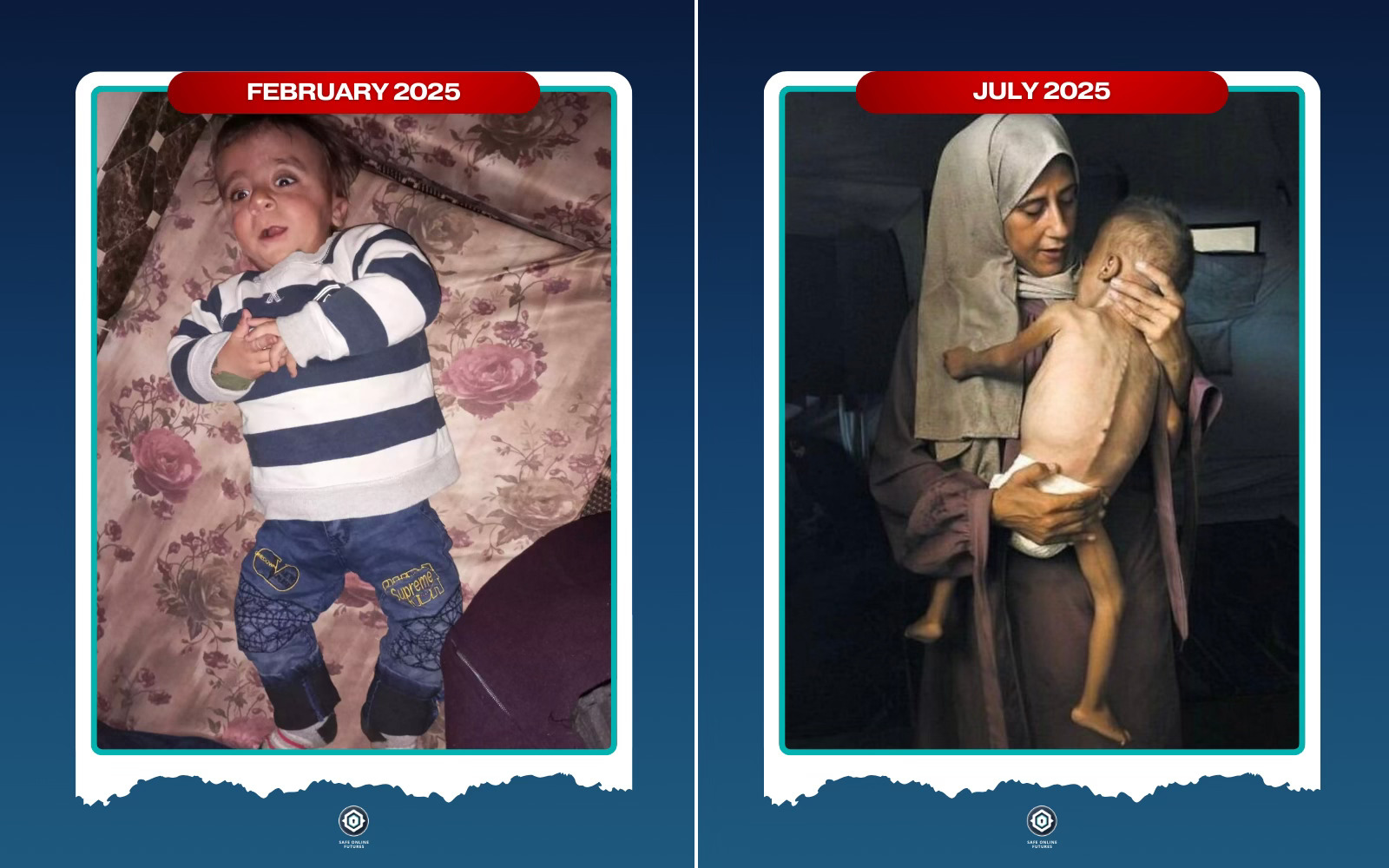
If the mother didn't create AI-manipulated content in war-torn Gaza, then where did the manipulation occur? Did it happen through local freelancers, fixers, NGOs, wire services, or editors before reaching NPR? Who in that chain had both the capability and incentive to enhance the February photo to make the July contrast more compelling?
This leads to the crucial question: who benefits from that narrative? A clear visual arc from "healthy" to "starving" drives clicks, shares, donations, outrage, and political pressure. In an attention-driven economy — and during a deeply polarizing conflict — there are powerful incentives for manipulation at multiple points in the pipeline.
The bottom line: suspicion isn't paranoia anymore — it's a survival skill. Without transparency about sourcing, dating, and AI involvement, we're left questioning not only the authenticity of the images, but the integrity of the institutions presenting them as truth.
This Is a Pattern, Not an Accident
I've been documenting instances like this for almost a year now. This isn't a one-off mistake or oversight. It's a pattern driven by the attention economy: news organizations now compete in a digital environment where dramatic, emotional content gets more clicks, shares, and engagement than careful, nuanced reporting. A heartbreaking photo generates massive traffic and social media virality — making AI-enhanced emotional manipulation incredibly tempting.
The photos came through different channels — wire services, local journalists, even supposedly from family members — but they all shared common AI artifacts that suggest manipulation. And in each case, major outlets published them as authentic without disclosure.
When trusted institutions publish potentially fake images as real documentation — and fail to follow their own ethical standards in the process—they're not just misleading you about one story. They're undermining the entire foundation of informed democracy.
When people can't agree on basic visual evidence, democratic debate becomes impossible. If we can't trust what we see in major newspapers, how do we make informed decisions about war, policy, or social issues?
Why This Is Different and More Dangerous
Every generation faces media scandals. Biased reporting. Factual errors. Sensationalism. But this is fundamentally different for several reasons:
Scale: AI can mass-produce convincing fake content faster than any human could create it manually.
Sophistication: Today's AI-generated images are harder to detect than crude manipulation of the past.
Speed: Fake content can be created and distributed faster than traditional verification systems can catch it.
Invisibility: Unlike obvious propaganda, AI-manipulated content looks completely authentic to most viewers.
No Accountability: There are no federal laws requiring news organizations to disclose AI use in journalism.
We're not dealing with mistakes or oversights. We're dealing with systematic deception that threatens the foundation of shared reality itself.
The Regulatory Black Hole
Here's something that should alarm you: at least 11 states have enacted laws limiting artificial intelligence, deep fakes, and synthetic media in political advertising, while the federal government has only proposed similar rules. Meanwhile, news reporting has no disclosure requirements whatsoever. That means political campaign ads in many states have stricter transparency requirements than the journalism that's supposed to help you make informed decisions about those campaigns.
Even when news outlets do create AI policies, there's little accountability. Research from 2023 analyzing newsroom AI guidelines found that only 8% of policies specify how they would be enforced. And as we've seen with NPR and The New York Times, even outlets with written transparency policies aren't following them. The vast majority of news outlets can use AI to generate or manipulate images with zero legal obligation to tell you about it.
We're flying blind in an information environment where the tools of deception are more powerful than ever, and the institutions we rely on for truth have no legal requirement to be honest with us about their methods.
Media Literacy Is Now Democratic Survival
When America's most trusted news sources violate their own ethics policies to manipulate your emotions, media literacy becomes a matter of democratic survival.
You need to know how to spot AI manipulation signs:
- Hands and fingers: AI struggles with complex hand positions and often creates extra, missing, or weirdly positioned fingers
- Facial features: Look for unnaturally smooth skin, warped ears, or beauty-filter effects in inappropriate contexts
- Fabric and textures: AI often fails to render realistic clothing textures or patterns
- Lighting inconsistencies: Shadows that don't match the supposed light source
But here's the problem: you shouldn't have to become a technical expert to trust basic news reporting. The fact that you do reveals how broken our information system has become.
What You Must Do
Question dramatic images, especially from conflict zones or emotional situations. These are most likely to be manipulated because they generate the strongest response.
Demand transparency. When news outlets publish dramatic images, ask: Did they disclose any AI involvement? Do they have verification processes? Are they following their own stated policies?
Support accountability. When outlets violate their own AI policies, call it out. Demand explanations. Cancel subscriptions if necessary.
Learn basic AI detection, but remember: the burden shouldn't be on you to verify what trusted institutions should be verifying themselves.
The Stakes
This isn't about political partisanship or media bias. This is about whether factual truth can survive in an age when anyone with the right software can manufacture convincing "evidence" of anything.
When trusted institutions publish potentially fake images as real documentation — and fail to follow their own ethical standards in the process—they're not just misleading you about one story. They're undermining the entire foundation of informed democracy.
Your ability to distinguish truth from manipulation isn't just about being well-informed anymore. It's about preserving democracy itself.
The question isn't whether you have time to learn these skills. The question is whether democracy can survive if you don't.
The old rules don't work anymore. When America's most trusted news sources may be failing their basic transparency obligations, media literacy becomes democratic survival.
The question isn't whether you have time to learn these skills. The question is whether democracy can survive if you don't.
The old rules don't work anymore. When America's most trusted news sources lie to you, media literacy becomes democratic survival.
Stay ahead of the lies — subscribe for more investigations into AI deception and media manipulation.