When Grief Becomes Performance Art
How a memorial service became a case study in synthetic media manipulation
Charlie Kirk’s memorial service was supposed to honor the dead. Instead, it felt like someone had thrown a megachurch revival, a Trump campaign rally, and a Turning Point USA merchandise launch into a blender.
Pyrotechnics lit up the stage. Christian rock bands played between speeches. Kirk’s widow Erika made her entrance to music and special effects that wouldn’t have been out of place at a WWE event. Within days of Kirk’s death on September 10, Snopes counted six new t-shirts appearing on Turning Point’s online store—the first one going live the very next day.
One observer captured the mood online: “It was a political rally framed as a fake memorial service.” Hard to argue with that assessment.
Something’s Off With the Pictures
The spectacle alone might be dismissed as typical political theater. But the visual record of this memorial raises deeper questions.
Two Associated Press photographs of Erika Kirk, snapped by the same photographer, show her wearing completely different rings.
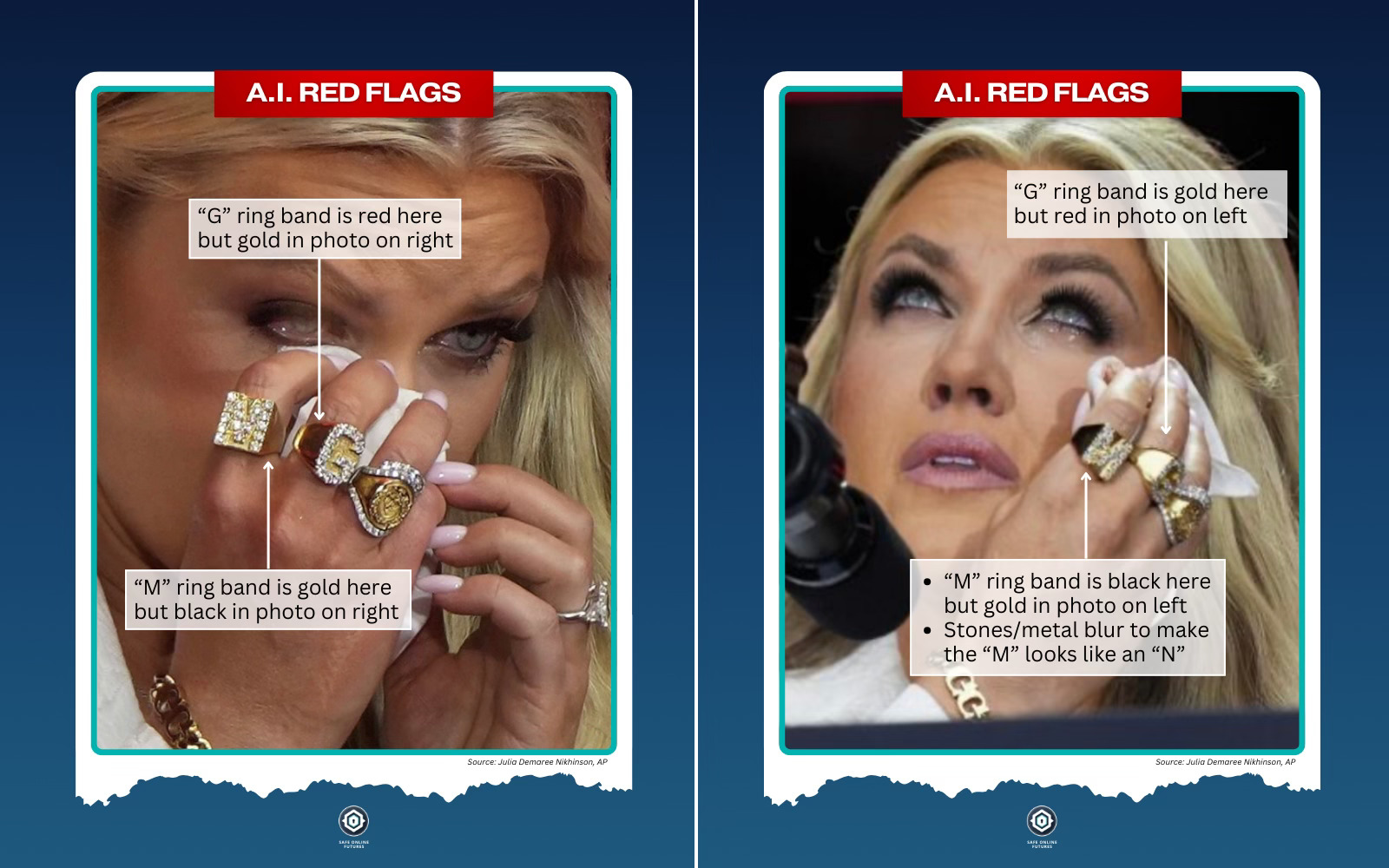
Getty and AP photos of Trump on stage show him wearing what appears to be two different ties, one with a pattern, one without. These photos and more contain the telltale artifacts of synthetic media.
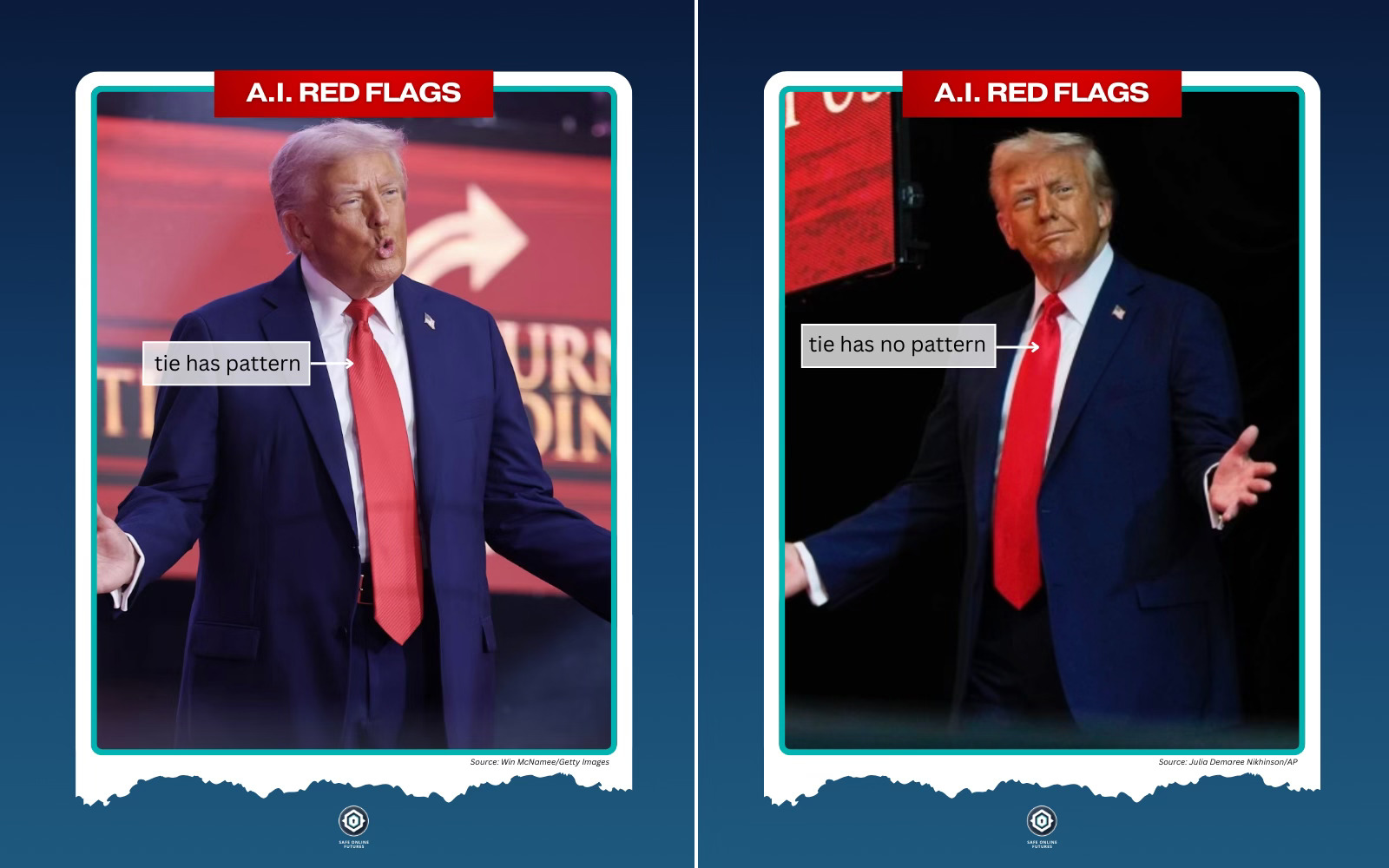
These aren’t subtle inconsistencies you need to squint to see. They’re glaring technical failures that beg an obvious question: if this memorial actually happened as advertised, why does so much of the official documentation look computer-generated?
What makes this particularly troubling isn’t just that Turning Point might be manipulating media — it’s that mainstream outlets are republishing these questionable visuals without apparent scrutiny, presenting them to audiences as straightforward documentation of real events.
This isn’t to suggest the memorial didn’t happen. But when synthetic media gets mixed in with authentic documentation, how are audiences supposed to distinguish between what’s real and what’s manufactured? The more we’re exposed to this blend of authentic and artificial content without clear labeling, the more conditioned we become to accept synthetic media as legitimate representation of events. We stop questioning the validity of what we’re being shown. And that makes it exponentially easier for those with power to shape our understanding of reality.
Manufacturing a Martyr
The speakers didn’t just memorialize Kirk — they weaponized his death. What started as remembrance quickly pivoted to political mobilization, with Kirk’s passing reframed as evidence of enemies that needed defeating.
Donald Trump made the subtext explicit when he took the stage: “He did not hate his opponents. He wanted the best for them. That’s where I disagreed with Charlie. I hate my opponents. And I don’t want the best for them. I’m sorry.”
This wasn’t a eulogy. It was a battle cry. Trump told the crowd that the left consisted of “radical lunatics” who “can’t be reasoned with.” The message was clear: Charlie Kirk didn’t just die — he was taken from us, and someone needs to pay.
The Method in the Madness
Strip away the pageantry and what remains is a carefully orchestrated information operation that accomplished several things simultaneously:
It moved merchandise while the spotlight was hot. It transformed a death into political ammunition. It flooded news cycles with synthetic media that muddies the water between authentic documentation and digital fabrication. Most importantly, it created a spectacle designed to generate maximum attention while making it increasingly difficult for audiences to distinguish performance from reality.
This isn’t necessarily the result of some master plan — though it might be. The effect is what matters. In an economy that runs on attention, confusion becomes a valuable commodity. When people can’t tell what’s real anymore, many eventually stop trying. That’s when they become willing to accept whatever version of reality their preferred authority figures are selling.
What Comes Next
If a memorial service can be this thoroughly stage-managed, this heavily manipulated, this disconnected from basic questions of truth and authenticity, what does that say about everything else we’re seeing?
This isn’t really about Charlie Kirk, or even about Turning Point USA. It’s about a media landscape where the line between genuine events and manufactured spectacle has been so thoroughly erased that audiences have no reliable way to tell the difference.
That should worry anyone who thinks democracy depends on citizens having access to something resembling shared reality.
Exposing how media manipulation, AI, algorithms, and the attention economy are rewriting reality. Subscribe for free to receive insights into the forces reshaping truth in the digital age.