When Influencers Become the Press
Inside Trump’s White House program turning content creators into credentialed storytellers
Press Passes for the Algorithm Age
The Trump administration calls it “modernizing” media access. That framing does a lot of work.
In January, Fortune reported that more than 7,400 influencers and content creators applied for White House press credentials under a policy pitched as a way to “connect directly with Gen Z.” Despite repeated claims of being the most transparent administration in history, officials won’t say how many were approved or release the list of names.
The opacity is deliberate. If the public doesn’t know which influencers carry official credentials, there’s no way to track who’s amplifying which messages — or why. The distinction between independent coverage and state-sanctioned content collapses entirely.
And the stakes keep rising. From 2020 to 2024, the percentage of adults who consume news from TikTok jumped from 3% to 17%, according to Pew. The shift isn’t just generational — it’s structural. As news consumption migrates to platforms built for viral content rather than verified information, credentialing influencers isn’t about reaching new audiences. It’s about capturing the infrastructure where those audiences now live.
What “Democratization” Actually Looks Like
In theory, expanding press access beyond legacy outlets makes sense. More voices, more perspectives, fewer institutional gatekeepers.
Traditional journalism has plenty of problems — corporate owners, shareholders, commercial pressures that shape editorial decisions. Influencers, by contrast, answer to no one but their audiences and the algorithm.
That sounds liberating. But accountability to an algorithm is not the same as accountability to the public.
This isn’t about broadening the conversation. It’s about controlling the narrative at its source.
The credential system doesn’t require training, editorial oversight, or fact-checking infrastructure. It requires an audience. And that audience becomes leverage — both for the creator seeking access and the administration granting it.
This is strategic curation, not democratization. And it’s happening precisely when AI tools have made manufacturing visual “evidence” cheaper and more convincing than ever.
The Antifa Roundtable
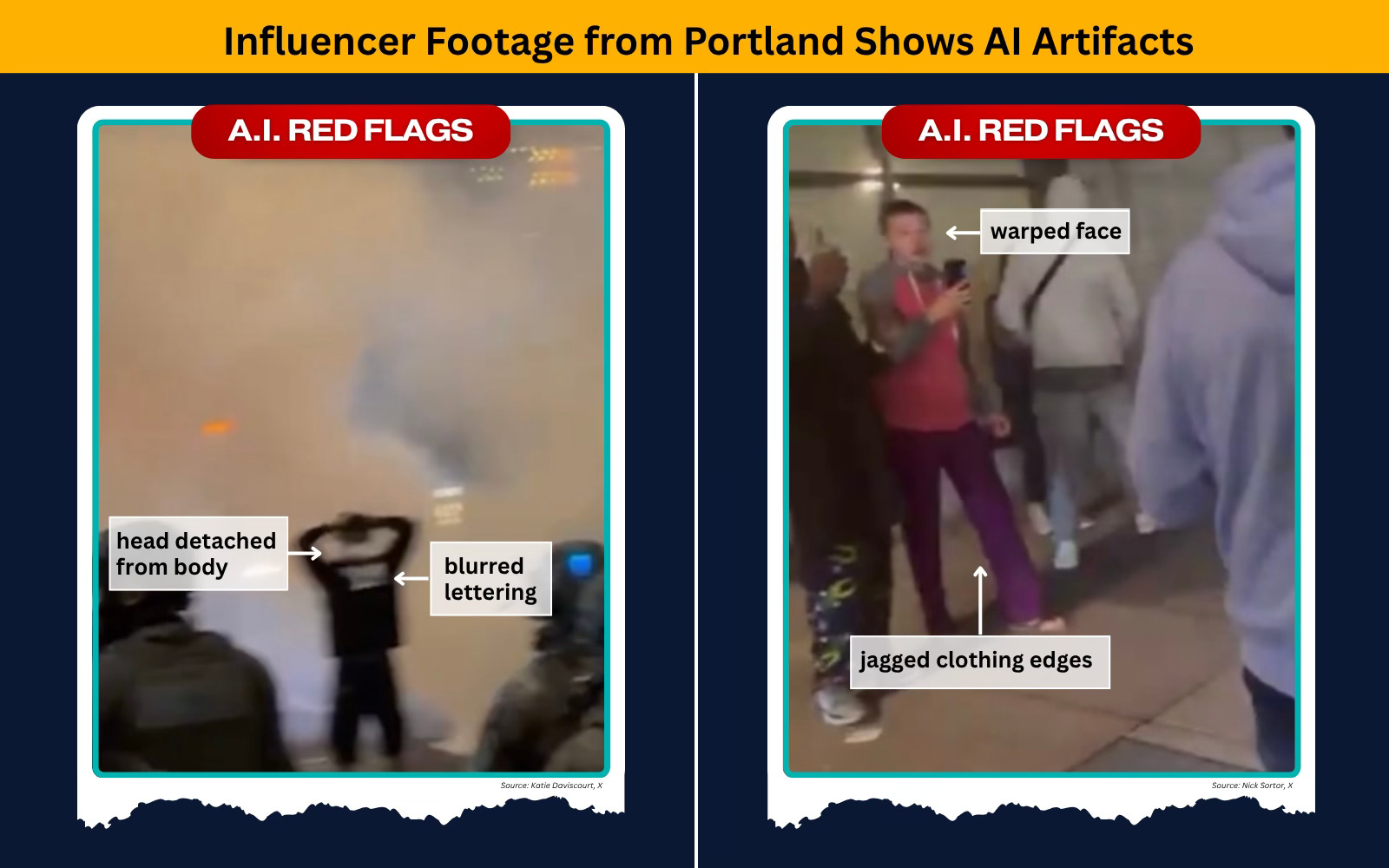
Last week, Trump hosted what his team billed as an “Antifa roundtable.” The guest list: conservative influencers who’ve spent months posting distorted footage of Portland protests.
Their narrative has been consistent — Portland is a war zone, overrun by violent leftists, abandoned by Democrats who won’t restore order.
But look closer at the images they’ve shared. Warped facial features, body proportions that shift between frames, jagged clothing edges, and blurred lettering.
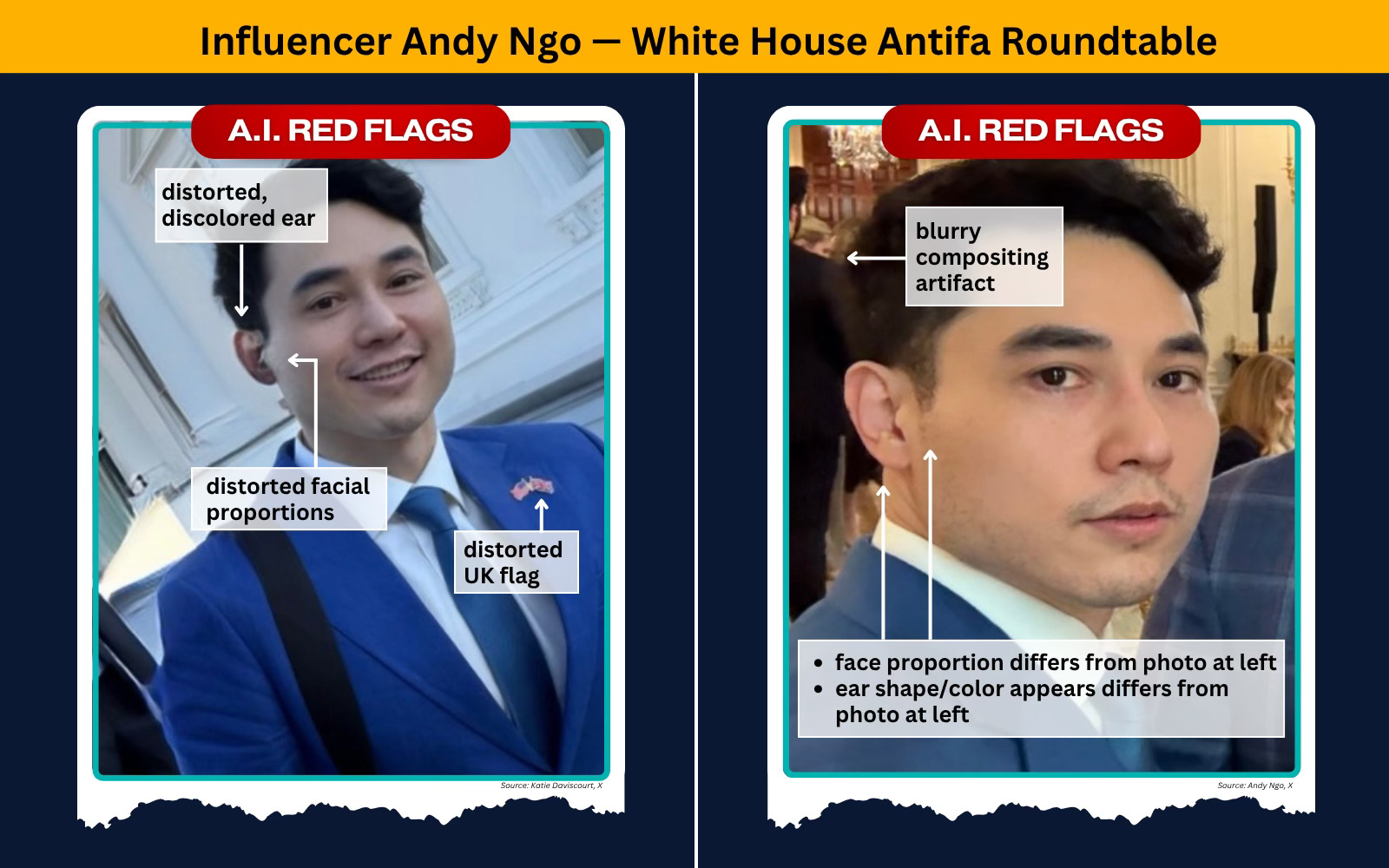
These aren’t compression artifacts. They’re signs of synthetic construction — visuals engineered to provoke emotional responses, not document reality.
How the Loop Works
The pattern is straightforward:
Generate outrage. Post AI-manipulated visuals designed to trigger fear, anger, or disgust.
Let the algorithm work. High-arousal content gets prioritized. Engagement becomes reach.
Reward performance with proximity. The accounts that go most viral get invited inside — credentials, photo ops, legitimacy.
Normalize the arrangement. Official access signals credibility to casual observers. Legacy journalists scramble to cover what influencers post first.
Repeat. The manufactured outrage becomes the content. The content becomes the news cycle.
It’s a closed feedback loop. Political power partners with algorithmic incentives to shape perception at scale.
Propaganda Without Press Releases
The elegance of this model is that it doesn’t look like state media.
There’s no need for official statements when the most viral accounts already say what you need them to — for clout, for access, for clicks.
Credentialing influencers gives the administration something traditional outlets can’t: a network of messengers who speak the native language of platform algorithms and have no editorial oversight to answer to.
When those messengers post AI-generated visuals, they’re not just creating images. They’re manufacturing belief.
What’s Actually at Stake
This isn’t only about Portland or protests or any single narrative.
It’s about the infrastructure of trust.
The work that used to belong to journalists and editors — verification, accountability, institutional memory — has been outsourced to creators with ring lights and official badges.
These influencers manipulate narratives through selective framing: out-of-context events, cherry-picked quotes, misleading data, images stripped of their circumstances. And when reality doesn’t provide enough material to support their agenda, technology fills the gap. AI-generated images don’t just supplement their storytelling — they manufacture the evidence itself.
Every synthetic image they post erodes the shared baseline of what we consider real. Every credentialed influencer blurs the line between reporting and performance.
We’re watching influence become infrastructure. Access become propaganda. AI become the amplifier.
One Question
When influencers are the press, who’s left to question power?
Next time you see a viral clip with a White House backdrop, pause. Ask whether you’re watching journalism — or state-sanctioned content marketing dressed up for the feed.
Read The Portland Playbook: How influencers weaponize AI — turning calm streets into chaos for clicks
Share this if you think access should never replace accountability.
This essay is part of an ongoing investigation into how influencers, algorithms, and AI tools are reshaping political communication in America.