When Manufactured Outrage Meets Machine Vision
How AI, right-wing media, and an FCC chair turned a late-night joke into a political weapon.
The fire started with a late-night joke.
In early September 2025, conservative activist Charlie Kirk was assassinated. Right-wing media immediately worked to distance the shooter from MAGA politics, despite evidence suggesting otherwise. On September 15, Jimmy Kimmel opened his show by mocking that effort. He described “the MAGA gang” as “desperately trying to characterize this kid who murdered Charlie Kirk as anything other than one of them.” Then he twisted the knife, comparing Donald Trump’s reaction to a child mourning a goldfish. It was a throwaway gag about Trump’s self-absorption.
But within days, it became ammunition.
A Slow Burn, Then Ignition
The fire didn’t catch right away.
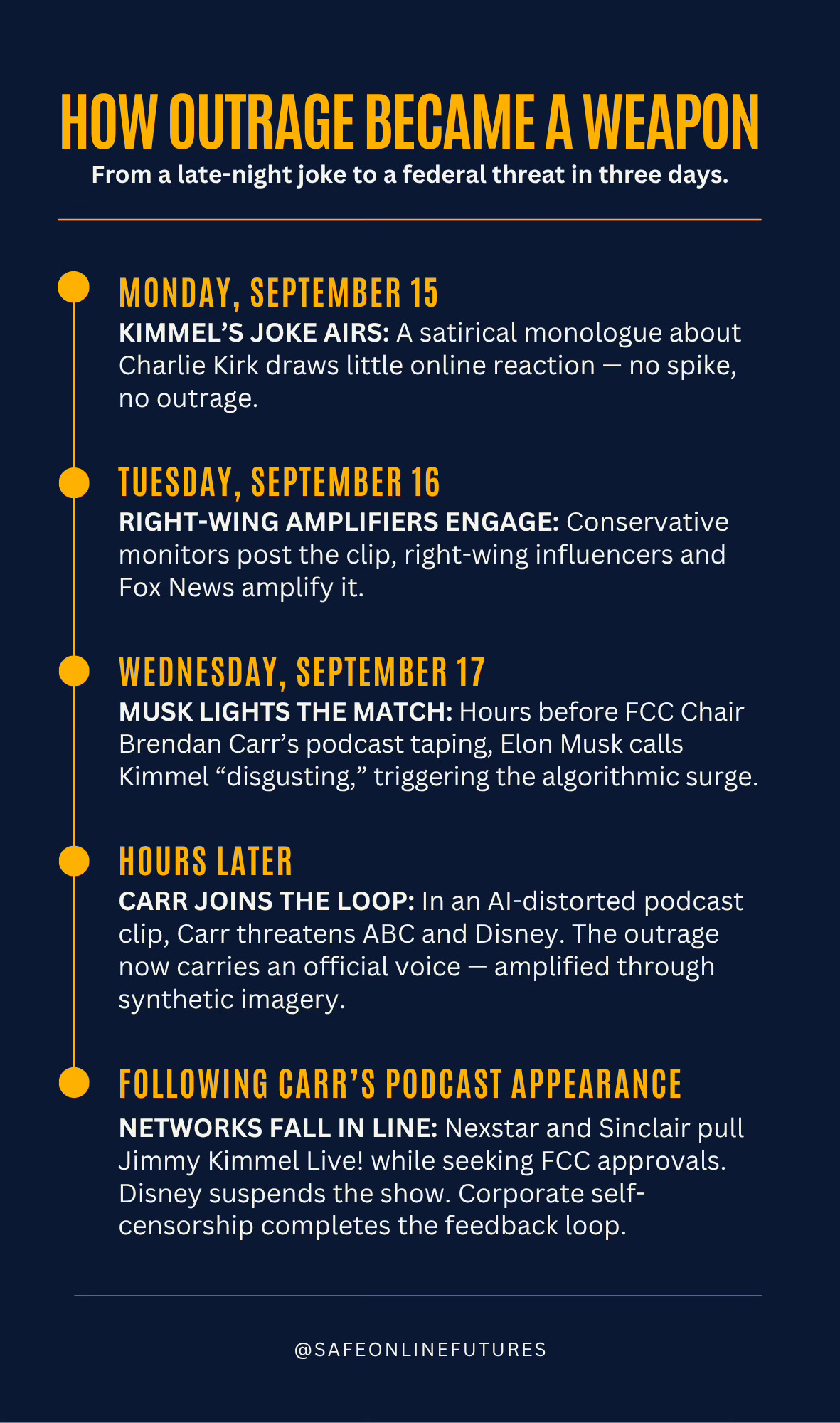
For nearly a full day after Kimmel’s monologue, the reaction online was strikingly muted. Analysts tracking posts on X and television mentions found little activity. The moment barely registered until a conservative media monitor whose job is to flag “liberal bias” in late-night shows posted a clip of the segment.
That’s when the gears began to turn.
By mid-day Tuesday, a handful of right-wing influencers started circulating the clip to their audiences. Conservative talk-radio hosts picked it up next, reframing Kimmel’s joke as “hate speech.” By that evening, Fox News had joined in, and the story shifted from commentary to coordination.
Then, hours before FCC chair Brendan Carr’s podcast taping on Wednesday, Elon Musk called Kimmel “disgusting” in a post to his 200-million-plus followers. That single amplification point ignited the outrage that smaller accounts had been trying to spark for 36 hours.
The backlash now looked spontaneous. But it wasn’t.
It was a chain reaction triggered by a few prominent voices and accelerated by the algorithms beneath them, an architecture built to reward anger with reach. In their 2018 book, Network Propaganda: Manipulation, Disinformation and Radicalization in American Politics, American scholars Robert Faris, Hal Roberts, and Yochai Benkler, describe this as a “command-and-amplify” dynamic: Influential figures signal what to be angry about, and algorithms do the rest.
By the time Carr appeared on conservative influencer Benny Johnson’s podcast the next morning, the feedback loop was fully active. A late-night joke had become a national controversy, ready to be weaponized by a federal regulator.
The Threat in the Machine
On September 17, Carr appeared on Johnson’s video-podcast, The Benny Show, one of the Trump administration’s go-to propaganda outlets. He called Kimmel’s comments “truly sick” and threatened ABC, Disney, and their affiliate owners:
“We can do this the easy way or the hard way. These companies can find ways to change conduct and take action, frankly, on Kimmel, or there’s going to be additional work for the FCC ahead.” — Brendan Carr, FCC Chairman
That sound bite spread instantly. It was clipped, captioned, and uploaded across the same channels that had been fanning outrage for days.
But the video itself tells a different story.
Frame by frame, Carr’s interview shows classic AI-manipulation red flags, the same ones visible in Johnson’s own videos I analyzed last week. His frameless glasses appear to fuse with his skin, their edges vanishing and reappearing between cuts. The left temple arm doesn’t appear to connect cleanly to the frame. A red stripe on the American flag appears to be tinted purple.
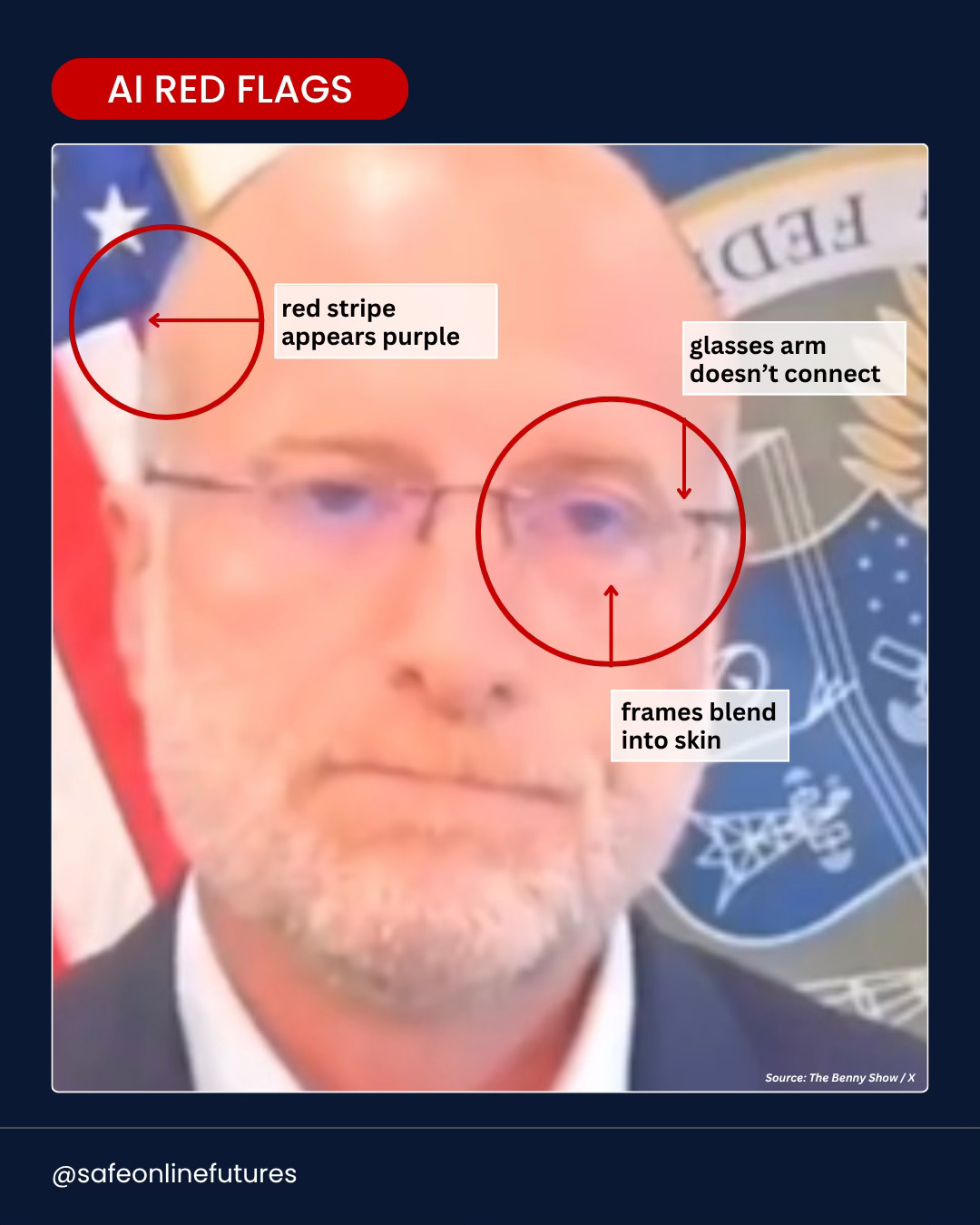
In other words, the FCC’s top regulator, appearing to threaten a network, may have been rendered through a machine. A digitally altered clip performing political intimidation.
When Outrage Becomes Enforcement
Within hours of Carr’s appearance, Nexstar Media Group and Sinclair Broadcast Group, two of the nation’s largest station operators, announced that they were pulling Jimmy Kimmel Live! from all ABC affiliates. Nexstar called Kimmel’s comments “offensive and insensitive.” Sinclair said it would refuse to air the show until “formal discussions are held with ABC regarding the network’s commitment to professionalism and accountability” and demanded Kimmel apologize to Kirk’s family and donate to Kirk’s conservative organization, Turning Point USA.
To the casual observer, this looked like the market responding to audience anger. But context matters.
Nexstar was in the middle of seeking FCC approval for its $6.2 billion acquisition of Tegna. Sinclair had pending filings with the FCC to acquire small-market stations and expand control over ABC affiliates. Disney, the parent company of ABC, was pursuing federal approval for its purchases of Fubo and NFL Media.
Each of these corporations had business before the very agency Carr led.
And Carr had just gone on a viral show to hint that non-compliance could have consequences.
This is how an outrage loop becomes an enforcement mechanism. Influencers manufacture anger to justify punitive action. A government official echoes that anger through synthetic video, making the threat feel organic and omnipresent. Corporations with pending approvals “self-correct” to avoid risk. Their compliance is then broadcast back into the same ecosystem as proof of victory.
It’s the same emotional algorithm that drives engagement on social media, just applied to power.
Provoke. React. Obey.
The Man Behind the Loop
Carr’s trajectory makes this even more revealing. He rose to prominence in 2024 after contributing to Project 2025, the conservative blueprint for a second Trump administration. In his chapter on the FCC, Carr accused technology and media companies of “censoring” right-wing voices and promoting “diversity, equity, and inclusion ideology.” Among his proposed top priorities: “reining in Big Tech.”
But when his own message went viral, it didn’t rely on organic reach. It relied on the same Big Tech pipelines he claimed to resist and, if the video evidence is accurate, on generative tools that blur the line between authentic speech and AI-assisted simulation.
The irony is almost mathematical: the man calling for limits on digital manipulation appears to be using it as a weapon of control.
In that sense, Carr’s Benny Show appearance wasn’t just a warning to ABC. It was a demonstration of how algorithmic outrage, political incentive, and synthetic media can merge into one self-reinforcing feedback loop. A loop that punishes dissent while rewarding compliance. A loop that looks spontaneous but is engineered to condition behavior.
When the Spectacle Replaces Substance
When regulators appear in manipulated interviews and broadcasters pre-emptively silence critics to protect their interests, democracy isn’t just under pressure. It’s being rewritten in real time. The spectacle replaces the substance. The simulation becomes governance.
That’s the danger of this new information economy: every clip, every quote, every digital smear can be sculpted by machine vision, amplified by human outrage, and legitimized by institutional fear.
The FCC’s role is supposed to be oversight. But in 2025, under Carr, it became a stage.
And what we witnessed in the aftermath of Kimmel’s monologue wasn’t just censorship by proxy. It was machine-assisted authoritarianism masquerading as moral outrage.
Because in the attention economy, the outrage is the point.
And every fake frame trains you to stop questioning what’s real.
This essay is part of an ongoing investigation into how politicians, influencers, algorithms, and AI tools are reshaping political communication in America.
Related Reading:
The Censorship Machine