When the State Controls the Video, It Controls the Story
How the Outrage Pipeline Turns Video into Political Power
In today’s media environment, video is treated as proof. If something is captured on camera, we assume it speaks for itself. But that assumption no longer holds — not because people are dishonest, but because which video is elevated matters more than what actually happened.
After the killing of Renee Nicole Good by a federal immigration agent in Minneapolis, multiple videos of the incident circulated online. Yet within days, one clip — filmed from the agent’s point of view and amplified by federal officials — became the dominant reference shaping public debate. That shift did not happen by accident, and it is not unique to this case.
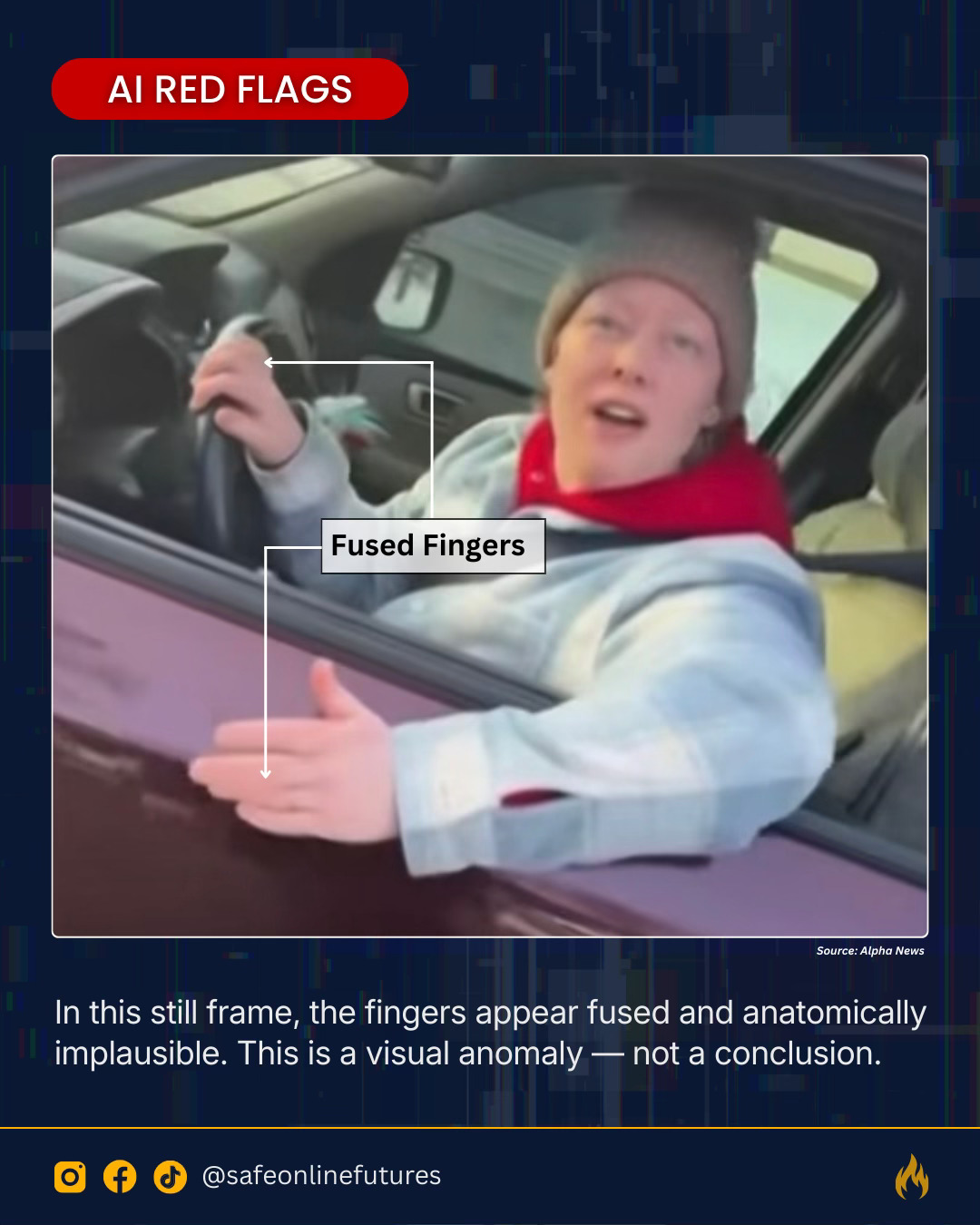
That elevation mattered. When the agent’s footage is slowed down and examined more closely, visual anomalies — such as fused fingers and smeared lettering on the vehicle — appear in moments that have been cited as evidence of threat and intent. Identifying anomalies is not a claim of AI fabrication; it is a reminder that footage elevated as proof still requires transparent sourcing, raw video release, and independent verification — especially in a fatal use-of-force incident.
This is the pattern. Again and again, a single perspective is rapidly framed as definitive, repeated by officials and aligned media, and absorbed by the public as settled fact. This explainer breaks down that process — what I call the Outrage Pipeline — in plain language, to show how moments of shock are transformed into narrative authority, and then into power.
Want the full breakdown? Read the long-form essay here.
The Framework: What is the Outrage Pipeline?
The Outrage Pipeline describes a recurring sequence through which public shock is converted into political leverage. It has five stages:
1. Provocation
2. Amplification
3. Normalization
4. Legitimization
5. Power Translation
This process does not require conspiracy or coordination. It relies on speed, repetition, and authority. When a particular version of events is elevated quickly enough — especially by officials and influential media figures — it can harden into accepted truth long before independent scrutiny occurs.
The result is not just outrage, but control over how reality is perceived and acted upon.
Stage One: Provocation
Provocation is often misunderstood as incitement or chaos. In the Outrage Pipeline, provocation is about framing.
In the Good case, bystander footage existed almost immediately after the shooting. Two days later, a short video filmed from the agent’s point of view entered circulation. That perspective matters. Point-of-view footage places the viewer inside one actor’s experience, subtly guiding emotional alignment before facts are settled.
This stage does not depend on falsification. It depends on which lens is centered. When one perspective is elevated as decisive, the question quietly shifts from “What happened?” to “Do you accept this framing?”
Provocation sets the interpretive boundaries. Everything that follows happens inside them.
From the outset, the incident was not only witnessed but framed — with official language and interpretation beginning to take shape even before any single piece of footage was elevated as definitive.
Stage Two: Amplification
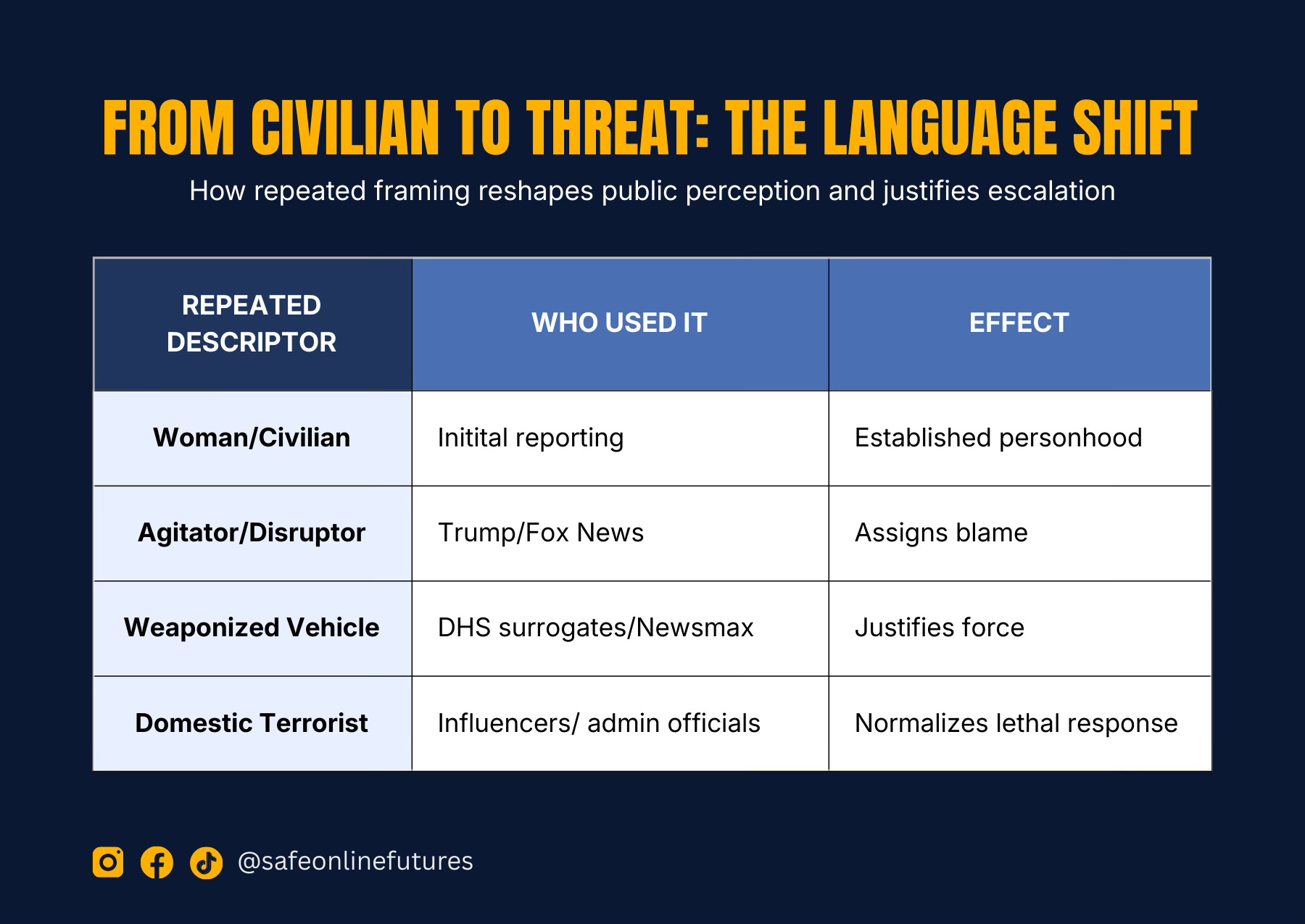
Amplification is where narrative authority begins to form. In the Good case, federal officials did not wait for video to shape public understanding. Within hours of the January 7 shooting, the Department of Homeland Security publicly characterized Good’s actions as an “act of domestic terrorism,” with DHS Secretary Kristi Noem deploying that label before any investigation had been completed or evidence independently verified. The framing came first.
When the ICE agent’s point-of-view video was later released and reposted by federal authorities, it did not introduce a new interpretation — it reinforced one that was already taking shape. Secretary Noem, Vice President JD Vance, and President Donald Trump each publicly described the footage as evidence that the agent had acted in self-defense, while dismissing competing interpretations and calls for independent review.
Amplification does more than increase reach. When senior officials repeatedly assert a specific framing — and then elevate media that appears to confirm it — they signal what version of events should be treated as authoritative. Competing footage is not disproven; it is displaced. Questions are not answered; they are crowded out. The interpretive field narrows, and one narrative begins to harden into accepted truth.
Stage Three: Normalization
That framing did not remain confined to official statements. It was normalized through repetition across high-reach conservative media and influencer channels, including Fox News host Brian Kilmeade, right-wing influencer Benny Johnson, and media personality Megyn Kelly, each of whom echoed variations of the same narrative to audiences numbering in the millions. Through cable news segments, podcasts, and social platforms, the same conclusions circulated repeatedly, often stripped of uncertainty or caveat. This repetition did not resolve competing interpretations; it overwhelmed them.
As repetition spread across official statements, cable news, and influencer channels, it began to feel like agreement.
When the same conclusion is voiced by the president, senior officials, cable news hosts, and influencers with millions of followers — even without coordination — it produces what is often experienced as an illusion of consensus. Repetition by powerful voices creates the impression that a claim is widely accepted, even when it remains disputed.
In this phase, language matters. Descriptions shift from neutral to accusatory. A civilian becomes an agitator. An incident becomes a threat. Over time, repetition replaces evidence. Disputed claims begin to sound like common sense.
Scale accelerates this process. When high-reach media figures and influencers repeat the same framing, audiences encounter it everywhere at once. Dissent does not disappear — but it starts to sound fringe.
Once a narrative feels universally agreed upon, questioning it can be reframed as extremism, disloyalty, or disorder.
Stage Four: Legitimization
Legitimization occurs when a narrative stops functioning as interpretation and begins operating as institutional truth.
At this stage, officials speak with certainty even as investigations remain ongoing. Calls for independent review are dismissed. Local authorities are sidelined. Claims are asserted, not tested. The language of provisional judgment gives way to finality.
In the Good case, federal leaders framed the incident not as a disputed use-of-force event, but as a matter of national security. That shift carries weight. Once a civilian is publicly categorized as a threat, scrutiny itself becomes suspect.
Legitimization narrows the range of acceptable questions. It does not require proof — only authority. And once authority has spoken decisively, alternative interpretations are no longer treated as part of the public conversation.
Perception becomes operational.
Stage Five: Power Translation
Power translation is where narrative authority turns into action.
When a version of events has been stabilized through provocation, amplification, normalization, and legitimization, it can be used to justify escalation. In the aftermath of the Good shooting, protests were framed not as civic response, but as disorder. Trump even publicly threatened to invoke the Insurrection Act.
Narrative certainty came first. Escalation followed.
This stage does not require universal agreement. It requires only that dissent be framed as dangerous or illegitimate. Once that threshold is crossed, the tolerance for force expands and accountability mechanisms weaken.
This is how stories turn into enforcement — not through evidence alone, but through repetition, authority, and speed.
Why this goes beyond one case
The Outrage Pipeline does not depend on whether footage is real, edited, or synthetic. It functions as long as authority elevates one version of events and repetition does the rest.
As AI-assisted media and subtle video manipulation become more common — and as platforms and institutions remain under no obligation to disclose — the window for verification continues to shrink. The danger is not simply misinformation. It is a system that converts perception into power before truth has time to surface.
Understanding this pipeline is no longer optional. It is a prerequisite for navigating modern political reality.
Note: This explainer focuses on how narrative power operates using real-world footage. As AI-assisted video, synthetic media, and provenance collapse accelerate, these dynamics will become faster, cheaper, and harder to challenge. This case is not an outlier. It is a warning.