When the State Controls the Video, It Controls the Story
Renee Nicole Good and the Outrage Pipeline in Action
Author’s note: This essay is intended as foundational analysis — not just of a single incident, but of a recurring system that shapes how political violence, media, and state power interact in the modern information environment. The framework used here reflects patterns observed across multiple cases, not an isolated event.
On January 7, 2026, a 37-year-old American citizen named Renee Nicole Good was fatally shot by a United States Immigration and Customs Enforcement (ICE) agent during a federal enforcement operation on a residential street in Minneapolis. Within hours of the shooting, several bystander cellphone videos of the encounter began circulating online, offering the first visual records of what had occurred. Two days later, a 47-second video filmed by the ICE agent involved was published by a Minnesota-based conservative outlet. The clip was then reposted by the Department of Homeland Security and quickly elevated by federal officials as decisive evidence of self-defense. Before any independent investigation had been completed and notwithstanding the existence of other visual records, that agent’s clip became the primary reference point through which public and political discourse was shaped. What followed was not merely reaction to a violent encounter, but a rapid consolidation of narrative power — a process in which contested events are rapidly framed and elevated into settled truth long before independent scrutiny.
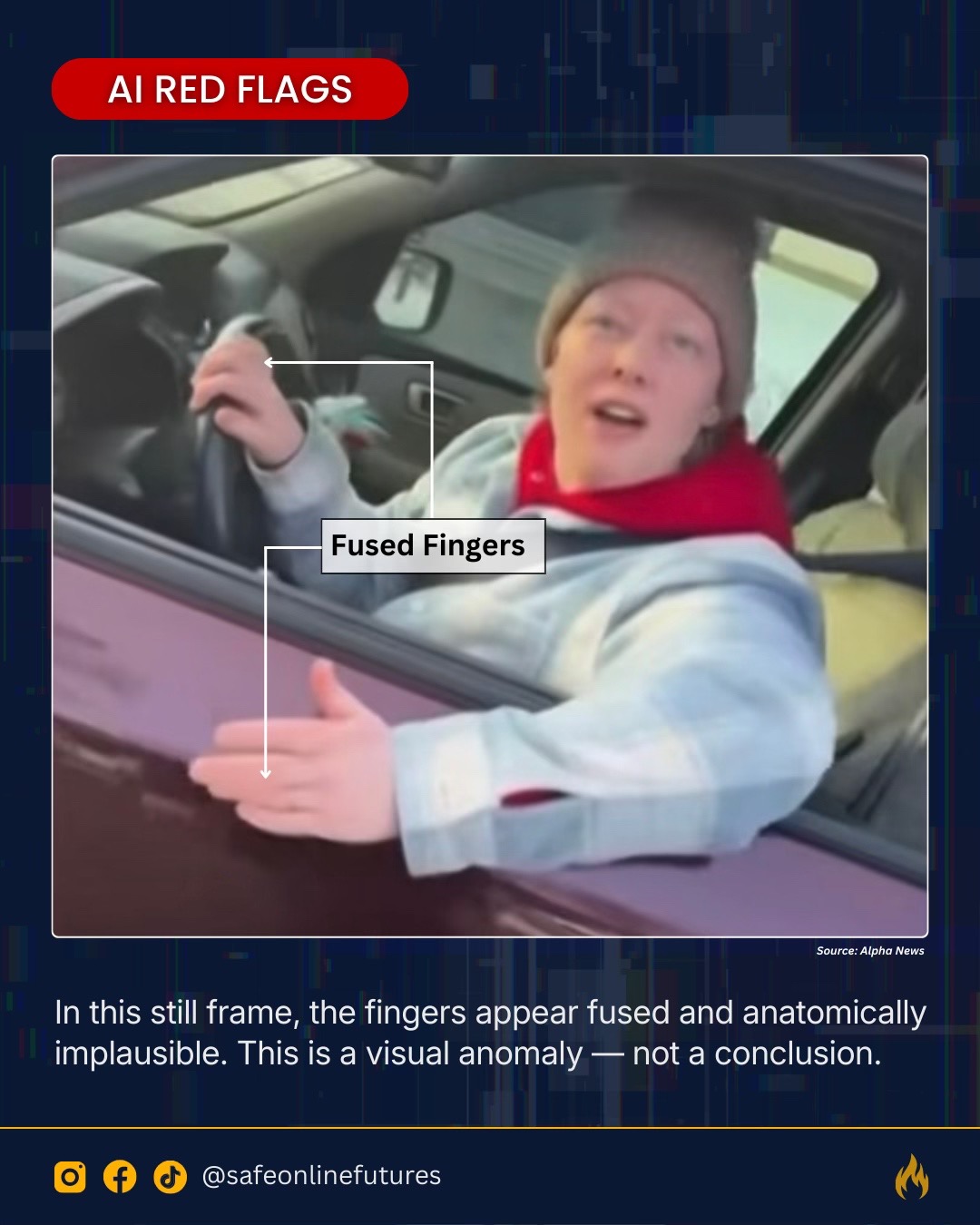
What distinguished this video from the bystander footage that preceded it was not simply what it showed, but how it was treated. Unlike civilian recordings, the agent’s clip was framed by officials and aligned media figures as conclusive proof of intent, threat, and justification. When the footage is slowed down, visual anomalies — including fused fingers and smeared lettering on the vehicle — appear in moments that later became the basis for narrative claims. Identifying such anomalies does not constitute proof of AI fabrication. It does, however, raise legitimate questions about sourcing, completeness, and verification — questions that warrant the release of raw footage and independent examination before any single clip is treated as unquestionable evidence in a fatal use-of-force incident.
This pattern — the rapid transformation of a contested event into a settled narrative — follows a familiar sequence, one that reveals how outrage is not merely expressed but engineered, amplified, and converted into power.
I refer to this sequence as the Outrage Pipeline — a recurring pattern in which moments of public shock are shaped into political leverage through a predictable set of stages. It begins with provocation, followed by amplification, normalization, legitimization, and finally the translation of outrage into expanded authority or force. The pipeline does not require secrecy or conspiracy; it operates through speed, repetition, and official validation. When a particular version of events is elevated rapidly — especially through statements and reposts by government actors — it can narrow the space for scrutiny, marginalize competing evidence, and establish a narrative that appears settled before it has been independently examined. The release and subsequent elevation of the ICE agent’s video following the killing of Good offers a clear example of this process in motion.
Stage One: Provocation — A Point of View That Shapes Interpretation
The first stage of the Outrage Pipeline is provocation — not in the sense of incitement or chaos, but in the selection of a framing that strongly shapes interpretation. In this case, multiple videos of the January 7 shooting existed. Bystander footage circulated almost immediately, capturing portions of the encounter from a civilian vantage point. What distinguished the later-released clip was not exclusivity, but perspective. Filmed from the ICE agent’s point of view, the video placed viewers inside the officer’s experience, a framing that tends to invite identification with the recorder at a moment when facts were still emerging.
Point-of-view footage carries a distinct persuasive weight. It collapses distance, centers a single perspective, and implicitly prioritizes the recorder’s perception as the most relevant one. When such footage is presented as a short, standalone clip during a period of heightened public tension, it can operate less as neutral documentation and more as narrative framing. In this case, the agent’s video did not simply add to the visual record; it functioned as a lens through which subsequent interpretations were filtered. By the time the clip entered wide circulation, the central question had already begun to shift — from what occurred on that Minneapolis street to whether the framing embedded in the footage would be accepted as authoritative.
Stage Two: Amplification — When Authority Is Conferred
Provocation alone does not stabilize a narrative. Amplification does. In the days following the release of the ICE agent’s video, the clip moved from partisan media into official circulation through reposts and public statements by federal officials. After being published by Alpha News, a Minnesota-based conservative outlet, the footage was reposted by the Department of Homeland Security and subsequently promoted by senior figures within the Trump administration.
Crucially, federal officials began defining the incident before the agent’s video was ever released. Within hours of the shooting, Department of Homeland Security Secretary Kristi Noem publicly characterized Good’s actions as an “act of domestic terrorism,” deploying a loaded label before any investigation had been completed or evidence independently verified.
Days later, Vice President JD Vance reposted the agent’s footage, framing it as proof of “self-defense.” He later characterized the shooting as “a tragedy of her own making.” White House Press Secretary Karoline Leavitt likewise shared the clip and defended the agent, asserting that the media had “smeared” him. She publicly referred to Good as a “deranged, lunatic woman” who, she claimed, tried to ram her vehicle into the officer. President Donald Trump made similar public statements, insisting Good had attempted to run the officer over, even as local officials publicly disputed that characterization and called for independent review.
With that elevation, the video was no longer one interpretation among many. It was publicly treated by officials as confirmation of a self-defense narrative. That framing did not remain confined to official channels; it was quickly reinforced by right-wing media figures and online influencers who repeated the same conclusions to mass audiences.
This repetition matters. When government officials circulate a specific piece of media, amplification does more than increase reach; it confers legitimacy. The video becomes not merely illustrative, but authoritative in the public narrative. Competing footage, unresolved questions, and ongoing investigative processes are not directly rebutted — they are displaced. In this way, amplification narrows the interpretive field, establishing a dominant version of events before independent scrutiny can meaningfully occur.
Stage Three: Normalization — How Repetition Creates the Illusion of Consensus
Once amplification establishes a dominant frame, normalization does the work of making that frame feel obvious. This stage does not depend on new evidence. It depends on repetition — across officials, media outlets, and influencers — until contested claims begin to sound like settled facts. Crucially, this convergence does not require coordination. It requires alignment.
In the days following Good’s killing, a consistent narrative emerged across the Trump administration and right-wing media ecosystems: that she was not a civilian who was shot, but an aggressor whose own actions justified lethal force.
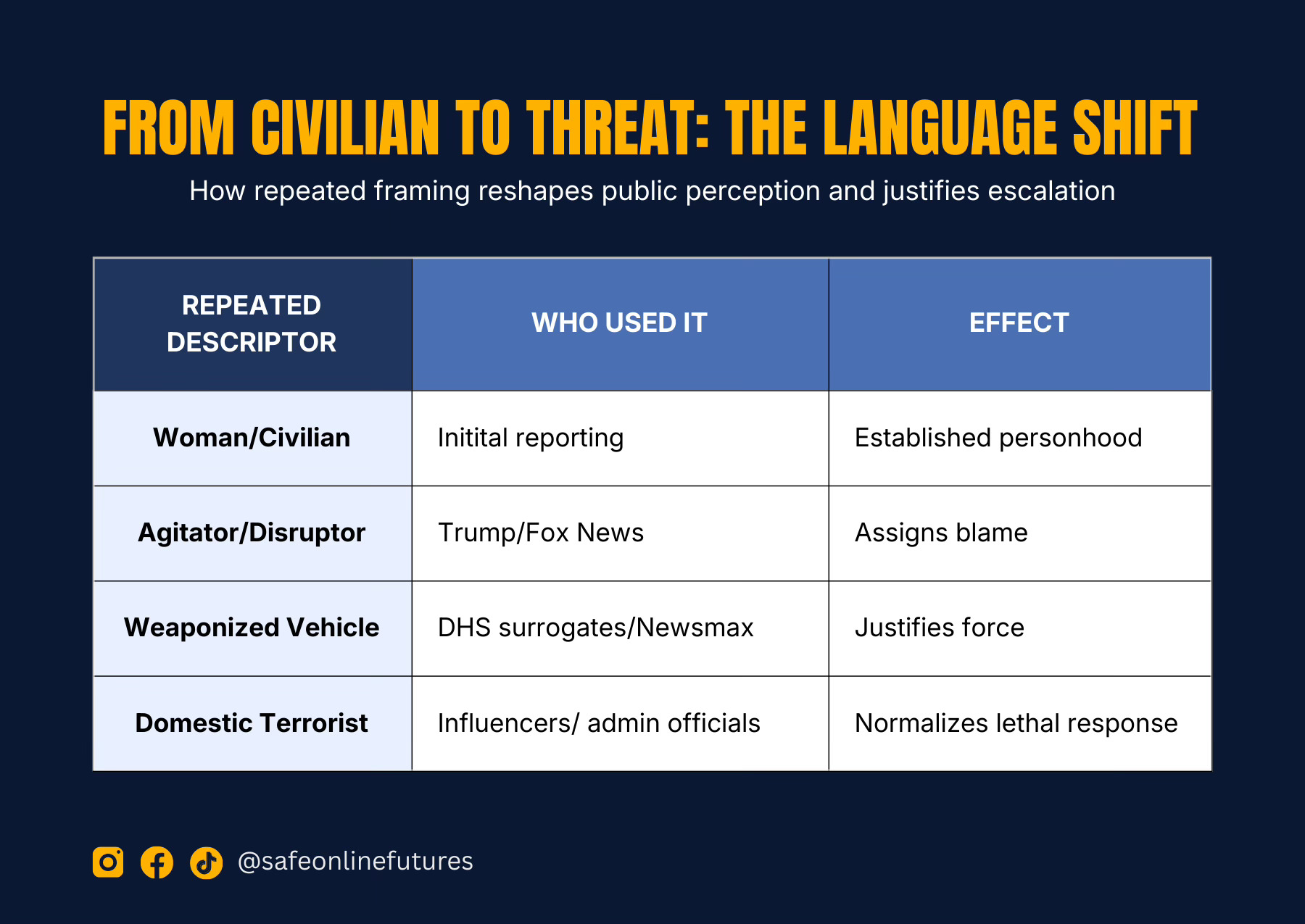
As the characterizations by senior officials spread through official and media channels, the language around Good shifted in broader media and influencer discourse. Instead of describing her as a civilian, the resulting lexicon leaned into terms implying threat and culpability — a shift reinforced through frequent repetition across political media channels. This linguistic alignment helped normalize a narrative where Good was not merely a tragic shooting victim, but an aggressor whose actions justified lethal force.
It was rapidly reinforced by right-wing media figures and influencers with massive online audiences. Fox News host Brian Kilmeade referred to Good as a “trained activist” who was “harassing ICE officials every single day.” Right-wing political commentator and YouTuber Benny Johnson — who has over 6 million subscribers and billions of views on his channel — labeled her a “paid agitator.” Media personality Megyn Kelly, whose independent platforms reach more than 4 million YouTube subscribers, claimed “she brought it upon herself,” while podcaster Tim Pool said “I wouldn’t call the person [Good] a victim. This is a perpetrator.”
None of these figures needed to coordinate with one another for the effect to take hold. The repetition itself did the work. As the same descriptors circulated — agitator, weapon, terrorist, self-defense — they crowded out alternative interpretations and reframed the killing as an inevitable outcome rather than a contested act of state violence.
Documenting this language is not an act of amplification; it is a record of how state power and aligned media figures publicly framed a civilian’s death.
When the same conclusion is voiced by the president, the vice president, government spokespeople, cable news hosts, and influencers — even without coordination — it produces what is referred to as an illusion of consensus. Repetition by powerful voices creates the impression that a claim is widely accepted, even when it remains disputed. Over time, repetition replaces evidence. Disputed claims begin to sound like common sense. And once a narrative feels universally agreed upon, questioning it can be reframed as extremism, disloyalty, or disorder.
Trump has been explicit about the power of repetition as a political tool. “If you say it long enough, hard enough, often enough, people will start to believe it,” he has said. Whether applied deliberately or instinctively, that principle is central to how the illusion of consensus takes hold — and why, once it does, the moral groundwork is laid not just to defend the killing, but to legitimize whatever comes next.
Stage Four: Legitimization — When Narrative Becomes Authority
Legitimization occurs when a narrative moves beyond interpretation and begins functioning as institutional reference. At this stage, contested claims are no longer framed as provisional but are asserted publicly with confidence by those in power. In the aftermath of Good’s killing, the self-defense narrative — already amplified and normalized — was reinforced through official statements and actions, even as independent review remained ongoing.
As public scrutiny intensified, senior federal officials spoke as though the central facts were already resolved. Trump publicly dismissed calls for transparency and local oversight, insisting that Good had “run [the officer] over” and characterizing Minnesota officials who questioned the federal account as “crooked.” When asked whether federal investigators should share findings with state authorities, Trump rejected the premise, declining to commit to any such disclosure.
At the same time, federal officials framed the incident using language associated with national security rather than civilian law enforcement. The Department of Homeland Security publicly described Good’s actions as “domestic terrorism,” a designation that carries substantial rhetorical and legal implications. This characterization did not merely defend the agent’s actions; it placed the killing within a framework that presumes threat and urgency, while casting dissent, protest, and inquiry as potential risks rather than civic responses.
These statements had tangible effects. Minnesota officials said they were being excluded from the federal investigation, even as federal leaders made public assertions about what had occurred. Major media outlets, in turn, reported those assertions prominently, often presenting them as authoritative accounts rather than as claims subject to verification. In doing so, the narrative acquired institutional weight before any independent findings were released.
Legitimization is the point at which perception becomes operational. Once official statements are treated as settled reference points, the space for challenge narrows — not because questions have been answered, but because authority has been asserted. At this stage, the issue is no longer which version of events is correct, but which versions are permitted to be taken seriously.
Stage Five: Power Translation — From Narrative to Force
Power translation is the final stage of the Outrage Pipeline, where narrative authority converts into real-world action. At this point, the significance of a contested event lies less in unresolved facts than in what official interpretations make possible. What began as a disputed killing becomes the justification for expanded state posture.
Narrative certainty came first. Force followed.
As protests grew in Minneapolis and criticism of federal conduct intensified, Trump publicly threatened to invoke the Insurrection Act, framing public dissent not as civic response but as disorder requiring federal intervention. These remarks were not accompanied by new investigative findings or independent conclusions. They rested on a narrative foundation that had already been asserted: that the shooting was justified, that the victim posed a threat, and that opposition to federal enforcement signaled danger rather than disagreement.
The investigation remained unresolved. The response did not.
In this framing, protest itself became suspect. Demonstrations were increasingly described as extensions of the same alleged threat used to justify the shooting, collapsing distinctions between civilian dissent, obstruction, and criminality. Once those distinctions blurred, the deployment of extraordinary federal authority appeared less exceptional and more necessary.
This is how perception becomes permission.
Power translation does not require universal agreement. It requires only that alternative interpretations be framed as reckless, illegitimate, or dangerous. Once that threshold is crossed, the range of acceptable response narrows and the tolerance for state force expands.
What remains is not simply disagreement over a single incident, but a demonstration of how modern power now operates: through screens first, statements second, and force last.
When the state controls the video — and the narrative built around it — it does not need to control reality. It needs only to control what is seen, repeated, and accepted as authoritative.
The death of Renee Nicole Good — and the political narrative that quickly formed around a single, state-amplified video — exposes a structural vulnerability in how truth is established in moments of crisis. When unverified media artifacts are elevated by government authorities and reinforced through aligned political and influencer networks, the window for independent scrutiny collapses. The danger is not confined to any one administration or ideology. In an information environment where video can be edited, compressed, enhanced, or generated outright, the decisive question is no longer simply what happened, but who controls the visual narrative first — and how quickly that narrative is translated into legitimacy, force, and power.
Note: This analysis focuses on narrative control using a single, state-amplified video. As AI-assisted media, synthetic video, and provenance collapse accelerate, the ability to establish what is authentic — and when — will become even more fragile. This case is a warning shot. The system it exposes is only getting faster.