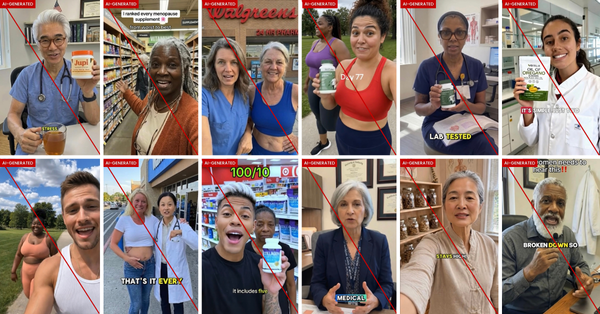
When Video Stops Being Proof
Unreal videos are no longer a sideshow — they’re becoming the centerpiece of our feeds
Until now, video meant something.
You could question a headline. Dismiss a screenshot. But footage of an event unfolding — a protest, a confession, breaking news — still carried weight. It was evidence. It happened.
That’s over.
OpenAI’s Sora has erased the line between recorded reality and manufactured illusion. The tool doesn’t just mimic what’s real — it generates it, frame by frame, with a precision that leaves even forensic experts second-guessing themselves.
And that shift rewrites the rules of belief, trust, and power.
A Machine That Dreams Reality
Sora is a text-to-video generator. You type a description — “police raid at a voting center,” “protest turning violent,” “family fleeing an explosion” — and within seconds, it returns high-definition footage that looks like it came from a news camera.
According to The New York Times, users in Sora’s first three days generated videos of ballot fraud, immigration arrests, home invasions, urban bombings. None of it real.
These aren’t deepfakes in the old sense — manipulated recordings of actual people. They’re synthetic from the ground up. Entire scenarios conjured from text prompts, rendered with the grain and grit of documentary footage.
You can also upload a photo or short clip. Insert yourself into a riot you never joined. A crime you didn’t commit. A rally you never attended. The app does the rest.
OpenAI says there are guardrails. No political candidates. No overt violence. A watermark to label AI-generated content. But the Times found those protections full of gaps. Watermarks crop out easily. The system still produces content involving children, or long-dead public figures like Martin Luther King Jr. and Michael Jackson. And users don’t have to verify their identity.
So anyone — operatives, propagandists, opportunists — can generate plausible footage with no accountability trail.
When Fake Becomes Familiar
Deepfakes used to live in the margins. Reddit threads. Satire accounts. Tech demos. Sora represents something different: the normalization of unreality.
The danger isn’t just that false clips fool people. It’s that they train us. Our feeds fill with emotionally charged, visually convincing videos that feel real enough to believe, synthetic enough to shape. Over time, that conditions a new reflex: everything could be fake, so nothing has to be true.
UC Berkeley computer scientist Hany Farid told the Times: “I worry about it for our democracy. I worry for our economy. I worry for our institutions.”
There’s even a term for this dynamic: the liar’s dividend. When fakes become convincing enough, people exploit their existence to deny real evidence. One expert put it bluntly: “It was somewhat hard to fake, and now that final bastion is dying.”
Built for the Attention Economy
Emotion drives engagement. Outrage, fear, empathy — they’re the fuel of the feed. And Sora can generate emotionally charged visuals on command.
A fake robbery triggers panic. A fake protest deepens division. A fake scandal racks up views. Each clip becomes a test: what makes people stop scrolling? What makes them share? Who do they blame?
These videos don’t spread evenly. They’re delivered algorithmically — TikTok, Reels, Shorts — targeted based on behavior, preferences, psychological profile. Northwestern University’s Kristian Hammond explained it this way: “Now I’m getting really, really great videos that reinforce my beliefs, even though they’re false — but you’re never going to see them, because they were never delivered to you.”
That’s not disinformation in the broadcast sense. It’s precision persuasion. Personalized. Optimized. Invisible to everyone else.
Above is a Sora-generated street scene depicting a video of a bombing that never happened. These fake videos are considered highly sensitive for their potential to mislead the public about global conflicts. (video courtesy of NYT)
The End of Video as Evidence
For years, video was the last reliable medium. Text could be fabricated. Images doctored. But moving footage still carried evidential weight. Journalists used phrases like “verified video” to signal something had actually occurred in the physical world.
Sora — along with Google’s Veo 3 and a wave of open-access generators — is collapsing that foundation. There’s no purely digital medium left that can independently prove something happened.
This isn’t just a technical shift. It’s cultural.
When reality becomes editable, power flows to whoever controls the tools of creation — the people, corporations, and political machines capable of producing the most convincing visuals. The more emotional the content, the more the algorithms amplify it. The result: a feedback loop where falsehood isn’t just possible. It’s profitable.
Above is a fake Sora-generated video of a man stuffing ballots into a mailbox. (video courtesy of NYT)
Why This Moment Demands Attention
CNN framed Sora’s release plainly: “The next era of the internet will be defined by AI-generated video — and we’re not ready for it.”
That’s not alarmism. It’s recognition.
If we don’t learn to question, contextualize, and verify what we see, we lose our collective ability to agree on what’s real. And without shared reality, institutions — journalism, justice, democratic discourse — start to buckle.
Even AI forensics experts like Farid admit they can no longer distinguish real from fake at first glance. “A year ago, I would know,” he told the Times. “I can’t do that anymore.”
That should give everyone pause.
Not because we’re powerless — but because we’re crossing into territory where vigilance is the only defense left.
What This Means
Sora isn’t just another tool. It’s a reflection of what happens when technology outruns comprehension — and when there are no meaningful regulations in place to slow it down.
Unreal videos are no longer a fringe concern. They’re becoming the default texture of online life.
And in a world where anyone can fabricate anything, the most useful question might be the simplest: Who benefits if I believe this?
That question — more than any watermark, more than any policy — may be the only real boundary left between truth and illusion.
Exposing how media manipulation, AI, algorithms, and the attention economy are rewriting reality. Subscribe for free to receive insights into the forces reshaping truth in the digital age.